
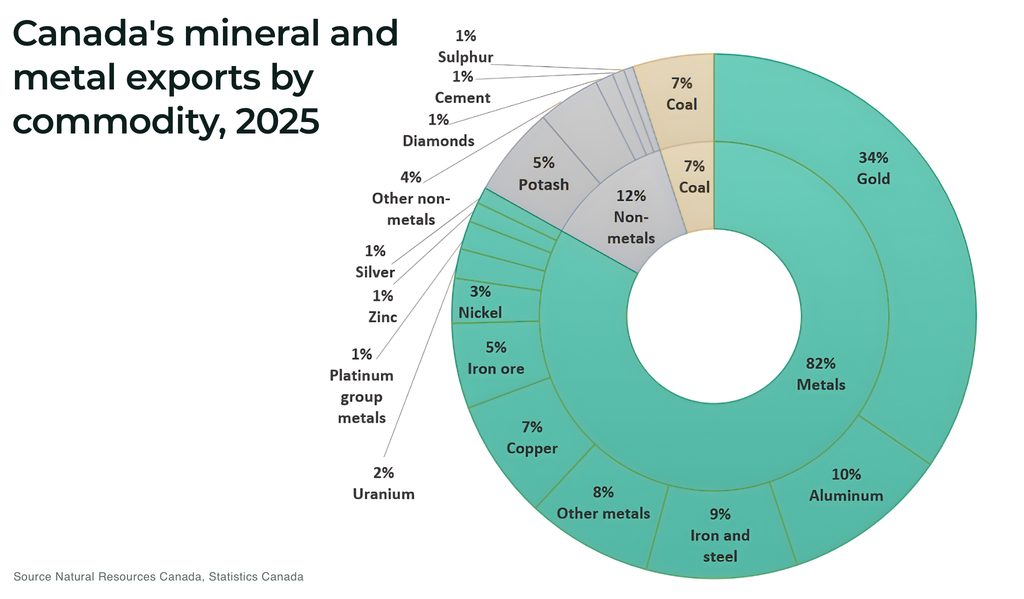
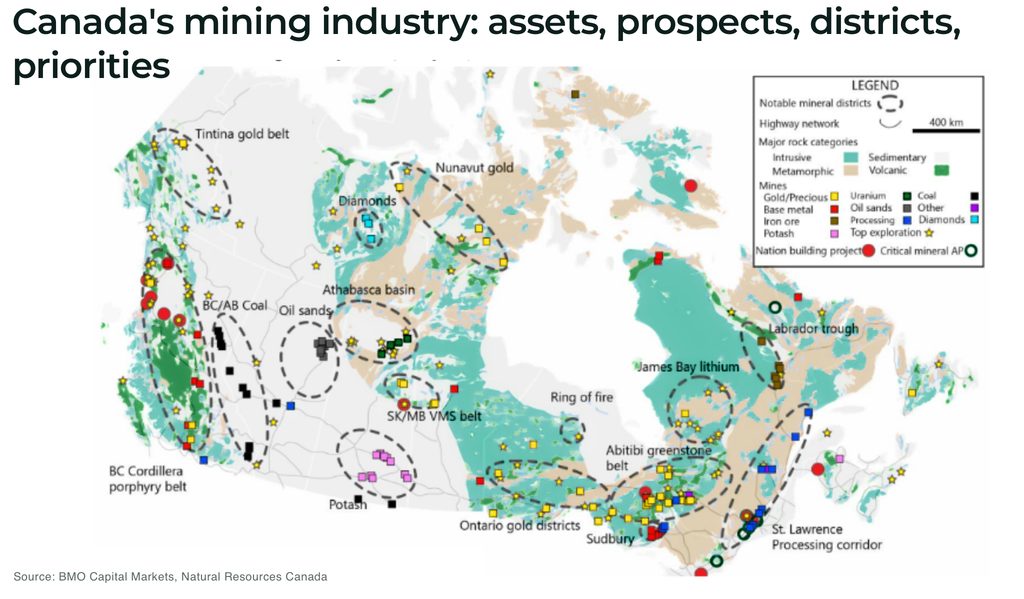
Canada has announced a five-year plan to catalyse C$1 trillion of investment, with mining and metals accounting for more than one-third of the 167 opportunities presented to global investors at the Canada Investment Summit in Toronto.
The two-day summit brought together investors from nearly 30 countries managing more than $100 trillion of assets. Ottawa said it produced almost C$500 billion of commitments, including nearly C$325 billion of bank financing across mining, energy, infrastructure, defence and technology, and close to C$100 billion from pension funds, insurers and other institutional investors.
BMO expects the wider Canadian investment cycle to strengthen. The bank forecasts mining development expenditure will rise by more than 11% over the next two years. Mining companies under its coverage are expected to spend around C$350 billion on Canadian operating costs, sustaining capital and growth projects over five years. BMO also identifies a requirement for investment in copper smelting and refining, battery precursors, rare-earth separation, magnets, graphite processing and recycling.
Importantly, the latest figures from the Ottawa summit are not mining allocations or capital already deployed. The government says approx C$280 billion of public investment and incentives is expected to help enable more than C$1 trillion from public, private and institutional partners.
The clearest new measure for miners is the Productivity Mega Deduction, a new permanent tax incentive on capital investment, which will let businesses immediately write off the cost of most new capital investments for tax purposes, announced by Prime Minister Mark Carney on Tuesday.
The policy expands immediate tax deductions from roughly 15% to more than 65% of eligible business assets. Mining property, machinery, equipment, railways and roads can qualify, while most buildings remain excluded from the permanent measure.
Ottawa estimates the change will cut Canada’s marginal effective tax rate on new business investment from approximately 13% to 6.4%.
Mining Association of Canada president Pierre Gratton said the measure could make Canada “one of, if not the most, competitive mining tax jurisdiction in the world.” The association said earlier deductions should improve cash flow and net present value, potentially helping marginal projects and brownfield expansions meet company investment thresholds.
Ottawa also announced project-level funding with the Canada Growth Fund committing approx C$140 million to Generation Mining for its Marathon copper-palladium project in northwestern Ontario, while the Canada Infrastructure Bank added C$50 million.
The public funding anchors Generation Mining’s final C$340 million financing tranche in a stated C$1.3 billion construction package for their copper-palladium Marathon project. The company plans to begin early works in the fourth quarter of 2026, although the equity and convertible-note components remain subject to closing, regulatory and shareholder approvals. The project would add to more than US$2.7 billion of mining construction already under way in Ontario, according to Industrial Info Resources. The firm identifies a further US$43 billion of potential mining projects in the province, while warning that not all will proceed as planned.
Public markets are already reflecting stronger investor interest. As Mining Journal highlighted during the summit, mining companies claimed 18 of the 30 places in the 2026 TSX30 ranking — the sector’s highest representation since the ranking began. The group included four silver companies, three copper companies and one rare-earth company.
Carney’s government is also seeking private investment through long-term concessions to operate the four largest airports in Toronto, Montreal, Calgary and Vancouver. Ottawa will retain ownership of the land and assets and plans to reinvest the proceeds in regional transportation and other infrastructure.
Permitting remains part of the programme. Canada signed its latest “one project, one review” agreement with Newfoundland and Labrador in September, extending efforts to reduce duplication between federal and provincial assessments.
The summit has placed Canadian mining projects in front of major international institutions. The next measures of progress will be binding project finance, completed approvals, construction starts and new processing capacity.