
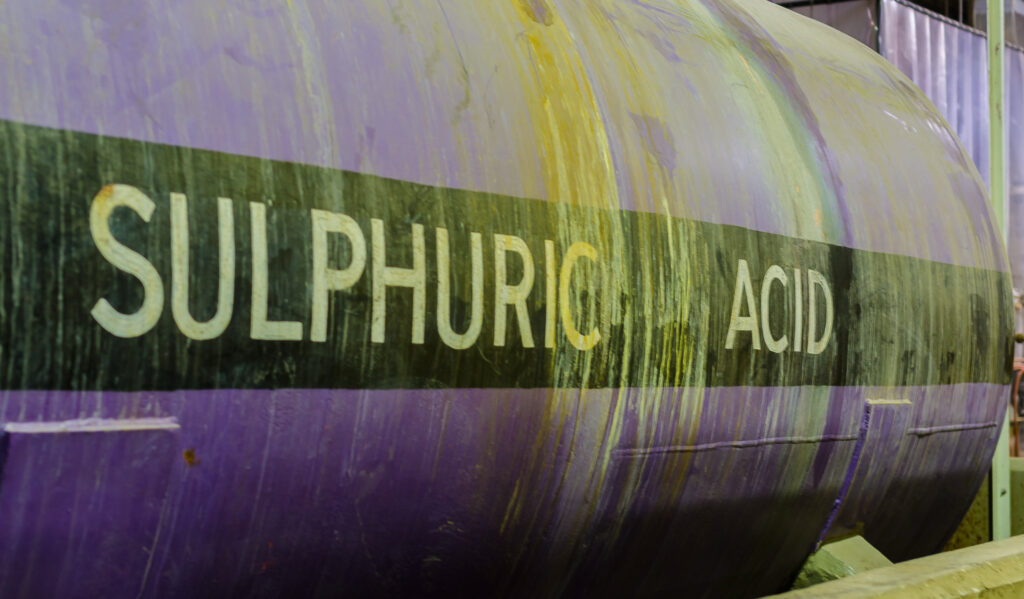
Russia has announced a temporary ban sulphuric acid exports until December 31, putting Kazakhstan’s uranium supply chain under renewed scrutiny after Russia provided 93.6% of the country’s acid imports in 2023.
The measure was approved by Prime Minister Mikhail Mishustin on September 12 and will take effect within ten days of its official publication. Moscow said the restriction is intended to protect supplies for Russian industry and mineral-fertilizer producers.
This is not an immediate, unconditional shutdown as exports may continue through international transit, intergovernmental agreements or specific approval from Russia’s prime minister or deputy prime ministers.
Russia produced almost 16 million metric tonnes of sulphuric acid in 2024 but exported only around 630,000 tonnes. Industry analysis indicates that Kazakhstan was the only buyer taking Russian acid in significant industrial volumes.
2024 sulphuric-acid exports:
| Selected exporter | Exports, 2024 |
|---|---|
| Japan | 3.44 million tonnes |
| China | 2.68 million tonnes |
| Canada | 1.75 million tonnes |
| Peru | 1.15 million tonnes |
| Bulgaria | 1.13 million tonnes |
| Germany | 1.08 million tonnes |
| Russia | approximately 630,000 tonnes |
| Belgium | 584,000 tonnes |
| Taiwan* | 549,000 tonnes |
*Reported by WITS as “Other Asia, nes.”
Source: World Bank WITS table using UN Comtrade data
So the “exemption” language from Moscow matters for Kazakhstan.
Sulphuric acid is the principal reagent used to recover uranium through in-situ leaching, the production method used across Kazatomprom’s operations. The company has described reliable acid supply as strategically important to uranium output and costs.
Kazakhstan imported 624,329 metric tonnes of sulphuric acid in 2023. Russia supplied 617,126 metric tonnes, representing 93.6% of the total and up from 289,651 metric tonnes in 2022. The figures are historical and do not confirm Kazakhstan’s current exposure, but they show the scale of the established trade corridor.
Kazatomprom, which represented approx 20% of global primary uranium production in 2025, reiterated 2026 production guidance of 27,500–29,000 metric tonnes of uranium in August. However, it also raised cost guidance partly because of significant increases in sulphuric acid purchase prices.
Its planned TQZ acid plant has now slipped from Q1 2027 to between Q3 2027 and Q1 2028 after construction encountered potential paleontological specimens. Kazatomprom said the delay was not expected to materially affect mining operations, although its assessment will feed into 2027 guidance.
For investors, the Russian ban creates policy risk before it proves a physical shortage. An intergovernmental exemption could preserve Kazakh deliveries. Without one, higher regional acid costs, and eventually weaker uranium recovery, become credible risks.
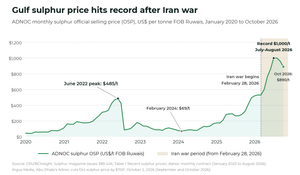
The ban also puts further pressure on the global sulphuric acid supply chain already under significant stress with the closure of the Strait of Hormuz.
(Our recent newsletter on Strait of Hormuz is chokepoint for sulphuric acid and critical metal processing)
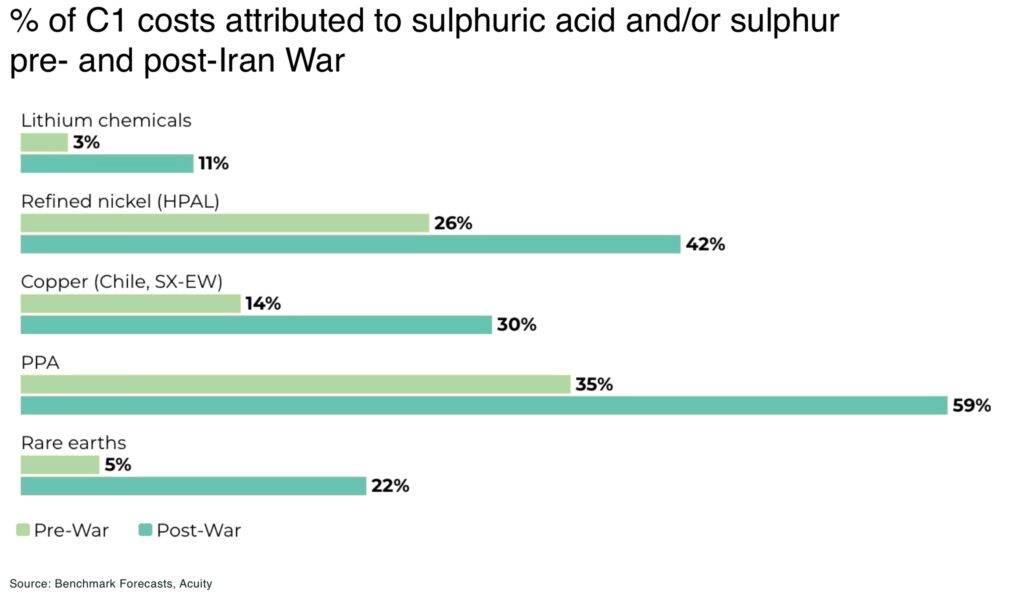
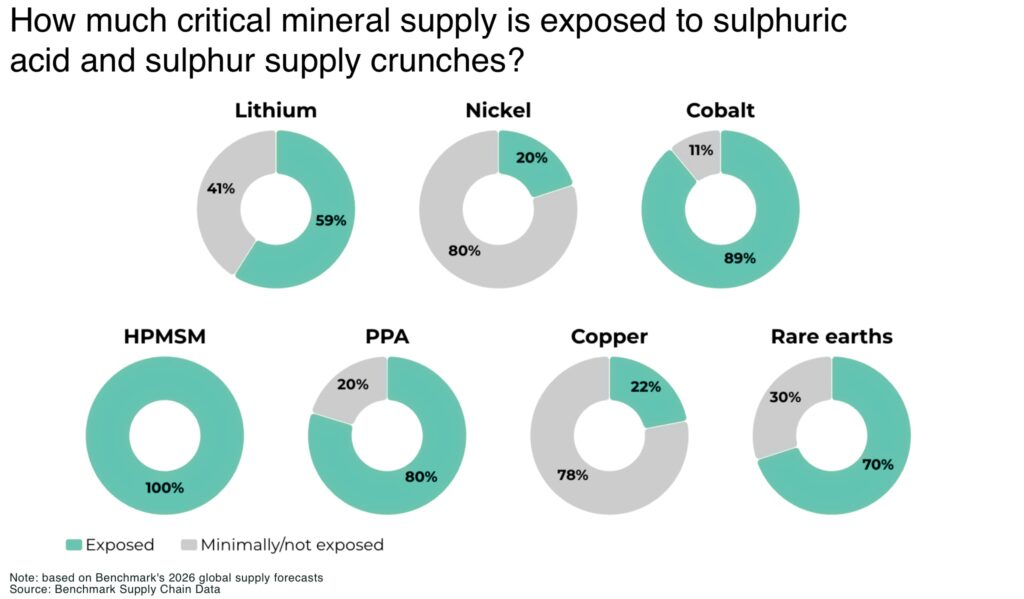
Estiamtes suggests the sulphuric acid crunch is now feeding directly into critical minerals production costs, with sulphur and acid accounting for an average 33% of C1 costs across key supply chains — rising to 42% for HPAL nickel and 30% for Chilean SX-EW copper.
The next signal will be whether Kazakhstan secures an exemption and whether Kazatomprom changes its production or cost guidance.