
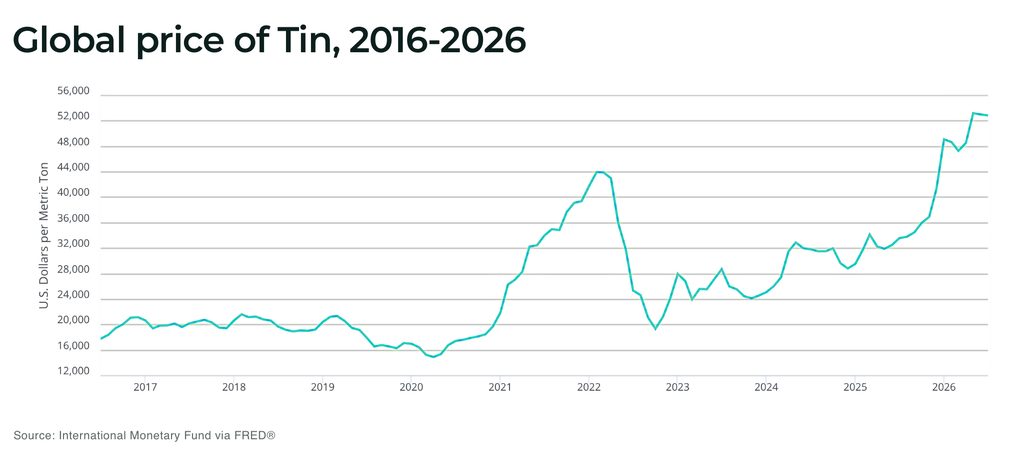
BMI has raised its 2026 average tin price forecast by 4.1% to US$51,000 a tonne, as semiconductor demand and constrained supply sustain pressure on the metal used to connect electronic components.
The increase from US$49,000, reported by Mining Weekly on September 14, comes as the market weighs growing AI investment against the prospect of more supply from Myanmar and Indonesia.
BMI expects some price moderation in Q4 2026 as supply disruptions ease and AI capital expenditure growth slows. Its new forecast is an annual average, rather than a year-end price target.
AI demand meets an uneven supply recovery
Tin’s exposure to electronics is already substantial. Solder accounted for 52% of tin use in 2024 with its role in connecting components making it a critical part of the physical supply chain behind the AI infrastructure buildout.
Find out more in our report on Artificial Intelligence and the next Critical Mineral SuperCycle
But expanding demand does not mean prices can only move higher with Myanmar is providing an early test of the market’s ability to restore disrupted supply.
The country’s Man Maw mine is gradually restarting after operations were suspended in 2023, according to International Crisis Group findings reported by AFP on September 10. China imported nearly 40,000 tonnes of tin ore and concentrates from Myanmar in the first half of 2026, already exceeding the whole of 2025.
Those figures measure ore and concentrate shipments, rather than contained tin, and production remains well below pre-suspension levels, with flooded shafts and depleted higher-grade deposits complicating the recovery.
Indonesia is also attempting to improve access to legal feedstock after the government allowed PT Timah to purchase ore from local miners in Bangka Belitung, aiming to reduce illegal ore and concentrate exports, according to the ITA’s August 21 update.
The distinction matters: redirecting existing production into legal channels could improve smelter access to ore without adding an equivalent volume of new global mine supply.
Can higher prices bring new mines into production?
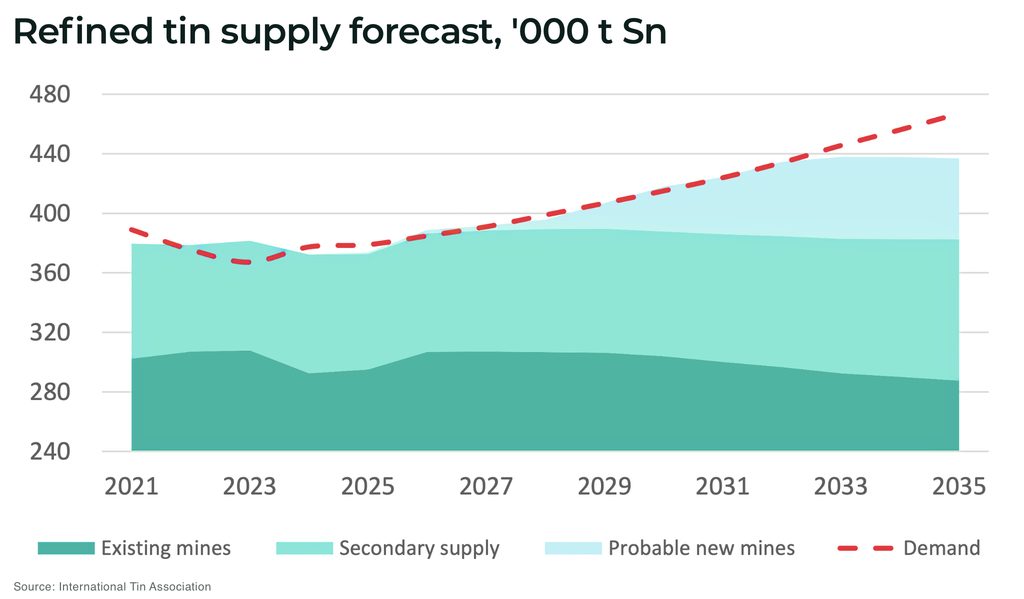
The longer-term constraint is investment. The ITA identifies underinvestment in exploration and development as a limitation on supply, despite abundant geological resources—a challenge we examined in our earlier analysis of tin’s role in the technology revolution.
There are projects advancing. First Tin’s updated feasibility study for Taronga in Australia envisages average annual production of 3,100 tonnes of contained tin over a ten-year mine life, according to the ITA’s August assessment.
For investors, the next signals are physical: the pace of Myanmar’s recovery, Indonesia’s legal ore deliveries and progress funding new mines. Higher prices strengthen the incentive to develop supply, but they do not settle how soon that supply will arrive.