
Mesabi Metallics plans to invest US$15 billion in an Iowa steel complex capable of producing an initial 7.5 million US tons annually, rising to approximately 10 million tons in later phases.
The planned electric arc furnace complex will use direct-reduction-grade iron pellets from Mesabi’s new mine and processing operation in Nashwauk, Minnesota, creating a domestic supply chain from ore extraction to finished steel.
The wider US$18 billion Mesabi investment comprises approx US$3 billion for the Minnesota mine and pellet plant and US$15 billion for the Iowa steelmaking complex. The US Export-Import Bank approved a US$770 million direct loan for the mine, but Mesabi has not disclosed complete financing, permitting or construction details for the US$15 billion Iowa plant.
The Iowa development is designed to produce up to 7 million tons of high-grade pellets annually, and expected to support more than 6,000 construction jobs and employ approx 1,750 people once operational.
The project could reduce US reliance on imported iron products, but producing steel domestically does not make the entire supply chain domestic.
Steelmaking shifts the mineral bottleneck
Electric arc furnaces require scrap or direct-reduced iron, electricity, graphite electrodes and alloying materials. The exact requirement will depend on Mesabi’s feed mix and the steel grades it intends to produce, neither of which has been disclosed:
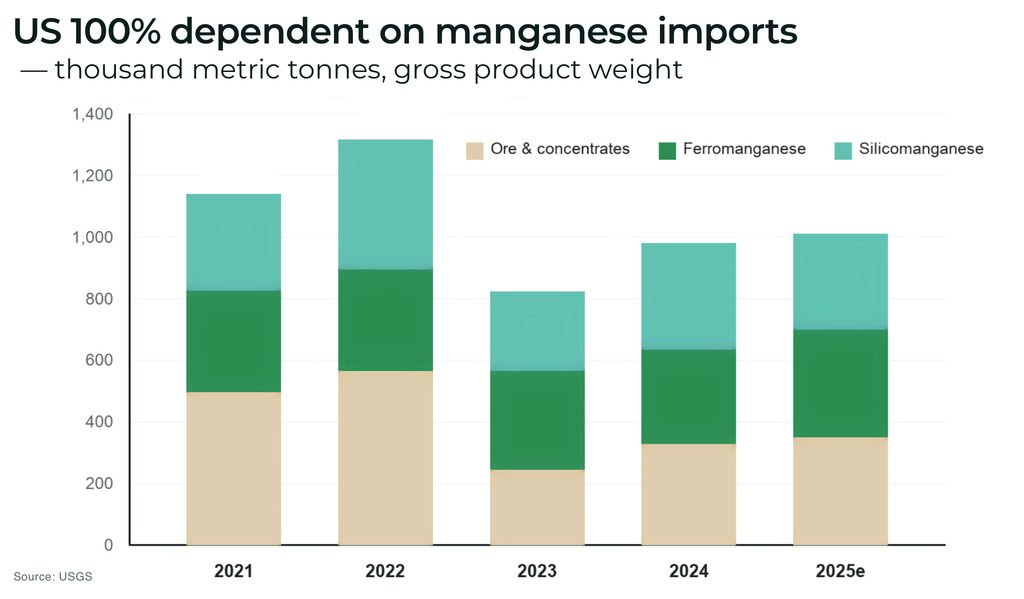
Manganese is the clearest exposure: the mineral is essential for removing sulphur and oxygen and improving steel strength — and the US was 100% net import reliant for manganese in 2025, with Gabon, South Africa, Malaysia and Australia supplying most imports.
At the Iowa plant’s initial capacity — equivalent to about 6.8 million metric tonnes — the mill could require approximately 41,000–61,000 metric tonnes of contained manganese annually. The estimate applies the USGS range of 6–9 kilograms of manganese for every metric tonne of steel and is illustrative rather than company guidance.
The furnaces will also consume graphite electrodes. Applying the approx 1.7 kilograms used per metric tonne of EAF steel implies demand of around 12,000 metric tonnes annually at initial capacity. These electrodes are primarily manufactured from synthetic graphite and petroleum needle coke, rather than mined natural graphite.
Demand for chromium, nickel, vanadium, niobium, boron and silicon will depend on whether the new steel mill produces stainless, automotive, defence or other high-strength steels — the Department of Energy identifies these materials as critical inputs for steel production and strengthening.
Feedstock could present another constraint, with high-specification EAF steel requires low-contaminant scrap or additional virgin iron units to dilute copper and other residual metals, and the US Department of Energy expects prime scrap availability to tighten as more mills move towards electric production.
Mesabi’s project may well anchor a major domestic iron and steel corridor, but its wider strategic value will depend on whether the US can also secure the imported ferroalloys, graphite electrodes, high-quality scrap and energy needed to keep it running.