
- Anglo American chief executive Duncan Wanblad said technology companies had shown “deep expressions of interest” in taking equity in miners to secure metal for data centres, although nothing has yet materialised
- the approaches come as LME cash copper settled at a record US$14,822 a tonne on October 12, while S&P Global expects copper use in data centres and their power infrastructure to rise from 1.1 million metric tonnes in 2025 to 2.5 million tonnes by 2040
- Wanblad pointed to China, where mines and processing plants are integrated into wider value chains, as the model Western buyers have yet to copy
Technology companies are holding talks with miners about buying directly into supply, Anglo American chief executive Duncan Wanblad told the Financial Times’ Metals and Mining Summit in London on October 15.
The revelation comes as the AI/data center build-out and demand for copper pushes buyers further up the supply chain.
“It’s high on the mind of most of the people downstream, certainly in the new forms of demand – data centres, AI, these sorts of things – and those conversations are absolutely being had,” Duncan Wanblad said, adding that some discussions included direct investment in miners and that there had been “deep expressions of interest” in equity stakes — although nothing had yet materialised.
The pressure behind these conversations is increasingly visible in the market with LME cash copper settling at a record US$14,822 a tonne on October 12.
“For sure, given the scarcity issue that we’ve been speaking about, a lot of people are looking for ways to secure supply,” Wanblad said.
Why tech needs copper
Data centres are, basically, electrical machines, and copper runs through almost every part of them, from power cables and busbars to transformer windings, circuit boards and the heat sinks on processors, as well as the substations and grid connections.
The power equipment is particularly copper-heavy with the metal accounting for around 10–15% of transformer and power cable prices, according to the IEA.
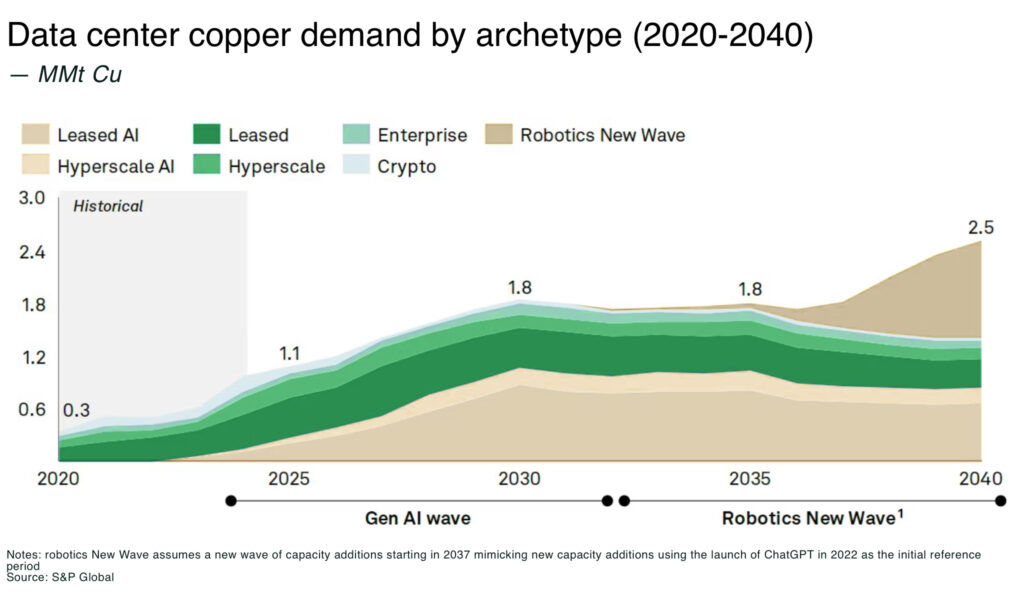
S&P Global forecasts that copper used in data centres and their associated infrastructure will rise from 1.1 million tonnes in 2025 to 2.5 million tonnes by 2040, within a range of 1.7 million to 2.7 million tonnes.
Meanwhile, the IEA expecte total copper demand to climb from 26.7 million tonnes in 2024 to 31.3 million tonnes in 2030 under today’s policy settings, with its latest outlook projecting a 25% supply deficit by 2035 based on the current project pipeline.
From offtake to ownership
So far, the tech sector has bought the metal rather than buying into the mines, for example:
- on July 2025, Apple committed US$500 million to buying American-made rare-earth magnets from MP Materials, including a US$200 million prepayment
- in January 2026, Amazon Web Services became the first customer for Rio Tinto’s Nuton copper from Gunnison Copper’s Johnson Camp mine in Arizona under a two-year agreement
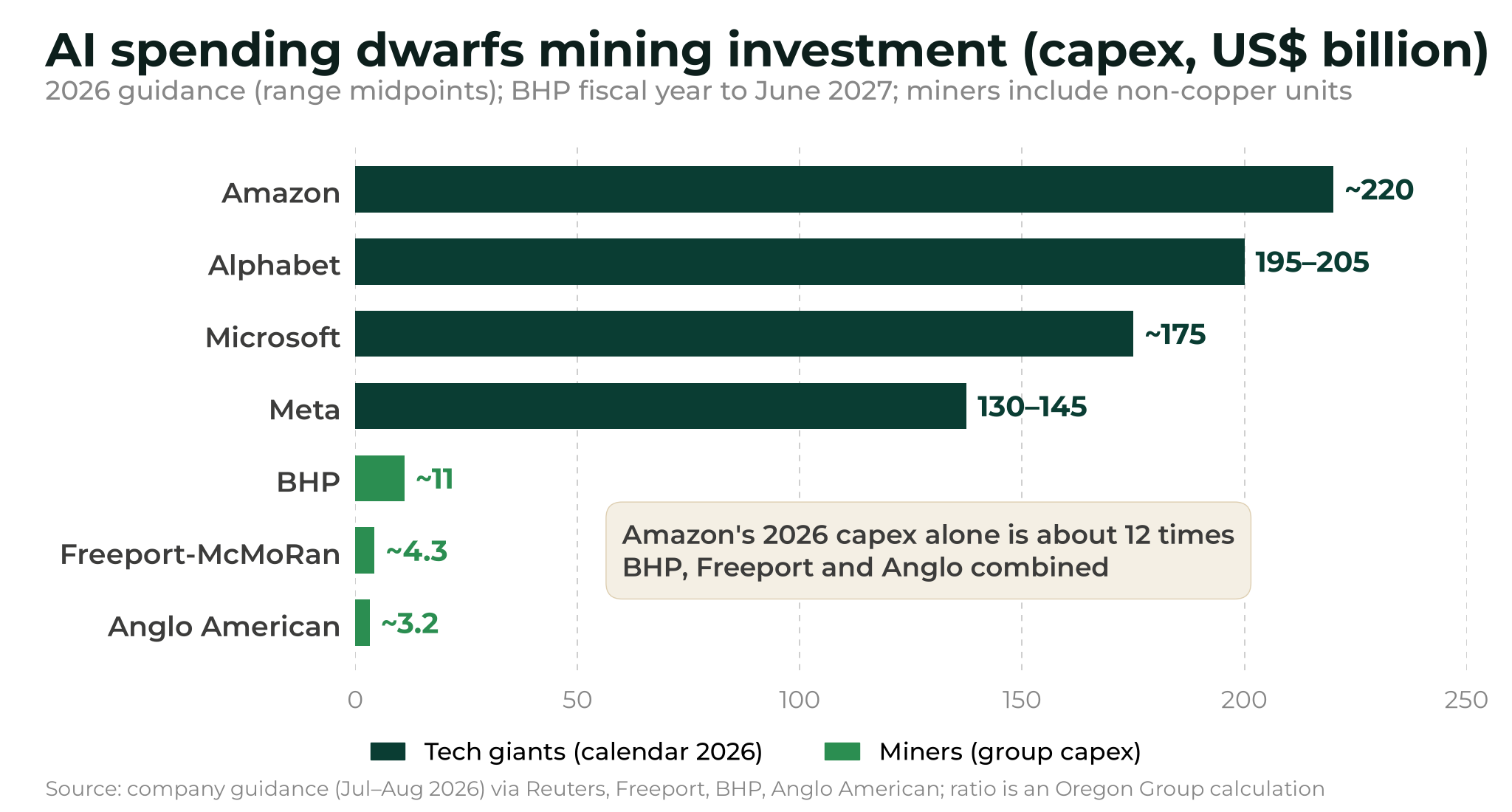
Equity would be a different order of commitment, and the logic follows from our earlier article on Copper’s new demand stack (and the AI chokepoint), when we argued that copper’s AI demand is unusually insensitive to price:
Unlike other sectors where high input costs might take a bite out of demand, data center developers are largely indifferent to copper prices. … Data centers will be built whether copper is trading at US$10,000 or US$20,000.
In other words, a buyer that cannot slow its build-out when copper becomes expensive has every reason to own a share of the tonnes rather than bid for them on the open market.
China’s integrated model
Notably, Wanblad framed the opportunity as one China has already seized.
“To some extent, you’ve seen value chain consolidation more in China than you have in the West,” Duncan Wanblad said, citing nickel, “where the mine and the processing facility are just part of a much bigger value chain, and the financial viability equation is calculated over the whole rather than the sum of the parts.”
A Western technology company taking a stake in a copper miner would, in effect, be importing a similar model, judging a mine not on its own margins but on the value of keeping a data centre or chip supply chain running.
The problem is that the buyers — especially tech companies — are unfamiliar with what they would be buying.
“When people start to get their heads around the shape of a mining business, the capital intensity and the fact that it’s inherently cyclical, it’s less familiar to the types of businesses that are putting the inquiries in at the moment,” Wanblad said, while warning more broadly that geopolitical uncertainty was slowing dealmaking. “There’s a lot of risk in terms of time … people become a little bit more conservative about whether they’re going to pull the trigger on these sorts of deals or not.”
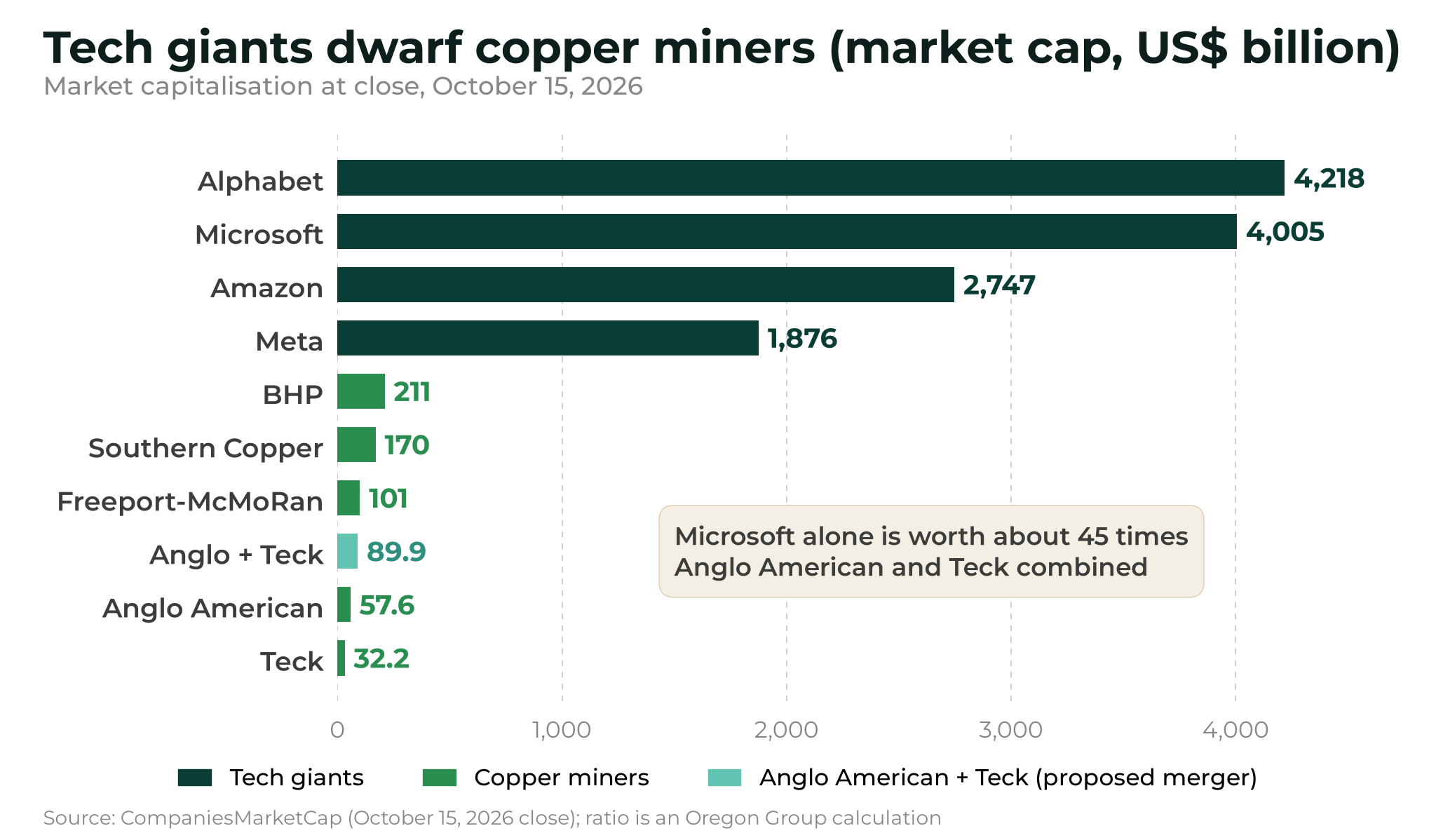
Meanwhile, Anglo is itself waiting on Beijing to approve its merger with Teck Resources, which would create one of the five largest copper producers with output of about 1.2 million tonnes a year, and China’s regulator has reportedly asked for guaranteed copper concentrate supply to Chinese smelters as a condition — a demand Anglo has not confirmed.
China built its grip on metals by treating mines as part of the factory, and if Silicon Valley now wants to do the same, it will be competing with Beijing not just for copper, but for the right to own the tonnes before they reach the market.