- a revised 2026 nickel ore quota of “290-odd” million tonnes has been approved by Indonesia’s energy ministry, Director General of Minerals and Coal Tri Winarno said on October 16
- mining experts’ association Perhapi’s advisory board chair, Rizal Kasli, estimates smelters need 310–400 million tonnes of ore this year, leaving a 3–87 million-tonne shortfall even with 23 million tonnes of Philippine imports
Indonesia has approved a revised 2026 nickel ore mining quota of about 290 million metric tonnes, which is still below the amount industry experts estimate its smelters need.
Tri Winarno, director general of minerals and coal at the Energy and Mineral Resources Ministry (ESDM), confirmed the approval on October 16, putting the nickel figure at “290-odd” million tonnes, saying the numbers were “not that detailed”.
The revision lifts the 260–270 million-tonne quota Jakarta set under this year’s work plans, known as RKABs, which was already above the 250–260 million tonnes the government first signaled — but it remains well below last year’s 379 million tonnes of quota approvals and the 320.37 million tonnes actually mined in 2025.
Notably, ESDM had already forecast 2026 output of about 290 million tonnes on October 6, based on miners’ performance through the third quarter. In other words, the revision largely formalises production that was already happening.
As we reported in February, in Indonesia orders world’s biggest nickel mine to cut ore quota for 2026, quotas have become a policy tool that could move in either direction:
“Indonesia is now using permits and quotas as a direct market lever. For investors, that raises the upside to any sustained tightening — and the policy risk that quotas can be revised again.”
That revision has now arrived. A mid-year review had already given higher allocations to specific operators, including Eramet’s Weda Bay, which suspended mining in May after exhausting its 2026 quota.
How big is the ore gap?
Rizal Kasli, chair of the advisory board of the Indonesian Mining Experts Association (Perhapi), says the new quota could still leave smelters short.
He set out the arithmetic to Kontan on October 19:
“Estimated nickel demand for smelters is around 310–400 million tonnes, so the nickel ore supply deficit is between 20 and 110 million tonnes. Assuming we can still import 23 million tonnes of nickel ore from the Philippines, the ore deficit for smelters is between 3 and 87 million tonnes,” Rizal Kasli said.
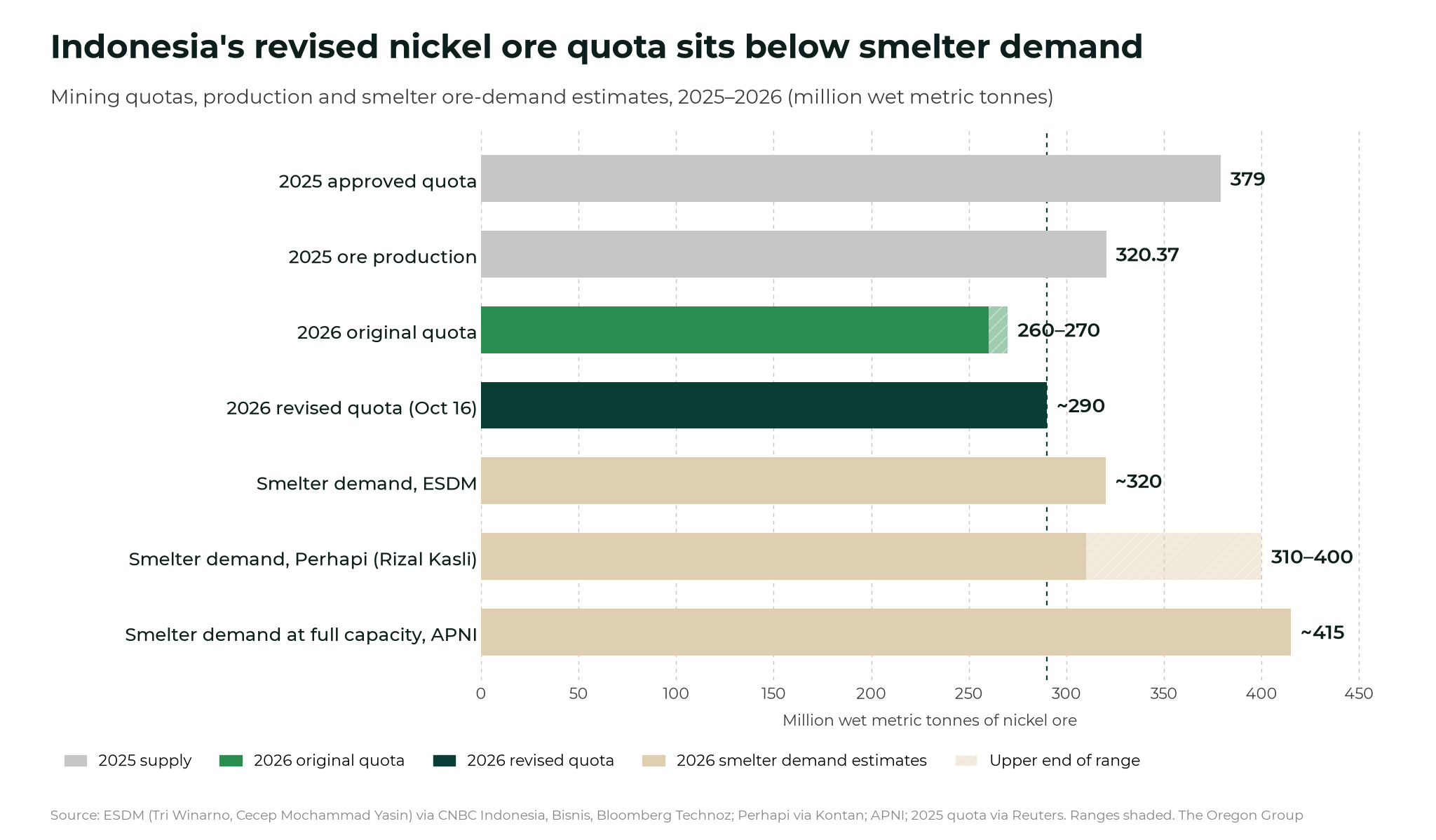
The width of that range reflects how little agreement there is on demand with other estimates, for example:
- ESDM puts verified smelter ore demand at about 320 million tonnes this year
- the Indonesian Nickel Miners Association (APNI) says Indonesia’s 79 smelters would need about 415 million tonnes a year running at full capacity
Philippine ore is filling the gap
Meanwhile, Indonesia imported 13.52 million tonnes of Philippine nickel ore in January–August, up 65.69% from 8.16 million tonnes a year earlier, according to Statistics Indonesia.
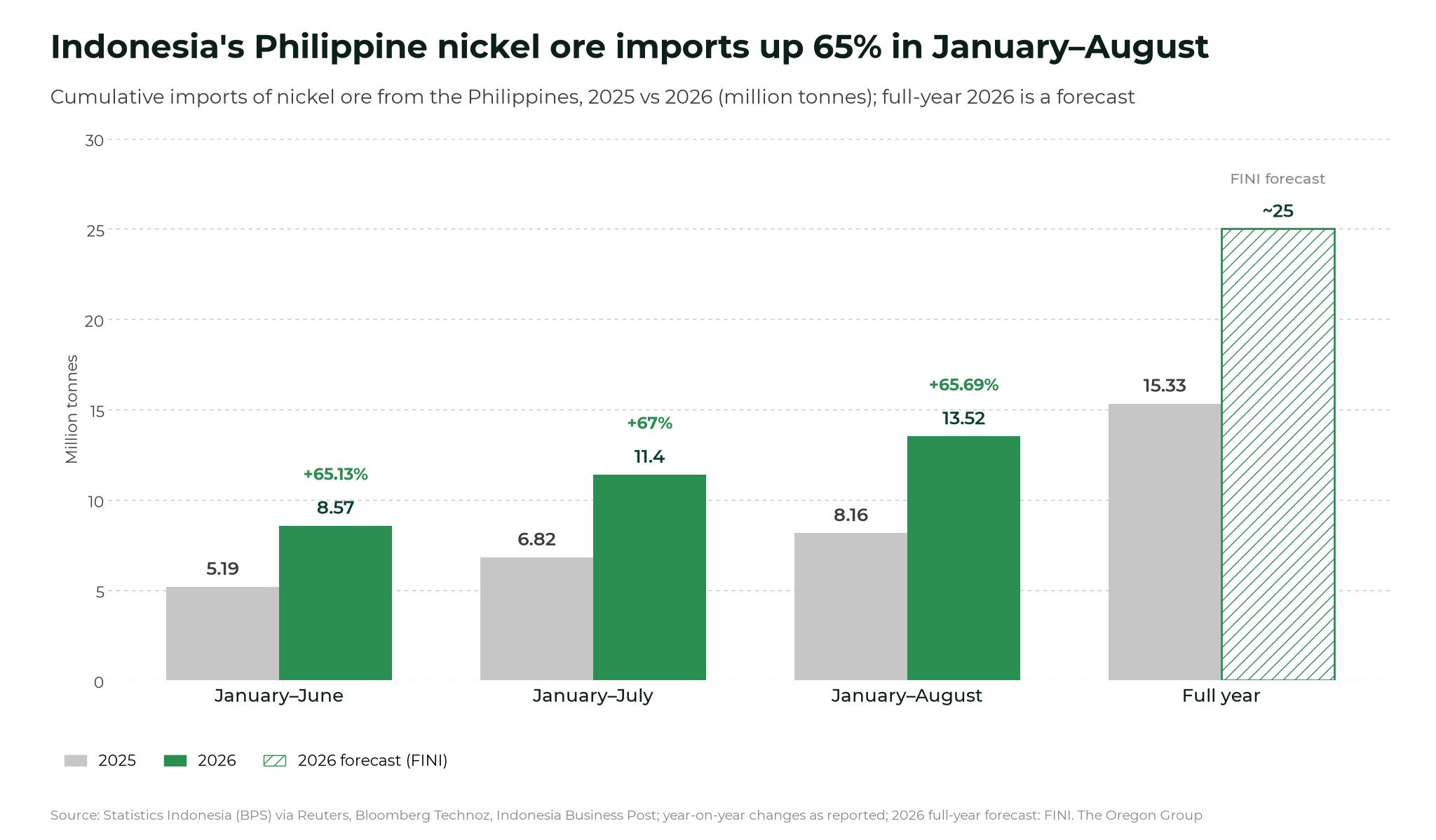
Most of it went to Weda in North Maluku, about 7.8 million tonnes, and Morowali, about 3.23 million tonnes, compared with 15.33 million tonnes for the whole of 2025. The Indonesian Nickel Industry Forum (FINI) expects about 25 million tonnes this year, and imports are on track for a record year.
The problem is that Philippine supply is not unlimited. FINI chairman Arif Perdana Kusumah has warned that Philippine production capacity “is not that large”, and its miners also hold contracts with China.
China remains the bigger buyer, taking 11.8 million of the 17.53 million wet tonnes the Philippines exported in January–April. The rainy season is now also disrupting mining and port loading in Zambales.
If ore is short, why are prices falling?
Indonesia’s reference nickel price (HMA) for the second half of October was cut to US$15,847.67 a tonne, from US$16,322.67 in the first half. The benchmark for 1.6% nickel ore with 35% moisture fell to US$59.12 a wet tonne.
Indonesian smelters also hold about two months of ore inventory, according to Shanghai Metals Market. Water shortages in Morowali have cut some rotary kiln electric furnace lines to 30–40% of normal rates since September 22, reducing ore demand.
ESDM itself argues there is no deficit. Cecep Mochammad Yasin, the ministry’s director of mineral business development, says stockpiles were close to 40 million tonnes at the end of 2025.
The refined market tells the same story, with the International Nickel Study Group forecasting surpluses of 19,000 tonnes in 2026 and 70,000 tonnes in 2027.
Jakarta wants value, not volume
Basically, Jakarta is not trying to close the gap.
Energy and Mineral Resources Minister Bahlil Lahadalia said on October 7 that the government is considering a moratorium on new semi-finished nickel smelters, which make products such as nickel pig iron and mixed hydroxide precipitate. As we reported, that came a day before Indonesia launched US$10.2 billion of nickel, battery and aluminium projects. He also signaled that existing smelters may not be allowed to run flat out:
“Our goods cannot be sold cheaply. So most likely, even if installed capacity is, say, 10, what may be able to produce, as long as we still have oversupply, will not reach 10. That is what we will regulate,” Bahlil Lahadalia said.
The National Economic Council (DEN) expects exports from downstream nickel, aluminium and lithium-battery-component industries to reach about US$50 billion in 2026, up from US$34.5 billion in 2024. Meanwhile, a planned increase in mineral royalties, including nickel, was postponed in May.
In other words, the ore deficit is not a flaw in Jakarta’s quota system. It is the policy, and so far Philippine ore, smelter stockpiles and a drought at Morowali have stopped it from biting.