
China’s premium for imported copper has surged from around $20 per tonne in late January to $100 per tonne, its highest level since May 2025, according to Shanghai Metals Market.
At the same time, copper inventories monitored by the Shanghai Futures Exchange fell 20% in one week to 79,909 tonnes. Stocks are now at their lowest level since August 2025 and have dropped more than 80% from their mid-March peak.
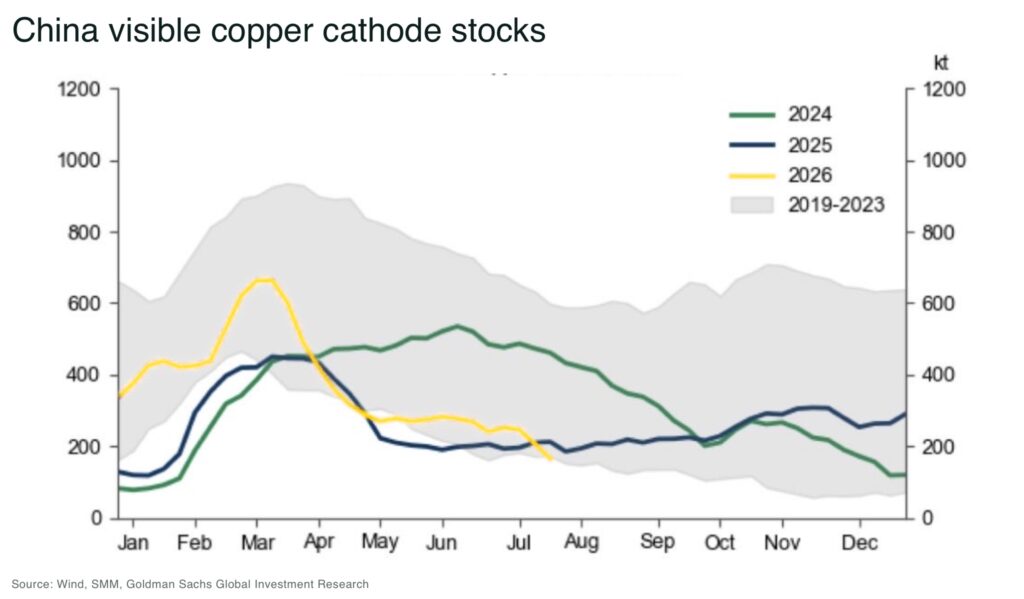
In other words, the world’s largest copper consumer is paying its highest import premium in 14 months, with buyers paying substantially more to secure physical metal just as locally available inventories are collapsing.
The Yangshan premium measures the additional price paid to import copper into China. Unlike futures prices, it offers a direct indication of demand for deliverable metal. Its move into triple digits suggests that the physical market is significantly tighter than the headline copper price implies.
China is pulling in metal
China’s refined copper imports reached a nine-month high in June, according to Reuters.
The squeeze is partly the unintended result of Beijing’s crackdown on China’s “invoice economy.” Authorities have intensified scrutiny of circular trades in which related parties exchange metal and use the resulting tax invoices to obtain financing. Restrictions on those invoices have reduced liquidity in the scrap market, constraining supplies and forcing some consumers to substitute refined cathode.
The higher Yangshan premium does not necessarily indicate a broad acceleration in Chinese end-user demand; it may instead reflect a sudden shift from scrap to imported refined copper. But the immediate physical consequence is the same: stronger competition for cathode at a time when exchange inventories are already falling.
London stocks are heading east
The pressure is now visible outside China.
Total copper inventories in London Metal Exchange warehouses stood at 295,275 tonnes, down 24% since the end of May. Although, more than half that metal had already been earmarked for withdrawal.
Cancelled warrants reached 166,025 tonnes, leaving only around 129,000 tonnes of on-warrant copper immediately available to the market. That available stock fell by roughly 35% in a single week.
Traders report that some of the metal leaving LME warehouses is being shipped to China, where the higher import premium has made those movements increasingly attractive.
The result is a reinforcing cycle: low Chinese inventories lift import premiums, higher premiums attract metal from the LME system, and falling LME availability tightens the market further.
Copper is plentiful, but in the wrong place
The exception is the United States.
Inventories held in CME Group’s Comex warehouse system have reached a record 630,293 tonnes after eight consecutive quarterly increases. Metal has been pulled into the country as traders position for possible US import tariffs.
This has produced a sharply divided market. Inventories are accumulating in the US while falling in China and across the readily available portion of the LME system.
The issue is therefore not simply how much copper exists in exchange warehouses. It is whether that copper is available in the right form and location.
Until the US tariff position is resolved, a large volume of metal may remain effectively trapped in American warehouses while consumers elsewhere compete for a diminishing pool of supply.
Chile offers little relief
The tightening is occurring as production from Chile, the world’s largest copper-producing country, continues to disappoint:
- in its production report published on July 15, Antofagasta said copper output fell 9.5% year on year to 285,000 tonnes during the first half of 2026
- in its June-quarter report published on July 20, South32 said its attributable payable copper production from Sierra Gorda fell 10% year on year to 16,000 tonnes during the three months ended June 30, as earlier weather-related disruption restricted mine access and forced the processing of lower-grade material
Individually, the production losses remain manageable but, collectively, they reduce the market’s ability to replace the copper now being withdrawn from warehouses, just as copper’s demand stack broadens:
The physical market is moving first
LME copper traded near $13,600 per tonne on Monday July 20, approximately 9% higher since the beginning of the year. Comex copper rose to around $6.35 per pound, less than 5% below its early-June record.
Yet macroeconomic uncertainty is mitigating the futures price from fully reflecting the deterioration in physical availability, as concerns over global growth, interest rates, geopolitical tensions and US tariff policy continue to constrain investor positioning.
However, China’s import premium is telling a different story, with the move from US$20 to US$100 per tonne, alongside an 80% decline in Shanghai inventories since March, is more than routine volatility. It is a warning that consumers are competing for a smaller volume of immediately available copper.