
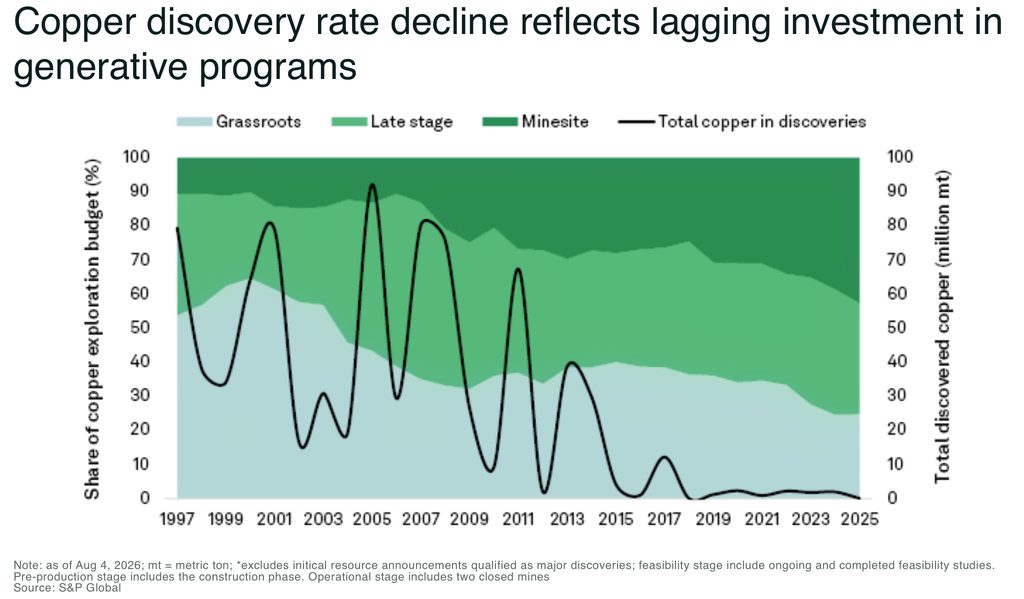
No copper deposit discovered in 2025 currently meets the “major discovery” threshold of at least 500,000 tonnes of contained copper, according to S&P Global’s latest review.
The global copper discovery database now covers 263 deposits discovered since 1990, containing 1.402 billion tonnes of copper across reserves, resources and past production, which means:
- five more deposits and 37 million tonnes more copper than S&P reported last year
- but more than 60% of the additional volume came from deposits connected to existing mining complexes, not newly identified systems
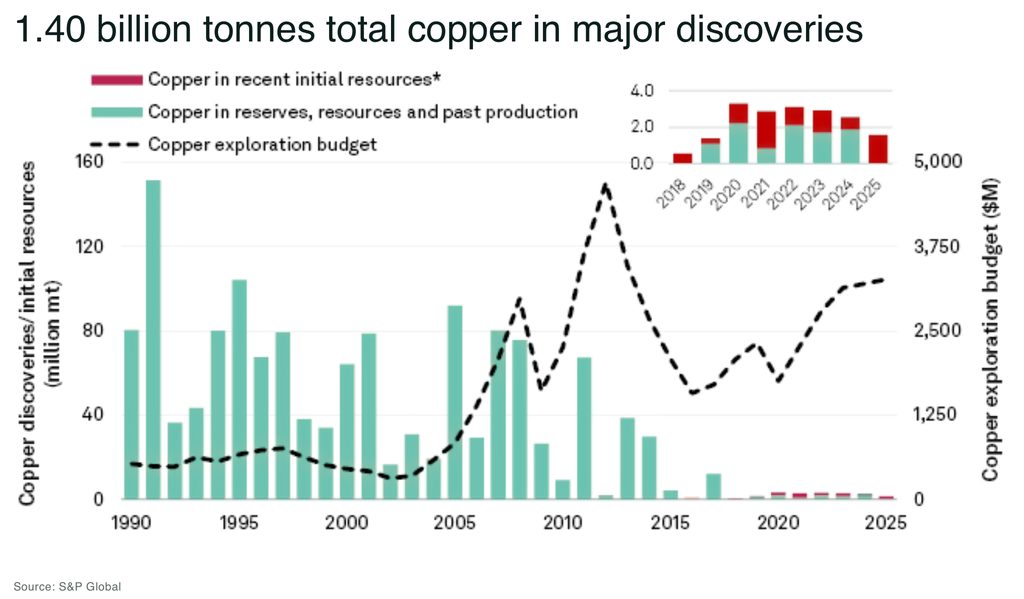
Instead, copper miners are expanding resources they already know faster than they are finding new districts. For example, in 2025, minesite exploration captured 43% of global copper exploration budgets, compared with 25% for grassroots work.
Total copper discovered since 2000 remains below the volume discovered during the 1990s alone.
Brownfield exploration offers existing infrastructure, clearer permitting pathways and lower development risk, and can add near-term tonnes — but it does little to replace the long-term project pipeline.
Discovery is only the first bottleneck
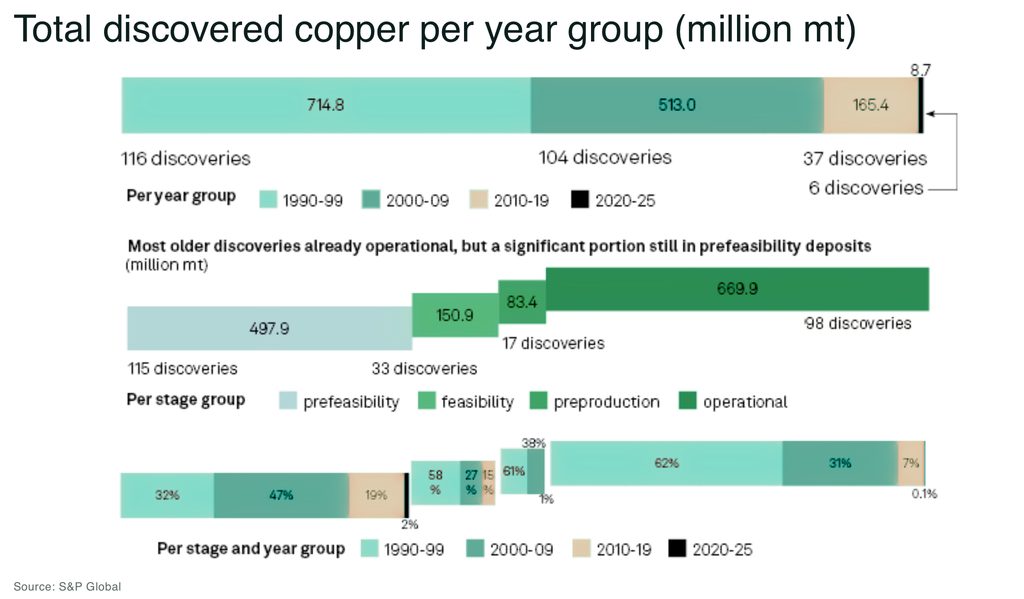
Of the 263 major discoveries identified by S&P, 165 have not entered production. Of those, 135 have not completed feasibility studies and only 17 have reached construction or pre-production.
That matters because:
- the average copper discovery now takes 17.5 years to reach production
- and the average drilling depth has also increased nearly 50% since 2010 to around 600 metres
The new figures reinforce the copper exploration bottleneck previously examined by The Oregon Group: the market must both find new deposits and move existing discoveries through feasibility, financing, permitting and construction.
Argentina is one emerging bright spot. Grassroots copper exploration budgets there increased from US$18 million in 2024 to US$66 million in 2025, while S&P identified a 33% significant-drilling ratio between January 2021 and July 2026—above the US and Australia.
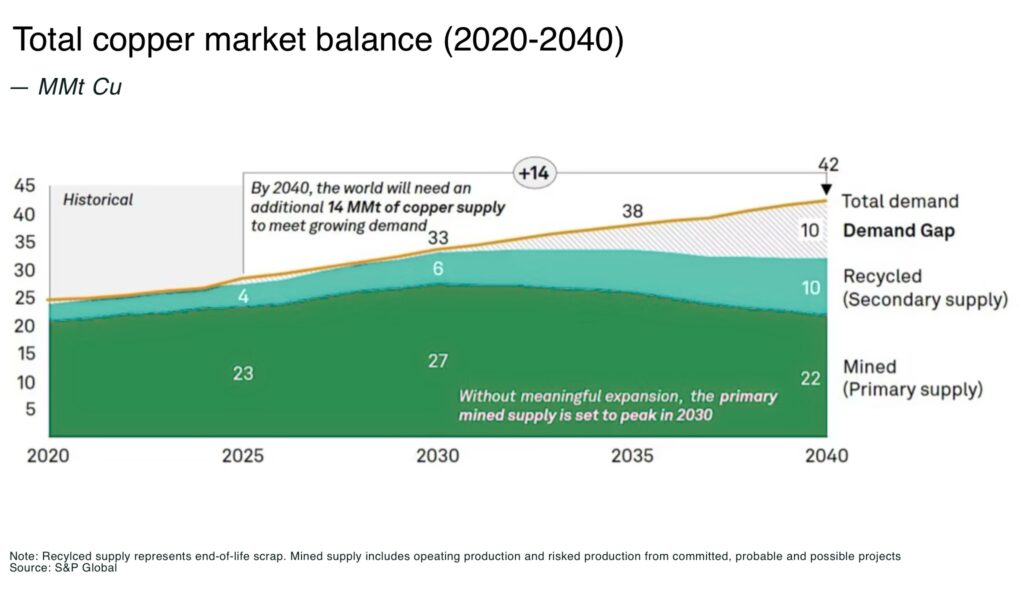
S&P forecasts copper concentrate deficits in 2026–2027 and through much of the 2030s.
The strategic point is simple: copper’s supply problem is no longer just about geology. It is about where exploration capital is deployed — and whether discovered deposits can become mines quickly enough.
And this is happening as copper is facing a potential “super squeeze” with its demand stack is deepening, just as the supply pipeline tightens.
Find out more with our recent newsletter: Copper’s new demand stack (and the AI chokepoint)