
- two unions representing 709 Centinela employees have entered a second week of strike action after negotiations with Antofagasta Minerals failed
- the unions say operating truck numbers have halved and November copper production could fall by 50% if the dispute continues
- Antofagasta says the striking employees represent 22% of Centinela’s directly employed workforce and has not changed its production outlook
- the disruption comes after Chilean copper production fell 7.7% during the first eight months of 2026
A strike at Antofagasta Minerals’ Centinela mine — producing roughly 1% of global copper mine supply and 4.5% of Chilean output — has entered its second week, with unions warning that the disruption could cut the operation’s November copper production by half.
Centinela and the Minera Esperanza and Distrito Centinela unions returned to voluntary mediation on October 13 after workers began industrial action on October 7. No agreement had been announced at the time of writing.
The unions say their members account for more than half of Centinela’s critical mine operators, including drill and shovel operators, and more than 60% of its equipment-maintenance workforce — and that the number of haul trucks operating at the mine has already been cut in half.
Antofagasta disputes the scale of the immediate production risk. The company says the unions represent 709 employees, equivalent to approx 22% of Centinela’s direct workforce, and has maintained its production outlook.
How much copper is exposed?
Centinela produced 240,400 metric tonnes of copper in 2025, alongside 156,500 ounces of gold. The operation accounted for more than one-third of Antofagasta’s 653,700 metric tonnes of group copper production in 2025.
Antofagasta’s current group guidance is for 625,000–655,000 metric tonnes of copper in 2026, but production had already fallen 9% year on year to 285,000 tonnes during the first half, principally because of lower output at Centinela and Los Pelambres.
The unions’ 50% figure applies to possible November production rather than full-year output. The eventual loss will depend on how long the strike continues, the effectiveness of the mine’s contingency plan and whether deferred ore movement can be recovered later.
Chile’s copper output is already falling
The timing leaves Antofagasta with limited room for another operational setback.
Chile produced 369,500 metric tonnes of mined copper in August, while the country’s mining production index fell 11.7% from a year earlier.
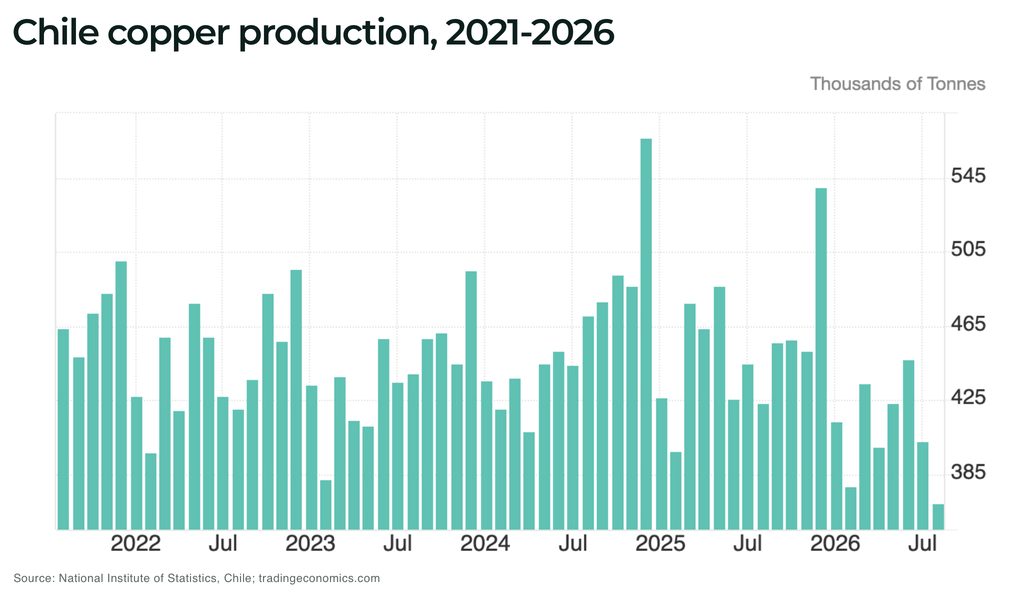
The Chilean central bank reported that overall mining activity contracted 17.4% year on year in August, driven particularly by lower copper extraction, lower ore grades, maintenance and adverse weather.
The Centinela dispute therefore adds labour risk to a supply system already dealing with weaker grades and operating interruptions.
Copper prices recently traded above US$14,400 per metric tonne, with the strike helping offset pressure from a stronger US dollar. Near-term availability is particularly tight: the LME cash contract was recently trading at a US$181.50-per-tonne premium to three-month copper, a market structure associated with demand for immediately available metal.
A strike beside Antofagasta’s biggest growth project
Centinela is also the site of Antofagasta’s most important expansion.
The Second Concentrator project is projected to add 95,000 tonnes per day of processing capacity and is expected to double Centinela’s production of copper concentrates. Antofagasta estimates average additional production during the first ten years at 144,000 tonnes of copper, 130,000 ounces of gold and 3,500 tonnes of molybdenum annually.
The company has not said the strike is delaying construction or commissioning, but resolving the dispute matters because Antofagasta is preparing to operate a substantially larger and more complex mining district from 2027.
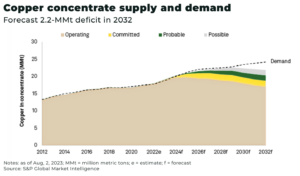
With Chilean output already falling and readily available metal carrying a premium, even a temporary reduction at a 240,000-tonne operation removes flexibility from an increasingly disruption-sensitive market.