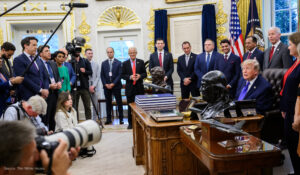


The G7 has agreed to reduce reliance on any single supplier of rare earths and permanent magnets to below 60% by 2030, in the clearest sign yet that Western governments are trying to turn critical minerals security from policy language into industrial strategy.
The target, agreed by G7 leaders in Évian, France, is aimed at cutting exposure to China, which dominates rare earth processing and permanent magnet supply chains used across electric vehicles, wind turbines, defence systems, robotics and advanced electronics.
“We aim to significantly reduce our dependencies on a single supplier outside the G7 and partner countries for rare earths and permanent magnets to under 60 per cent by 2030 and continuing to decrease further over time, with an ambition to reach 50 per cent as soon as possible” — G7 Leaders’ declaration on securing supply chains for critical minerals, June 17, 2026
G7 leaders said they would work with partner countries to build mining, processing and recycling capacity across the full critical minerals value chain. The bloc also set an ambition to reduce single-supplier dependence to 50% as soon as possible after 2030.
The move follows more than a year of supply chain tension after Beijing’s export controls on permanent magnets exposed how dependent manufacturers remain on Chinese midstream processing.
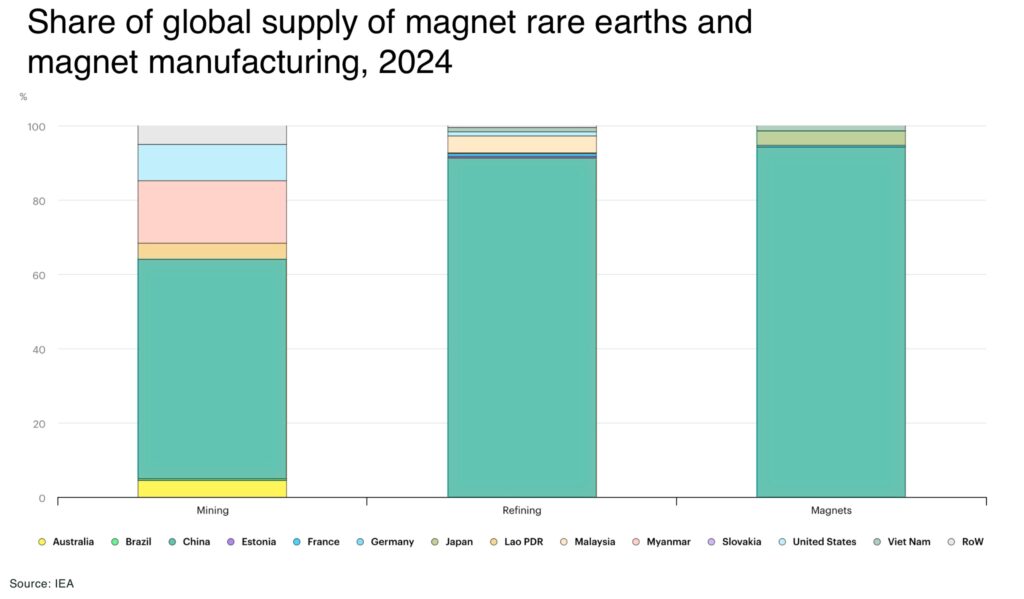
- in 2024, China accounted for 60% of global mined production of magnet rare earths
- for refining, China represented 91% of global refined output
- and its share is even higher for permanent magnet production: in 2005, China accounted for around 50% of the production of sintered permanent magnets, but its share expanded significantly to reach 94% in 2024
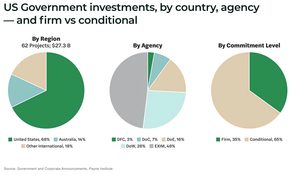
The G7 said 195 critical minerals projects have been announced since the start of 2026, representing $73.4 billion of investment, including equity participation and offtake agreements. But officials acknowledged the challenge remains significant: building mines is only part of the problem. The harder bottleneck is processing, separation, refining and magnet manufacturing.
The alliance will begin with pilot traceability and transparency mechanisms for lithium and nickel, before extending the system to five additional critical minerals each year, with particular attention to rare earths.
Leaders also backed stronger coordination between development finance institutions, export credit agencies and private capital, including possible joint procurement, price-gap subsidies, quotas and price floors to support new non-Chinese supply.
A new G7 Critical Minerals Resilience and Production Alliance will coordinate policy, data sharing, stockpiling and crisis response. The International Energy Agency and OECD will help monitor markets, identify distortions and provide early warnings of supply stress.
The message is blunt: critical minerals are no longer just a commodity issue. They are now a security, industrial and geopolitical priority.
For investors, the focus is shifting from discovery alone to supply chain position. Projects with credible routes into processing, offtake, financing and allied-country supply chains are likely to become more strategic as governments try to build alternatives to China before the end of the decade.