
- Lockheed Martin’s proposed purchases from NioCorp could reach 15 tonnes of scandium oxide annually, but the agreement is non-binding
- Bloom Energy’s expanded Oracle partnership included 1.2 GW of contracted fuel-cell capacity, connecting scandium demand to AI infrastructure
- the Pentagon announced a conditional US$400 million loan commitment to Sunrise Energy Metals
A single defence customer could reshape scandium supply and demand.
In August, NioCorp announced a non-binding agreement with Lockheed Martin covering potential purchases of up to 15 tonnes of scandium oxide annually, supplied as oxide or aluminium-scandium alloys, over ten years. Lockheed’s potential annual purchases equal a quarter of the 60 tonnes of global scandium oxide consumption estimated for 2025.
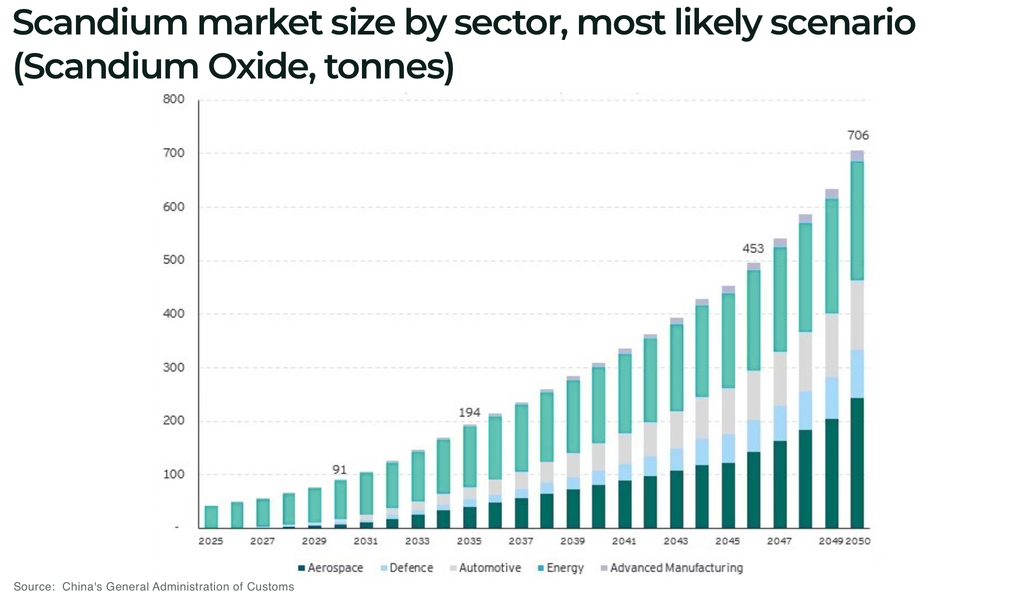
And potential new demand extends well beyond defence, with the longer-term opportunity spanning aerospace, automotive and energy industries:
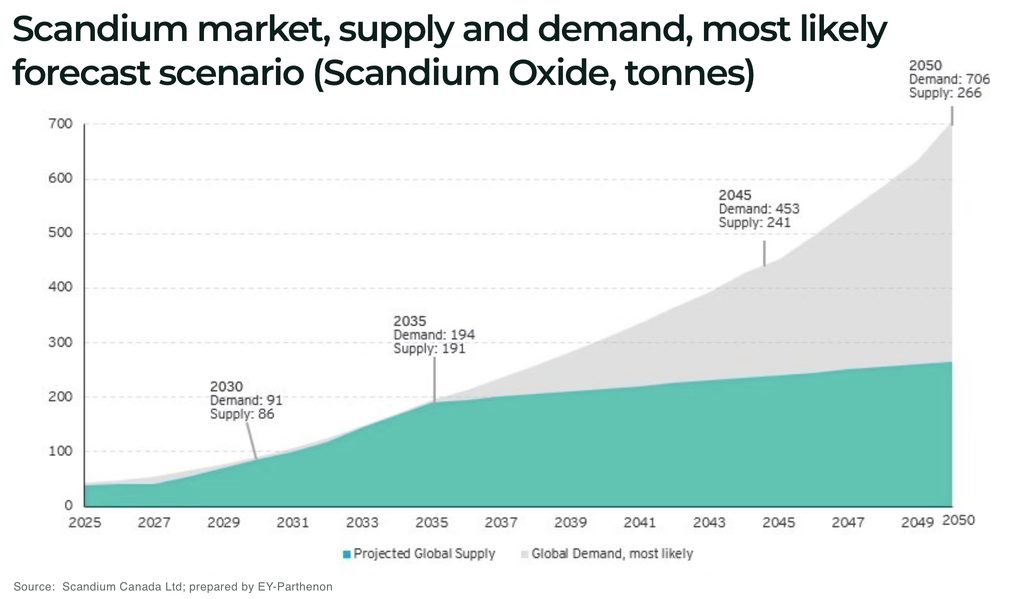
An EY-Parthenon study commissioned by Scandium Canada projects global scandium oxide demand reaching 194 tonnes annually by 2035, with a supply gap emerging that year — that would be more than x3 the estimated consumption in 2025.
The market for scandium is comparatively tiny, the world produced approx 80 tonnes of scandium oxide in 2025 vs 29 million tonnes of refined copper (at that rate, copper refineries produced an equivalent weight of scandium in roughly 90 seconds).
But, this means one new major customer or supply disruption can materially change the balance. And there may be more than just one.
For example, not just NioCorp’s deal with Lockheed Martin, but Bloom Energy — using scandium oxide in its solid oxide fuel cells, connecting the metal to electricity demand from AI data centre — alone could require around 200 tonnes of scandium oxide annually by the early 2030s, approx x2.5 the entire world’s estimated production in 2025.
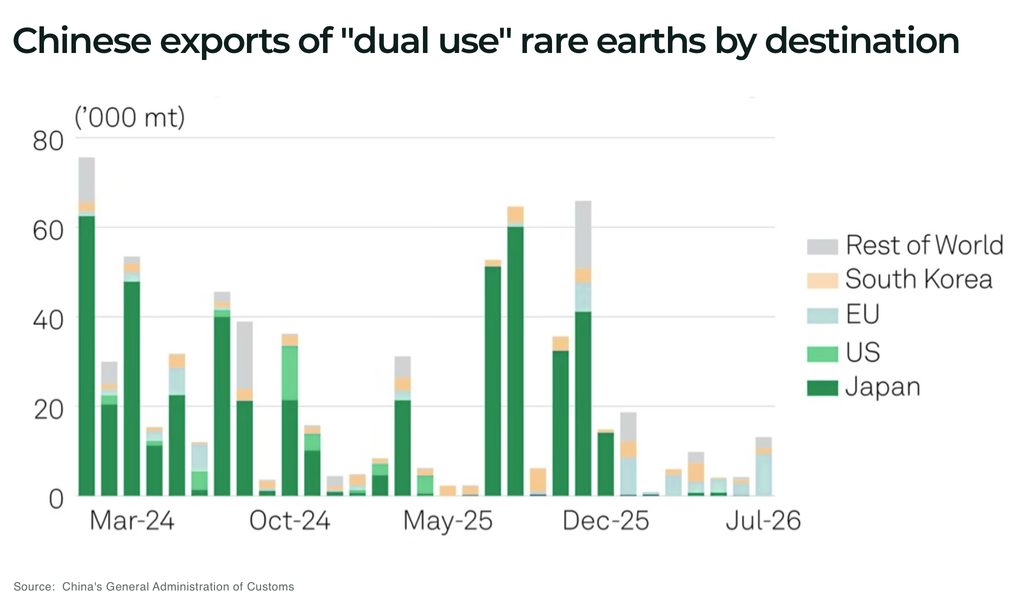
Then, in August 2026, exports from China, the world’s largest scandium producer, fell to zero in August 2026.
The purchases are, of course, not guaranteed, and export restrictions may always be lifted, but the scale and importance of scandium explains why this small market is attracting increasingly urgent attention from defence contractors, technology companies and governments.
What is scandium
Scandium is a soft, silvery metal classified as a rare earth element (RRE) group (although, as the 32nd most abundant element on earth (gold is the 75th), it is far from being rare)
The problem is that scandium is spread widely and thinly, most often combining with other metals, so it is mostly processed as a by-product from other mined metals.
This means there is little reliable data on production, especially in what is a relatively small market, so it’s difficult to understand the size of the market, as well as supply and demand dynamics.
And, importantly for mining, high-grade deposits suitable for commercial mining are extremely rare, and extracting it as a by-product from other ores is similarly challenging.
But, there’s a reason it’s listed as a critical mineral in the US, EU, Canada, Australia.
Is scandium already in shortage?
The available annual figures do not establish an immediate global deficit, with the US Geological Survey estimating:
- consumption reached 60 tonnes of scandium oxide in 2025
- while citing industry estimates of approx 80 tonnes of production and more than 90 tonnes of annual capacity
However, supply is tightening as China ratchets up restrictions on scandium exports:
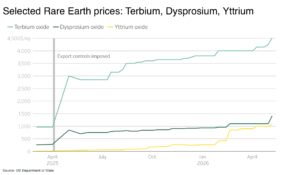
- in April 2025, responding to Trump’s “Liberation Day” tariffs covering a broad range of Chinese products, Beijing announced export control on seven rare earth elements, including scandium and its associated metals, oxides, alloys, compounds, targets and magnet materials
- Beijing suspended its October 2025 restrictions until November 2026
- but, then in April 2025, Chinese customs data indicate that exports of yttrium, terbium, scandium and dysprosium to the US, effectively halted
The US has been 100% dependent on imports of scandium for the last 20 years, with Japan suppling 89% of US scandium oxide imports during 2021–2024. That supply includes material refined from Philippine feedstock, but the report does not disclose the upstream origin of the entire Japanese share — with obvious concerns over China’s leading share of global production and exports.
Defence and AI are changing scandium’s demand outlook
Scandium has two especially important demand drivers into larger markets:
In aluminium alloys, it can improve strength and corrosion resistance while preserving low weight, supporting aerospace, defence and other demanding applications. eg NioCorp’s Lockheed agreement builds on a joint development programme for scandium-based aircraft components.
The second route is electricity and AI investment. eg Bloom Energy uses scandium oxide in its fuel-cell electrolyte to improve power density, durability and fuel efficiency, and, in April 2026, Bloom announced that Oracle intended to procure up to 2.8 GW of fuel-cell systems under an expanded agreement.
Bloom says its scandium supply chain can support up to 25 GW of annual production capacity and does not depend on China, according to its July explanation of scandium sourcing.
However, specialist consultancy OnG Commodities questioned the visibility of that supply in a September analysis published by the MMTA, while acknowledging that it did not know where Bloom sourced its scandium.
“The principal uses for scandium in 2025 were in aerospace alloys and solid oxide fuel cells used in large-scale power generation and backup power systems for critical infrastructure” — USGS, Scandium, 2025
Scandium global supply does not guarantee US supply
Scandium’s supply problem is increasingly about access.
USGS estimates suggest production (80 tonnes in 2025) currently outpaces consumption (60 tonnes) but, especially in such a small commodity market, say little about the material available — and the subsequent leverage available to suppliers — to individual buyers, in the required form and under acceptable export conditions.
For example, by February 2026, US chipmakers were reporting delays obtaining scandium export licences and seeking Washington’s help, with a US government official telling Reuters some US manufacturers now face “shortages”, putting at risk, for example, America’s 5G chip industry.
The exposure extends beyond aircraft structures and fuel cells. Scandium is also used in aluminium–scandium nitride thin films, which improve the performance of radiofrequency components used in communications and sensing. These applications connect scandium supply to radar, avionics, satellite communications and 5G infrastructure. By February 2026, US chipmakers were reporting delays obtaining Chinese scandium export licences and seeking Washington’s help.
Yttrium offers a warning of how these disruptions can spread. Used in heat-resistant jet-engine coatings, its shortage had forced some North American coating suppliers to pause or stop production, according to Project Blue’s April analysis. At that point, the shortages had not disrupted engine or semiconductor production itself, but they threatened to compound existing aerospace bottlenecks. Even when the quantities involved are small, interrupted access to a specialised material can put much larger manufacturing programmes at risk.
That creates a market increasingly divided by origin and access: material available within China, and supply that US manufacturers can reliably secure outside Beijing’s licensing system. Even if restrictions ease further, their potential return gives Washington a reason to finance alternative production.
Recent US commitments include:
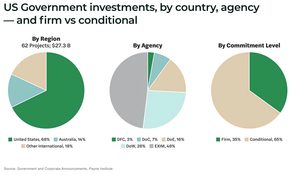
- Sunrise Energy Metals, Australia — US$400 million conditional loan commitment, August 2026: the Pentagon’s Office of Strategic Capital backed development of the Syerston scandium project and downstream processing capabilities. The proposed financing provides a right of first offer on output, but remains subject to conditions before financial close
- ElementUSA, Louisiana — US$29.9 million award, November 2025: the Defence Production Act funding supports a demonstration facility to recover gallium and scandium from industrial waste, alongside development work in Texas. The award covers both minerals
- NioCorp’s Elk Creek Resources, Nebraska — up to US$10 million, August 2025: a milestone-dependent award supports a domestic scandium supply chain extending from mining to alloy manufacture and qualification for defence applications
- in September 2025, the Defense Logistics Agency announced plans to procure more than 6,000kg of scandium oxide for the National Defense Stockpile from a source in Sorel-Tracy, Quebec, Canada
“The world has entered an era in which access to critical minerals will shape industrial strength, technology leadership and national security… Scandium is one of the clearest examples” — Robert Friedland, chairman of Sunrise Energy Metals
And it’s not just the US investing in new supply:
| Source | Scale and latest development | Supply status |
| Rio Tinto — Sorel-Tracy, Quebec | In November 2025, Rio and Canada Growth Fund announced approximately C$25 million to expand nameplate capacity to 9 tonnes annually. The operation recovers scandium from titanium dioxide production waste, without additional mining | Existing producer with an announced expansion. The release does not establish that the full expanded capacity has been commissioned |
| Sumitomo Metal Mining — Taganito, Philippines / Harima, Japan | An established supply chain recovers scandium from Philippine nickel processing and refines it into oxide in Japan. Sumitomo’s May 2026 strategy presentation confirms plans to increase production capacity, although it does not quantify the expansion | Operating supply chain with expansion planned. This is particularly relevant to diversification because the disclosed route starts with Philippine feedstock |
| Rio Tinto — Burra, New South Wales | Formerly the Platina project. Rio identified potential production of up to 40 tonnes annually for about 30 years when announcing its acquisition | Development project. Rio’s current project page describes environmental studies and permitting; it gives no confirmed production start date |
| Scandium International — Nyngan, New South Wales | The existing feasibility-study design contemplates approx 38.5 tonnes of annual nameplate capacity. A mining licence was granted in October 2025, and an updated feasibility study was commissioned in June 2026 | Permitted development project, awaiting financing and customer agreements. The capacity figure comes from the existing study, not operating production |
| Scandium Canada — Crater Lake, Quebec | A potential dedicated scandium mine. In August 2026, the company postponed its prefeasibility study to incorporate resource expansion and processing changes, opting for an updated resource estimate and preliminary economic assessment. | Earlier-stage potential supply. There is no confirmed commissioning date; it should not be presented as imminent production |
These figures should not be added together as imminent supply, but instead describe different development stages and production measures.
New supply still has to be built
The supply response is gathering momentum, but delivery is not certain — and will take time.
For example, Sunrise’s Syerston project illustrates the gap with its planned initial capacity of 60 tonnes of scandium oxide annually, but commissioning in the first half of 2028. Its US financing commitment remains conditional, and engineering, construction, etc still stand between the announced funding and commercial supply.
Meanwhile, demand is moving into deployment.
Bloom’s expanded Oracle agreement includes 1.2 GW of contracted fuel-cell capacity, with installations underway and continuing into 2027. Bloom claims it has secured a diversified scandium supply chain, but other buyers have encountered difficulties with US chipmakers facing delays obtaining Chinese scandium export licences, including companies sourcing through third countries.
Longer term, the EY-Parthenon study commissioned by Scandium Canada projects demand reaching 194 tonnes annually by 2035, when a global supply gap emerges.
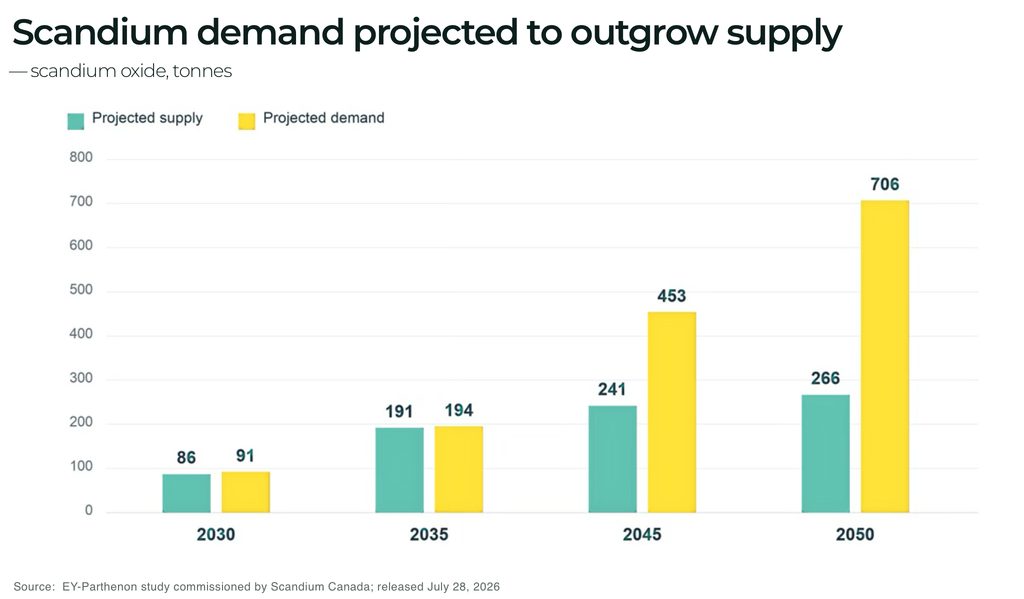
The pressure therefore operates on two timelines:
- manufacturers need dependable material today despite ongoing export restrictions from China
- and new producers must finance and build capacity for incoming future demand
Any project delays would widen that exposure, and the recent volatility in pricing in other smaller commodity markets, such as tungsten, highlight what can happen if there is any disruption in a tight market.
Scandium FAQ
How big is the scandium market?
USGS estimates global consumption at approximately 60 tonnes of scandium oxide in 2025. This is oxide tonnage, not scandium metal.
Why could AI increase scandium demand?
Bloom uses scandium oxide in its solid oxide fuel cells, which are being deployed to power data centres. Demand will depend on deployment volumes and material requirements per unit.
Has Lockheed Martin committed to buying NioCorp’s scandium?
The August 2026 announcement describes a non-binding memorandum of understanding. It does not guarantee purchases or a definitive agreement.
Where could additional supply come from?
Routes include expanded byproduct recovery at Rio Tinto and proposed mining projects such as Syerston and Elk Creek. Their capacities should not be treated as current production.