
Major US mineral suppliers say they will not be ready for a January 1, 2027 Pentagon deadline requiring defense contractors to stop purchasing covered rare-earth magnets, tungsten, tantalum and molybdenum sourced from China, Russia, Iran and North Korea.
US demand for neodymium-iron-boron, or NdFeB, magnets reached roughly 48,000 tonnes in 2025, according to Arthur D. Little data, reported by Reuters — but domestic sources supplied just 300 tonnes.
“It’s going to take many more years to get the needed infrastructure in the ground to compete” — Chris Berry, a minerals industry analyst and consultant, told Reuters.
And, even if US magnet production capacity reaches the projected 5,000 tonnes by the end of this year, it would still represent little more than 10% of total national demand.
To be clear, that comparison overstates the Pentagon’s direct requirement: 48,000 tonnes covers the entire US market, not defense procurement alone, but the numbers reveal the scale of the industrial gap.
This is not simply a ban on Chinese magnets
The Pentagon’s 2027 rule reaches much further upstream than just Chinese magnets, with the updated Defense Federal Acquisition Regulation Supplement extending restrictions across critical supply chains:
- mining the constituent minerals
- refining and separation
- metal and alloy production
- powder formation and pressing
- sintering or bonding
- magnetisation
- production of the finished magnet
The governing law, 10 USC 4872, covers samarium-cobalt and NdFeB magnets, tungsten metal powder, tungsten heavy alloy and components, tantalum metals and alloys, and molybdenum. It applies to Pentagon prime contracts and subcontracts at every tier.
In other words, assembling a magnet in Texas does not make it compliant if its oxide, alloy or another restricted input came from China.
And China still produces 60% of mined magnet rare earths, 91% of refined output and 94% of sintered permanent-magnet production.
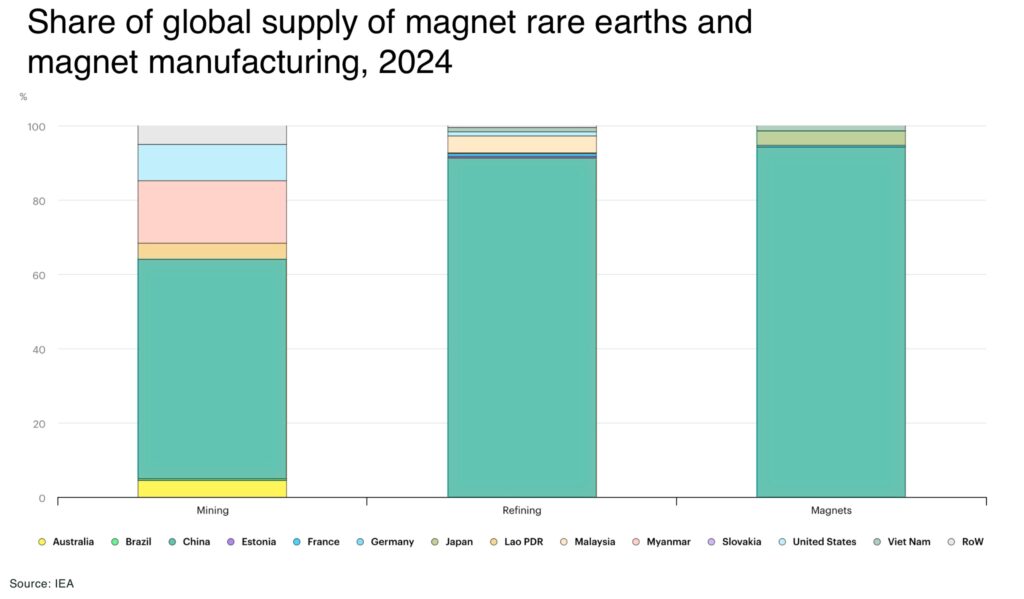
This is why the deadline is so difficult: the bottleneck is not the ore body, but the supply and processing chain between the mine and the finished magnet.
China tightens its own rare earth restrictions
China’s rare earth export restrictions are also adding pressure to the Pentagon deadline.
China has added MP Materials and USA Rare Earth to its export control list, restricting Chinese companies from supplying the two US rare earth firms with certain dual-use goods and technologies, putting two of America’s most important rare earth producers directly in Beijing’s sights.
Announced capacity is arriving too late
America’s project pipeline is growing rapidly has the potential to establish the first serious non-Chinese rare-earth industrial ecosystem in decades, but unfortunately much of it is scheduled to arrive after the deadline:
| Supplier or project | Near-term position | Larger-scale capacity |
|---|---|---|
| MP Materials | Its Independence facility is commissioning and ramping towards a projected 3,000 tonnes per year of magnets. | The additional 7,000-tonne 10X facility is only expected to begin commissioning in 2028. |
| USA Rare Earth | Stillwater Phase 1A is targeting a 600-tonne annual run rate by the end of Q4 2026; Phase 1B is expected to bring total capacity to 1,200 tonnes in Q1 2027. | Its 6,400-tonne South Carolina facility is targeted to begin commissioning in 2028. |
| Ucore | Its initial Louisiana machine will separate about 600 tonnes per year of rare-earth oxides—not produce magnets—and is scheduled for installation, testing and commissioning in H1 2027. | The proposed complex is designed for approximately 9,600 tonnes of oxide throughput. |
| VAC, Sumter | The recently commissioned South Carolina facility has 2,000 tonnes of magnet nameplate capacity. | Planned upstream integration relies on projects and processing expansions stretching into 2027–2029. |
| Evolution Metals & Technologies | The counter-case: it says 13 new machines could lift allied production capacity to approximately 10,000 tonnes by November 2026. | The equipment was still awaiting delivery, installation and commissioning when the target was announced. |
USA Rare Earth commissioned Phase 1A of its Stillwater facility in March, but reported no revenue from neo-magnet manufacturing during the first quarter. The company expects the line to ramp towards 600 tonnes of annual capacity by the end of 2026.
MP Materials has commenced manufacturing magnets on industrial-scale equipment at Independence, but remains in the final stages of commissioning. Its filing says production will increase in phases as additional capabilities are commissioned and scaled towards a projected 3,000-tonne annual capacity.
Evolution Metals, meanwhile, says 13 ordered magnet-production machines represent more than one year of their manufacturer’s planned Western output. The equipment was scheduled for delivery and installation by November 2026, leaving only a short period for commissioning and production ramp-up before the Pentagon deadline.
Rare earths are only part of the problem
The same deadline covers tungsten and tantalum, where the US upstream position is arguably even weaker.
- according to the US Geological Survey’s 2026 tungsten summary, tungsten has not been mined commercially in the US since 2015. The country remains more than 50% import reliant, with China accounting for 26% of imports during 2021–2024
(See our recent analysis — Why tungsten prices are rising so fast: inside the supply crunch) - the USGS tantalum assessment is more stark: America has not mined tantalum since 1959 and was 100% net import reliant in 2025; China supplied 22% of total tantalum imports and 47% of imported tantalum metal and powder during 2021–2024
- Molybdenum is the exception. US mines produced an estimated 40,000 tonnes in 2025 and the country was a net exporter
Importantly, the new rule does not require every mineral to be mined domestically — Australian tantalum, South Korean metals or European magnets may comply — but the entire relevant chain must be documented.
The waiver has not disappeared
Trump’s Executive Order 14415, “Securing America’s Defense Supply Chains and Ensuring Domestic Acquisition of Critical Materials,” signed on July 20, 2026, tightens the waiver process ahead of the deadline.
From January 1, waivers generally require an approved mitigation plan documenting exhaustive attempts to find compliant material and a timetable for removing non-compliant supply. The order also directs the Pentagon to develop rules requiring contractors to trace critical supply chains back to raw-material origin and allows contractual remedies against companies that fail to qualify alternative suppliers or implement approved mitigation plans.
The executive order was presented as a hardening of the deadline (it stops routine waivers, threatens contractual remedies and requires contractors to map supply chains back to raw-material origin), but the it also preserves a route for non-compliant material where contractors submit an approved mitigation plan that:
- identifies the non-compliant source
- documents exhaustive efforts to find compliant supply
- shows how the material will be removed from the supply chain
- provides a firm transition timetable
We do not expect the January 2027 deadline to be repealed and waivers do exist, but we do not yet know how vigorously the Pentagon will apply them. Instead it is likely to become a forcing mechanism: contractors will map their supply chains, qualify allied material, place more long-term orders with Western producers and seek waivers where no alternative exists.