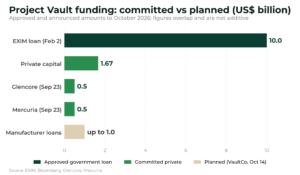


The US has secured its first US$1 billion of procurement commitments for Project Vault, moving the planned strategic critical-minerals reserve from government financing approval towards physical stockpiling.
- Glencore announced a separate US$500 million commitment backed by financing from the US Export-Import Bank
- Mercuria committed US$500 million to the reserve on September 23, 2026
Mercuria describes its contribution as a commitment to Project Vault, while Glencore says the EXIM financing will allow it to source, procure and deliver minerals to the reserve. The combined US$1 billion is therefore not US$1 billion of new government spending, or necessarily US$1 billion of private capital — but it moves the project from concept to execution.
Glencore and Mercuria will use their trading, logistics and risk-management networks to purchase minerals globally and deliver them to VaultCo, the private company responsible for implementing the critical minerals reserve.
Neither company disclosed which minerals it will purchase, the volumes involved, the supplying countries or when deliveries will begin.
Project Vault moves from approval to procurement
President Donald Trump announced Project Vault in February 2026 after Chinese export restrictions exposed the vulnerability of US manufacturers to interruptions in rare earths and other critical materials.
The EXIM board approved a direct loan of up to US$10 billion to finance the reserve, while the wider plan combines that lending capacity with approximately US$2 billion of private capital.
Unlike the Pentagon’s National Defense Stockpile, Project Vault is a US $12 billion public-private partnership, backed by a $10 billion loan from the Export-Import Bank of the United States (EXIM), designed principally for civilian manufacturers. Participating companies will specify the materials and grades they need, while traders purchase, transport and manage inventories stored at facilities across the US.
Boeing, GE Vernova, battery manufacturer Clarios and data-storage group Western Digital were among the companies initially identified as potential industrial users. Mercuria, Hartree Partners and Traxys were named as the original suppliers.
Seven months after the launch, the Mercuria and Glencore agreements provide the first clear evidence that the financing framework is being converted into purchasing capacity. The two traders can aggregate demand from manufacturers that lack the scale or expertise to contract directly with overseas mines and processors.
But important details remain undisclosed. VaultCo has not published its target mineral list, inventory volumes, acquisition prices, storage locations or drawdown rules. Its independent, industry-led structure has also raised questions about transparency and oversight, given the size of the federal loan supporting it.
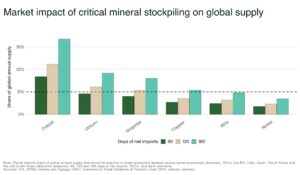
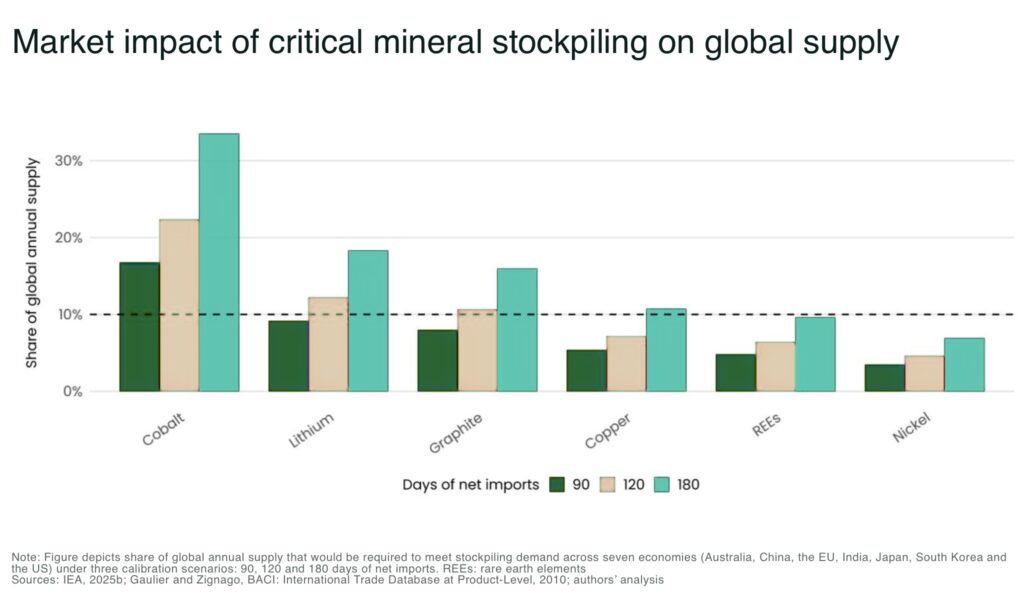
Critical mineral stockpiles could absorb 10% of key metals supply
A recent report by the London School of Economics warns that simultaneous buying by Australia, China, the EU, India, Japan, South Korea and the US could consume up to 34% of global cobalt supply under a modelled 180-day net-import scenario.
Lithium, graphite and copper would each face stockpile demand exceeding 10% of annual supply.
The latest commitments do not yet prove that the US has a functioning minerals reserve. They do show that Project Vault has moved beyond a US$12 billion financing plan and begun assembling the commercial network needed to buy and store material.