

Structural scarcity in critical minerals is not just an investment story. It is a business-building opportunity that most of the startup world hasn’t noticed yet.
Key Takeaways
- We are entering a prolonged period of structural commodity scarcity driven by AI, electrification, defense and reindustrialization all pulling on the same constrained materials at the same time.
- Supply cannot respond quickly — most critical mineral projects take 10 to 17 years from discovery to production
- The biggest business opportunities in this cycle are not in mining itself, but in the infrastructure, logistics, data, financing and processing layers around it
- Founders who understand physical supply chains will have a meaningful edge over the next decade
For most of the last decade, you could build something valuable without ever thinking about the physical world.
The formula for building a large company was essentially: find a market, write code, raise money, grow fast. The physical world was someone else’s problem. That era is not completely over, but the ground has shifted in ways that most founders have not fully absorbed yet.
The constraint now is not code or capital. It is materials. And the businesses that understand this early — and build around it — are going to have an enormous advantage over the ones still optimizing for a world that no longer exists.
What a commodity supercycle actually means
Commodity supercycles happen when a structural shift in the global economy drives demand for raw materials higher for a sustained period — not a quarter or two, but years or decades — while supply struggles to keep up.
We have been through a few of these. The industrialization of China drove the last major supercycle in the 2000s. Before that, post-war reconstruction drove one in the 1950s and 1960s.
What is happening now is potentially larger than either of those, because the demand is coming from multiple directions at once.
AI infrastructure is consuming copper, rare earths and energy at a scale that was not in anyone’s models five years ago. US data center construction hit an annualized $50 billion in April 2026. Electrification of transport is driving demand for copper, lithium, cobalt and nickel. Grid upgrades to support that electrification require additional copper at an enormous scale.
Defense spending is rising across NATO and allied nations, and modern weapons systems are mineral-intensive in ways that conventional platforms never were. Reindustrialization — the US and Europe bringing manufacturing capacity back onshore — requires the same materials, in large quantities, domestically.
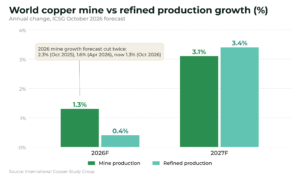
All of this is hitting a supply side that is structurally unable to respond quickly. A copper mine takes 16 to 17 years from discovery to first production on average. Permitting timelines in Western jurisdictions have not shortened. Exploration budgets fell to a record low as a share of global mining spend in 2025. The IEA has warned of a potential 30% copper supply deficit by 2035.
This is not a temporary imbalance; instead, it is a structural one. And structural imbalances create business opportunities.