- Alphamin will allocate up to 3,600 metric tonnes of contained tin a year from its Bisie mine in Congo to US refiner Nathan Trotter for an initial two years
- that is just under 20% of Bisie’s targeted output, bound for Nathan Trotter’s US$65 million Tin Ridge plant in Virginia, which targets first production in 2027
- the US has not smelted tin since 1989, and net imports met 77% of its refined tin consumption in 2025
Alphamin Resources has agreed to supply up to 3,600 metric tonnes of contained tin a year from its Bisie mine in the Democratic Republic of Congo to Nathan Trotter & Co., which is building the first US tin smelter in more than three decades.
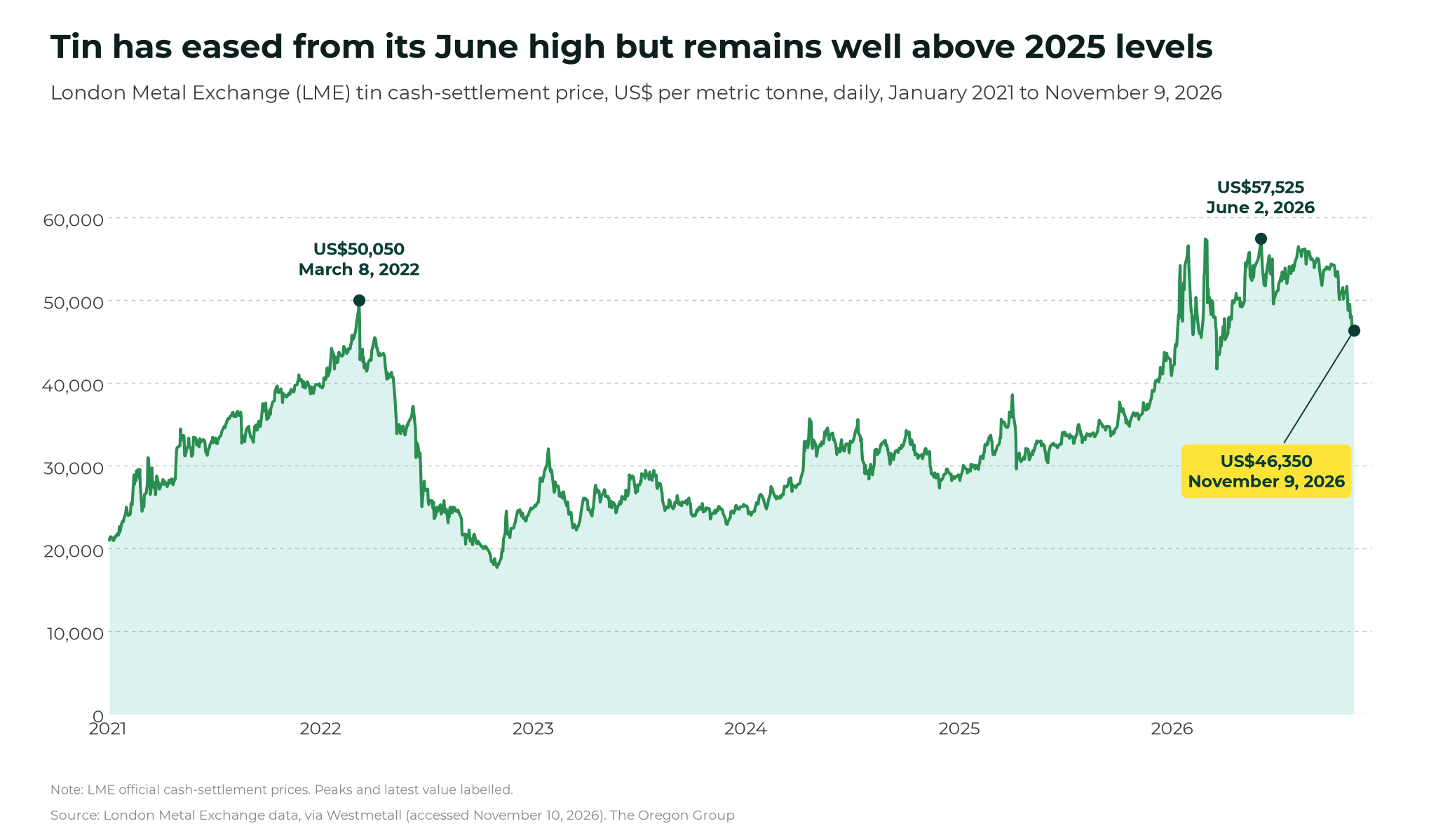
The deal comes as Washington backs domestic processing of critical minerals, with tin trading at about US$46,000 a tonne on the London Metal Exchange on Monday, November 9.
The allocation runs for an initial two years and represents just under 20% of Bisie’s targeted production — Bisie, which Alphamin describes as the world’s highest-grade primary tin mine, currently produces about 20,000 tonnes of contained tin a year.
The concentrate is destined for Tin Ridge, a 115,000-square-foot plant in Henry County, Virginia, designed to refine both tin concentrate and scrap. It is still under construction, with first production targeted for 2027.
Why a US tin smelter matters
The US has not mined tin since 1993 or smelted it since 1989. In 2025, it imported an estimated 32,000 tonnes of refined tin, and net imports met 77% of apparent consumption. Peru, Bolivia, Indonesia and Brazil supplied most of those imports between 2021 and 2024.
The chart below shows US refined tin consumption, refined imports and tin recovered from scrap since 2021:
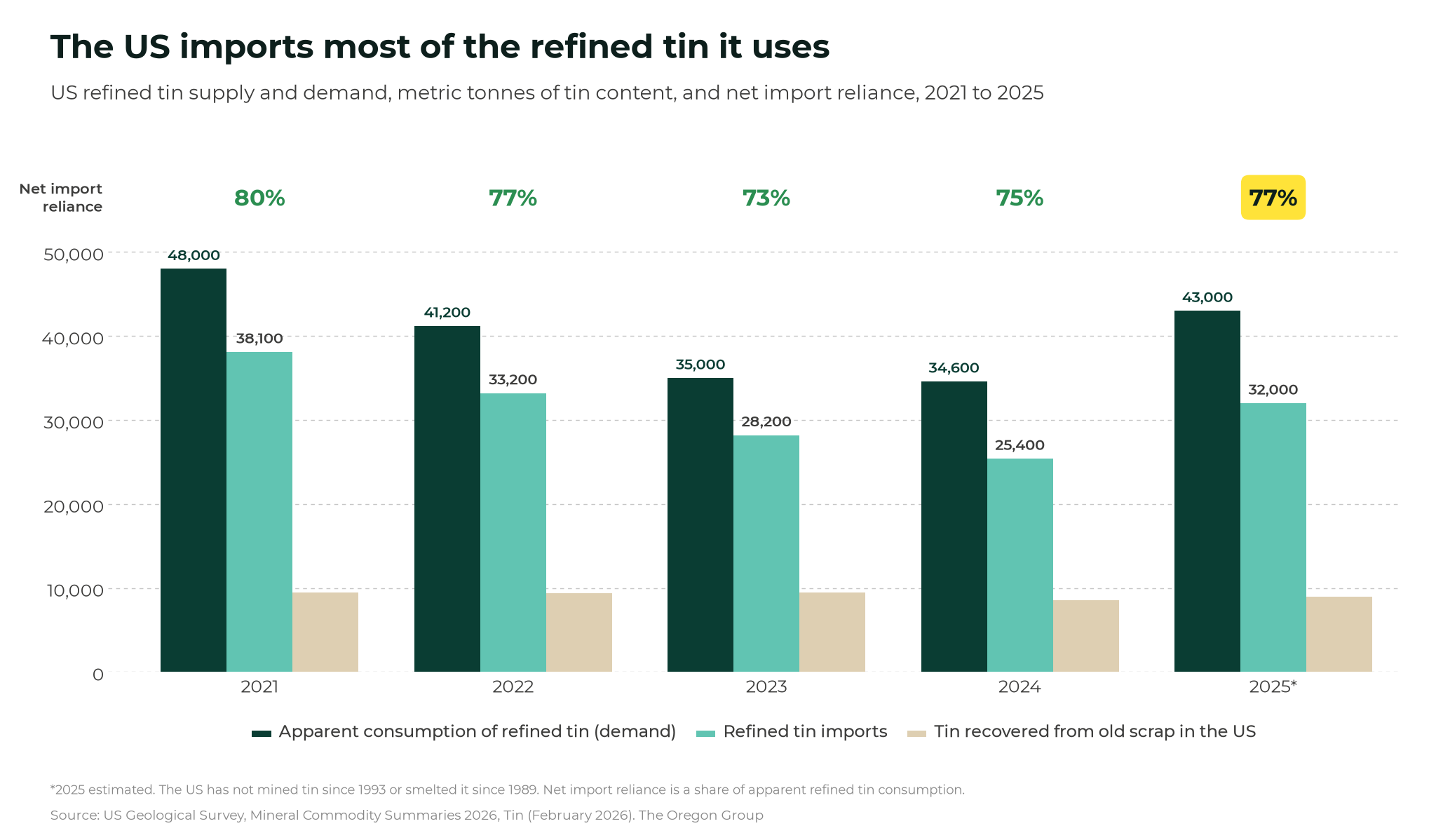
Before smelting losses, the full allocation would equal roughly a ninth of 2025 refined imports, our calculations show — and that matters because tin goes into solder for electronics and defence equipment, and Washington has already backed the project: the Pentagon awarded Nathan Trotter US$19 million under the Defense Production Act in September 2024 to build domestic tin smelting, refining and recycling capacity.
Meanwhile, Nathan Trotter is building a feedstock pipeline: the Alphamin deal follows a September agreement to buy up to 100% of Huntore Australia’s tin concentrate from its Mount Garnet operations in Far North Queensland, which are expected to produce up to 3,000 tonnes of tin concentrate a year.
The ownership is notable too, after Abu Dhabi’s International Resources Holding bought 56% of Alphamin in July 2025 and supports the deal. Alphamin links it to Pax Silica, the US-led supply-chain initiative launched in December 2025, which the United Arab Emirates joined in January 2026.
It also adds an alternative at a time when Asian supply is tight, as we reported when Indonesia’s refined tin exports fell 18% in September.
Prices reflect that tightness with London Metal Exchange cash tin peaked at US$57,525 a tonne on June 2 and settled at US$46,350 on November 9, still above any level reached in 2025.
Most of Bisie’s tin will still go to China
The deal diversifies a slice of Bisie’s output, but it does not redirect the mine. About 70% of Alphamin’s concentrate is sold to Yunnan in China because of competitive treatment charges, and most will keep going there, chief executive Eoin O’Driscoll told Fastmarkets in October.
He framed the US deal as diversification rather than a break with Chinese smelters: “The east will continue to refine the majority of the world’s tin, but diversification is good for us and good for everybody,” Eoin O’Driscoll said.
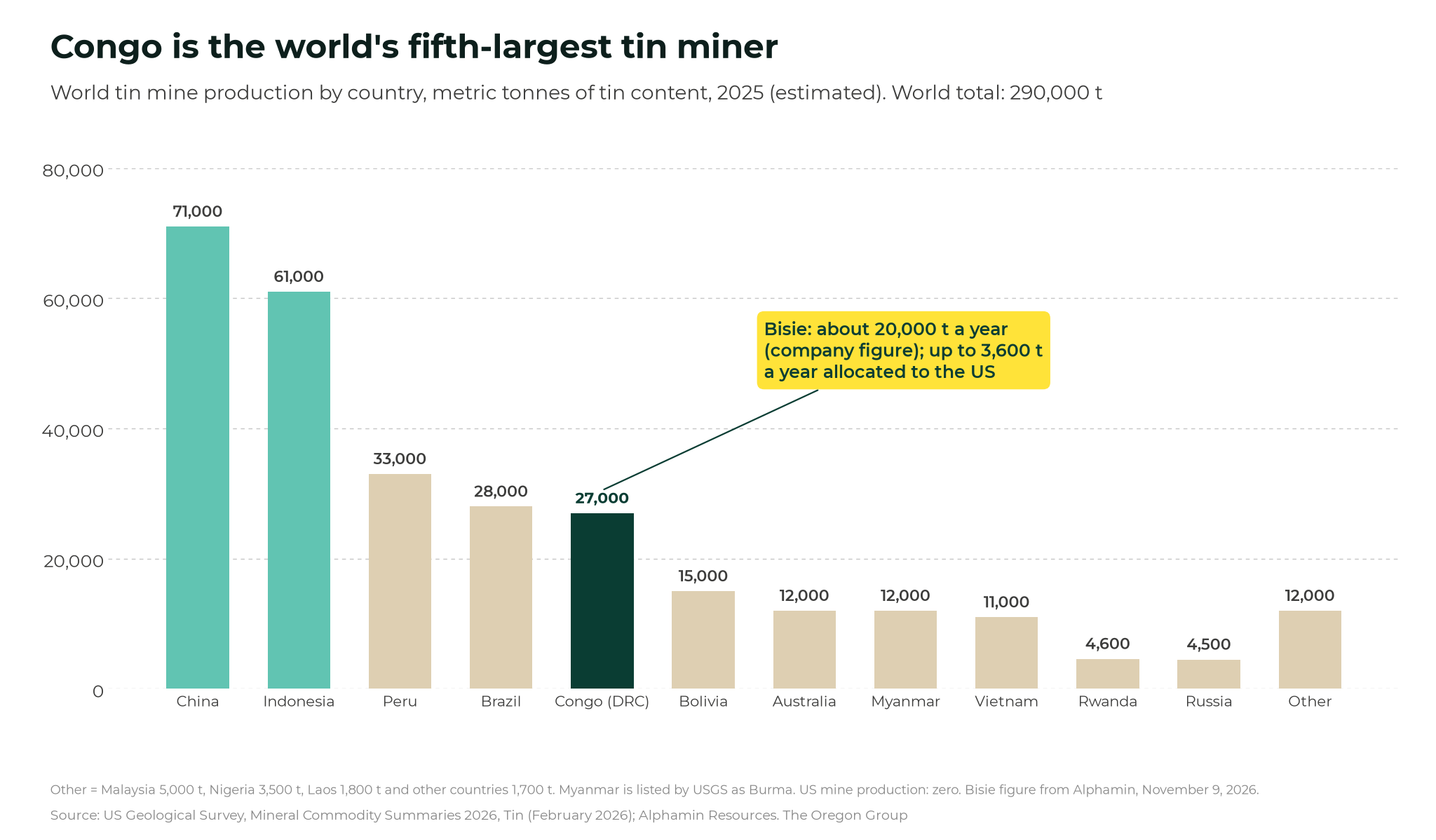
China was the largest tin miner in 2025, at an estimated 71,000 tonnes, and Yunnan Tin was the world’s largest refined tin producer in 2024, at 85,000 tonnes.
Congo ranked fifth among tin-mining countries in 2025 with an estimated 27,000 tonnes, behind China, Indonesia, Peru and Brazil, as the chart below shows.
Potential disruptions to the deal
The deal may have been agreed but there’s still a journey between the contract and the pipeline itself, including:
- the smelter is not yet built, and its capacity has not been disclosed, despite expectations that the Virginia facility to be operational by late 2026; Nathan Trotter now targets first production in 2027
- Alphamin gave no pricing, treatment charges or first shipment date, and cautioned that construction and commissioning delays at the smelter could affect the arrangement. One trader told Fastmarkets they questioned whether Nathan Trotter is ready to import concentrate next year
- supply carries its own risk; for example, Bisie, about 180 km northwest of Goma in eastern Congo, halted operations on March 13, 2025 over security concerns and only began a phased restart on April 15, after the halt had sent tin to a three-year high
- demand also appears to be softening, with the International Tin Association estimates that refined tin use fell 1.3% in 2025 and expects it to fall a further 2.2% in 2026, partly because of record-high prices
The deal gives the US a credible source of high-grade concentrate for its first tin smelter in decades, but until Tin Ridge is running, most of Congo’s best tin will still be refined in China.