- Democrats set to control both chambers of Congress from January, according to AP race calls, but most of Trump’s minerals strategy rests on executive action they cannot overturn without beating a veto
- US Senate holds a 60-vote procedural test on Monday 9 November on a bipartisan permitting bill that Senate Democrats helped write, but some senior House Democrats would rather wait for a better deal
- the bill would add consequences for agencies that miss existing review deadlines, give challengers 150 days to sue and give mines a legal place to put their waste rock
- control of Congress gives Democrats subpoena power over the administration’s minerals deals, which could slow investment in US critical materials companies
Democrats are set to control both chambers of Congress from January — and, for mining, the first test comes within a week, not in January. The Senate returns on Monday November 9 to vote on whether to take up the bill carrying a bipartisan permitting overhaul. Senate Democrats helped write it, but some senior House Democrats want to wait until they hold the gavels.
The midterm result does not necessarily undo President Trump’s minerals strategy as tariffs, stockpiles and government equity stakes are mostly executive actions, and a Democratic Congress can’t overturn them without beating a presidential veto.
However, what changes is scrutiny, budget leverage, and who decides whether permitting reform passes and in what form.
How long mine permitting takes now
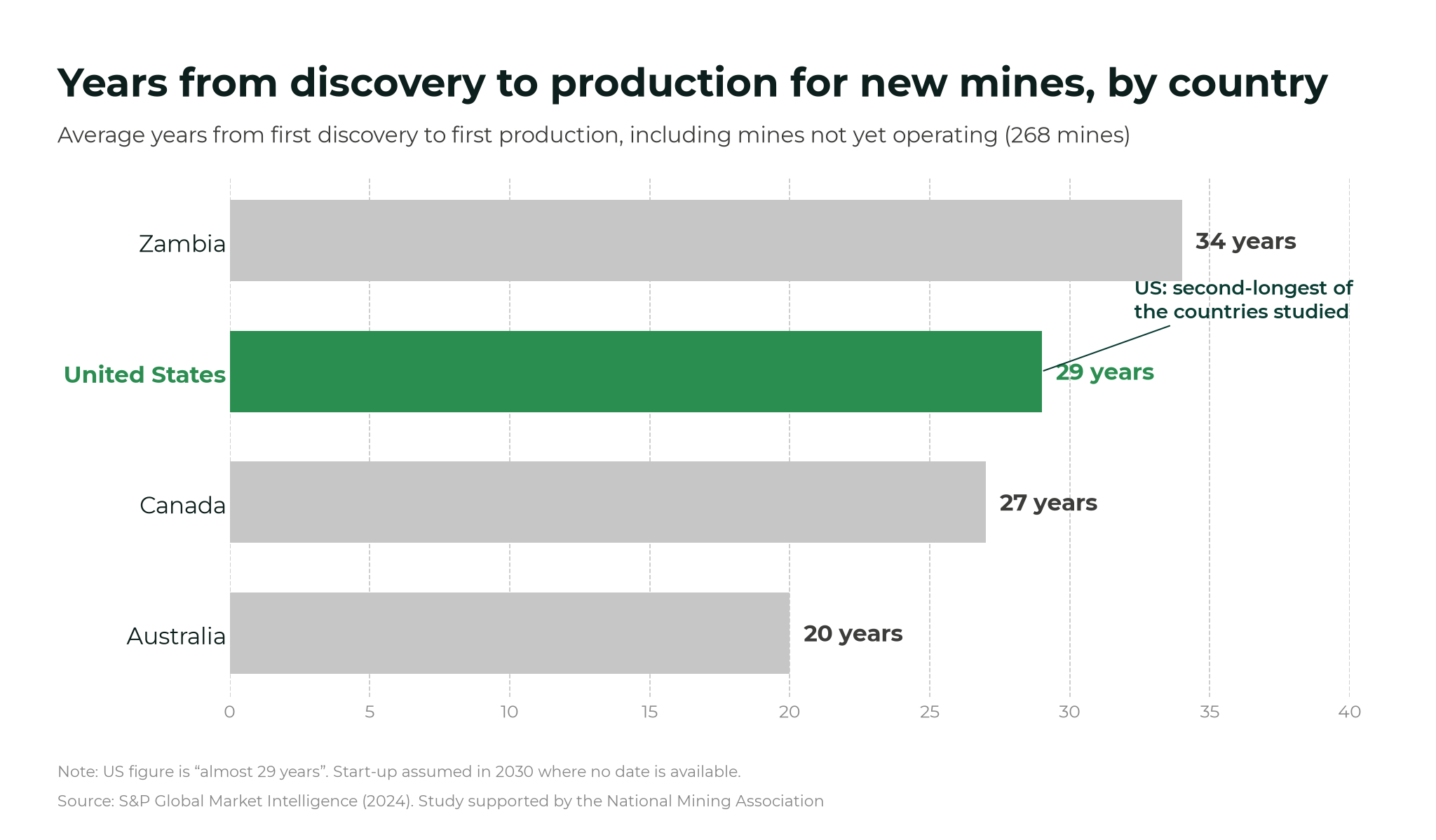
US mines can take an average of 29 years from discovery to production, longer than anywhere except Zambia (34 years) and ahead of Canada (27 years).
That figure covers exploration and financing as well as permits, though the Permitting Council has described it as 29 years to permit a mine before Trump.
What the Senate and House bills change for mines
The Senate bill, the Bipartisan American Affordability and Jobs Act, was written by Democrats Martin Heinrich and Sheldon Whitehouse with Republicans Mike Lee and Shelley Moore Capito— and it would amend the National Environmental Policy Act (NEPA), which governs federal environmental reviews.
For mines, the act would:
- add consequences for agencies that miss the two-year deadline for environmental impact statements and the one-year deadline for shorter environmental assessments, limits that current law already sets
- give challengers 150 days to sue, send cases to appeals courts, and stop judges from cancelling an approval outright
- let miners stake as many five-acre “mill sites” as they need for waste rock and tailings, closing the gap left by the 2022 court ruling against the Rosemont copper mine in Arizona
- use those mill-site fees for a new Abandoned Hardrock Mine Fund to clean up old mines
- stop agencies from revoking permits issued from 16 September 2026 except in narrow cases
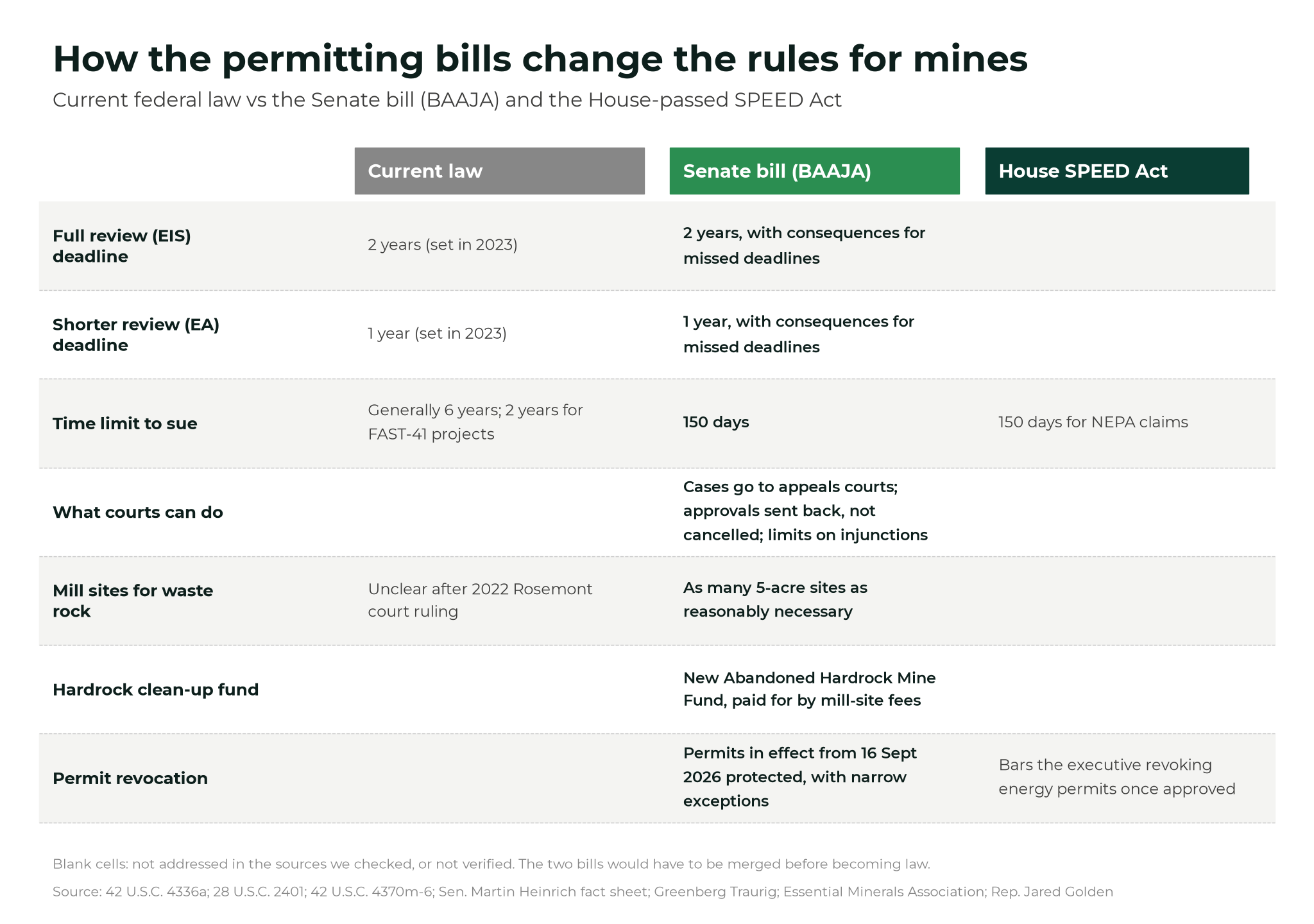
The House passed its own NEPA bill, the SPEED Act, 221–196 in December 2025, with 11 Democrats in favour. It also limits legal challenges and narrows when NEPA applies, and the two would have to be merged.
Democrats agree on the goal, not the trade-off
Democrats broadly want more US critical minerals supply and less dependence on China, but disagree on how much environmental law to trade for faster approvals.
Much of their minerals legislation is bipartisan, for example:
- Nevada senator Catherine Cortez Masto co-sponsors the SECURE Minerals Act, which would create a US$2.5 billion strategic reserve, led by Democrat Jeanne Shaheen and Republican Todd Young
- while fellow Nevada Democrat Jacky Rosen has backed a bill to create a National Critical Minerals Council, saying the US “needs an efficient and effective plan to secure these important resources”
On permitting, Democrats also want protection for wind, solar and transmission from an administration that has stalled their permits, and the Senate bill would stop any administration blocking a whole class of energy project. Heinrich makes the case for speed.
“It should not take decades to build the infrastructure our country needs.”
Martin Heinrich, top Democrat on the Senate Energy and Natural Resources Committee
Some House Democrats agree, including Scott Peters of California, who says the Senate bill “ought to be voted on this Congress”.
The case for waiting rests on leverage, and Jared Huffman, the top Democrat on the House Natural Resources Committee, made it before polling day.
“November 3rd is coming and we are likely to soon have a far better negotiating position. Folding our hand now or in the lame duck makes no sense”
Jared Huffman, ranking member, House Natural Resources Committee
Others doubt the administration would honour a deal. Four senators — Tammy Duckworth, Ed Markey, Jeff Merkley and Ron Wyden — have threatened to oppose the November 9 vote unless cancelled clean-energy grants are restored.
“The Trump administration’s record gives us no basis to assume that he will”
Duckworth, Markey, Merkley and Wyden, letter to the bill’s sponsors
Even Whitehouse, a co-author, wants proof: “We await real signs of regulatory good faith,” he posted on social media on October 29.
Where environmental groups stand
More than 100 environmental justice groups have urged Heinrich and Whitehouse to reject the bill, and Earthjustice’s Abigail Dillen objects to its permit protections.
“Over the next two years, BAAJA would create more legal runway for this president to make corrupt deals and greenlight harmful projects of all kinds, and it would constrain any future president from repairing the damage.”
Abigail Dillen, president, Earthjustice
Mining groups want it passed this session, with the Essential Minerals Association says it fixes “real problems our members face”.
What happens to Trump’s fast-tracking
Most of the speed-up in mining permitting so far is due to executive action; for example, the Permitting Council says 50 mining projects now have FAST-41 coverage, 49 of them added under Trump.
The industry welcomes the moves but wants a law as Rich Nolan of the National Mining Association says FAST-41 projects now get “far more coordination and support”.
“That’s very encouraging but there’s no question we need congressional action on permitting to affect the kind of sweeping change that’s required for this moment.”
Rich Nolan, president and CEO, National Mining Association
What the executive cannot provide is durability: without a law, a future president can revoke a fast-tracked permit, and challengers to projects outside FAST-41 generally have up to six years to sue.
Some of the named projects include:
- Resolution Copper (Arizona): the joint venture of Rio Tinto (55%) and BHP (45%) completed its land exchange in March and is now in state-level permitting, while Representative Adelita Grijalva has filed a bill to reverse the transfer
- Twin Metals (Minnesota): Congress reopened the land to leasing, but federal leases still have to be restored and Minnesota has halted state review
- Stibnite (Idaho): permitted in January 2025 and largely upheld in court in August, but legal challenges are pending
- Ambler (Alaska): the Arctic project’s FAST-41 schedule targets a final federal decision in September 2028
The 9 November vote
There are three main ways this fallout of the US midterms 2026 will likely go:
- passes in the lame duck: the Senate clears 60 votes and the two chambers merge their bills before the new Congress meets on 3 January, while competing for floor time with the 11 December government funding deadline
- waits for January: Democrats follow Huffman and rewrite the bill with stronger clean-energy protections, which delays new rules for mines, though a Democratic draft that wins Republican votes and Trump’s signature could prove more durable
- dies altogether: the next Congress cannot agree and mines rely on executive fast-tracking that the next president can reverse
What changes
Trump’s minerals deals will very likely face more scrutiny.
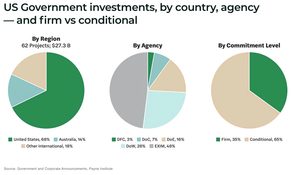
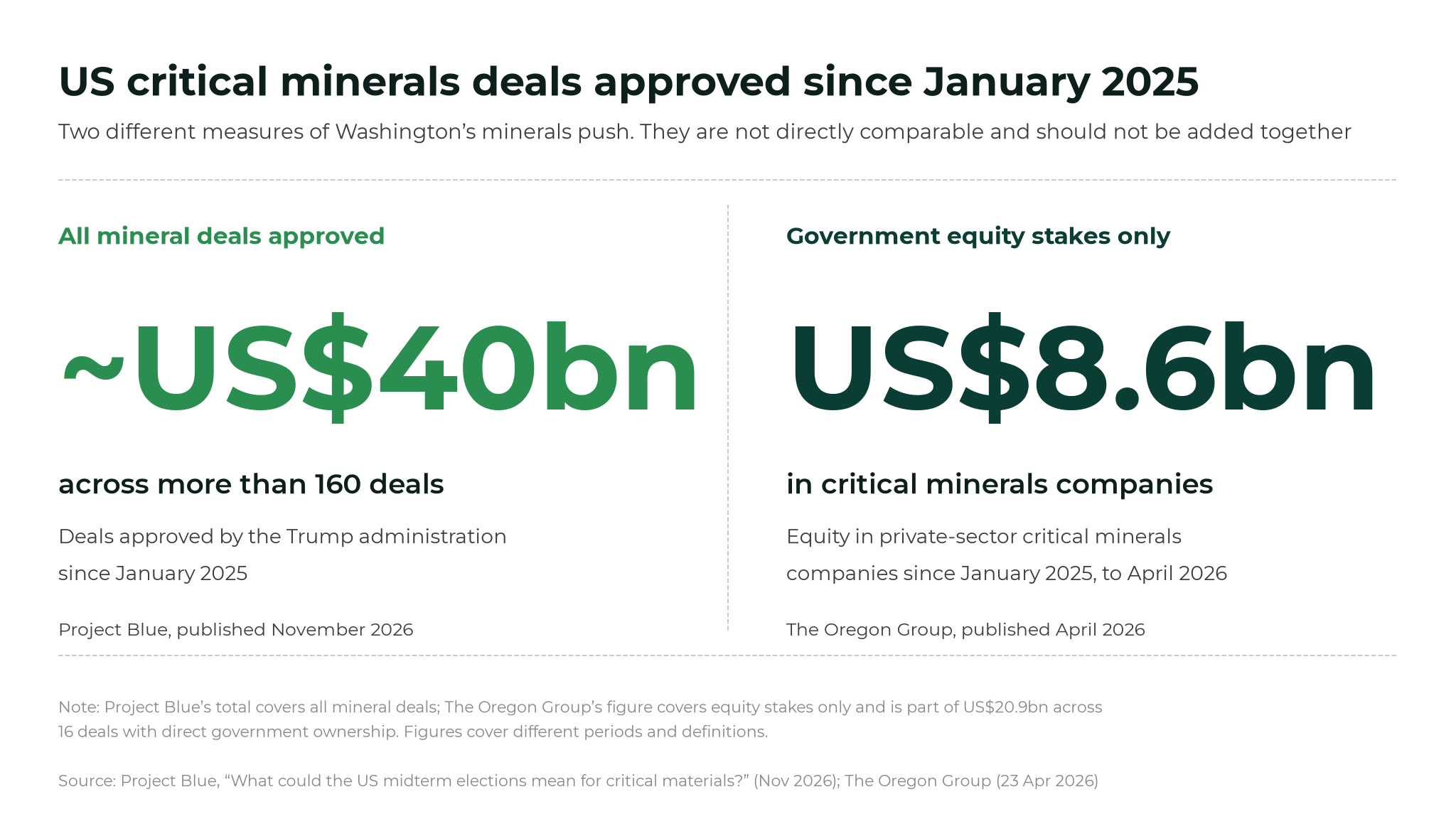
Washington has taken US$8.6 billion of stakes in critical minerals companies since January 2025, and Project Blue counts more than 160 mineral deals worth roughly US$40 billion approved in that time.
In August, 54 House Democrats warned that the loans and equity investments behind the deals “shift risk onto US taxpayers while encouraging companies to take on riskier projects”.
Democrats have pledged hearings and subpoenas over the equity stakes, and Huffman told S&P Global in September that “all of this is a priority”. Once the Senate result was clear, Senator Ron Wyden posted a single word on X: “Subpoenas.”
Project Blue, writing before the vote, set out the cost to companies:
“These investigations pose significant financial risks for critical materials firms, which would incur substantial legal fees in defending themselves. Therefore, a Democratic majority in even one House has the potential to stifle the trend of surging investment in domestic critical materials firms due to the increased risk of costly investigations.”
Project Blue, “What could the US midterm elections mean for critical materials?”
Project Vault, the stockpile, has cross-party support, with Democratic senator Jeanne Shaheen welcomed it. Copper tariffs stay the president’s call, though Saxo Bank’s Ole Hansen said the result reduces the likelihood of tariffs on refined copper.
The case against a big shift
Democrats also cannot repeal Trump’s mining actions on their own. The Congressional Review Act, which Republicans used to end the Boundary Waters mining ban near Twin Metals, needs a president’s signature, and the Oak Flat transfer was completed in March, so Grijalva’s bill would need to become law to undo it.
Federal mining policy also tends to outlast elections; for example, in 2024 we argued that Trump’s win signalled “a redirection, not a reversal” of US minerals policy, and the same applies now, since Democrats’ own minerals bills, such as the SECURE Minerals Act and the Critical Minerals Council bill, are bipartisan.
The election moved the question from whether America builds mines to who writes the rules. Democrats now have to choose between a permitting law they can pass this month and a better one they may not get.