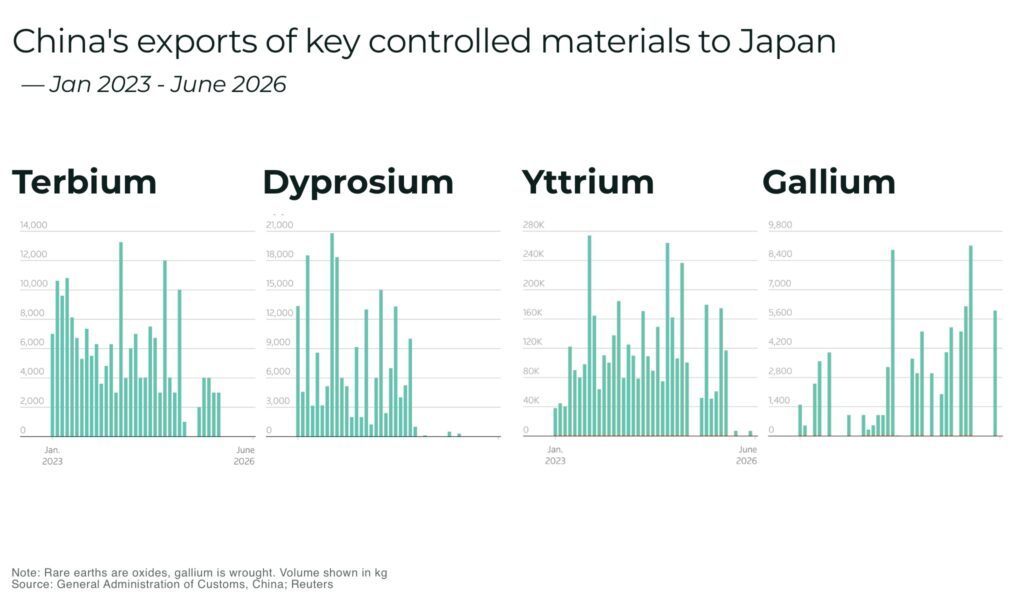
Japan is months from running out of yttrium, a rare earth used in jet engines and chipmaking, and has asked the US to press China to ease export controls, according to an October 20 Financial Times report
yttrium oxide costs about US$1,150/kg outside China, 179 times its price two years ago, against about US$9/kg inside China, according to Argus data cited by the FT
Tokyo has asked the US government and major companies to help persuade Beijing to loosen the restrictions, the newspaper reported, citing people familiar with the matter in Washington and Tokyo — an unnamed Japanese government official put the problem bluntly:
“Stockpiles are decreasing and rare earth saving efforts have a limit. The timeline is not years, it’s months and how to survive next year.”
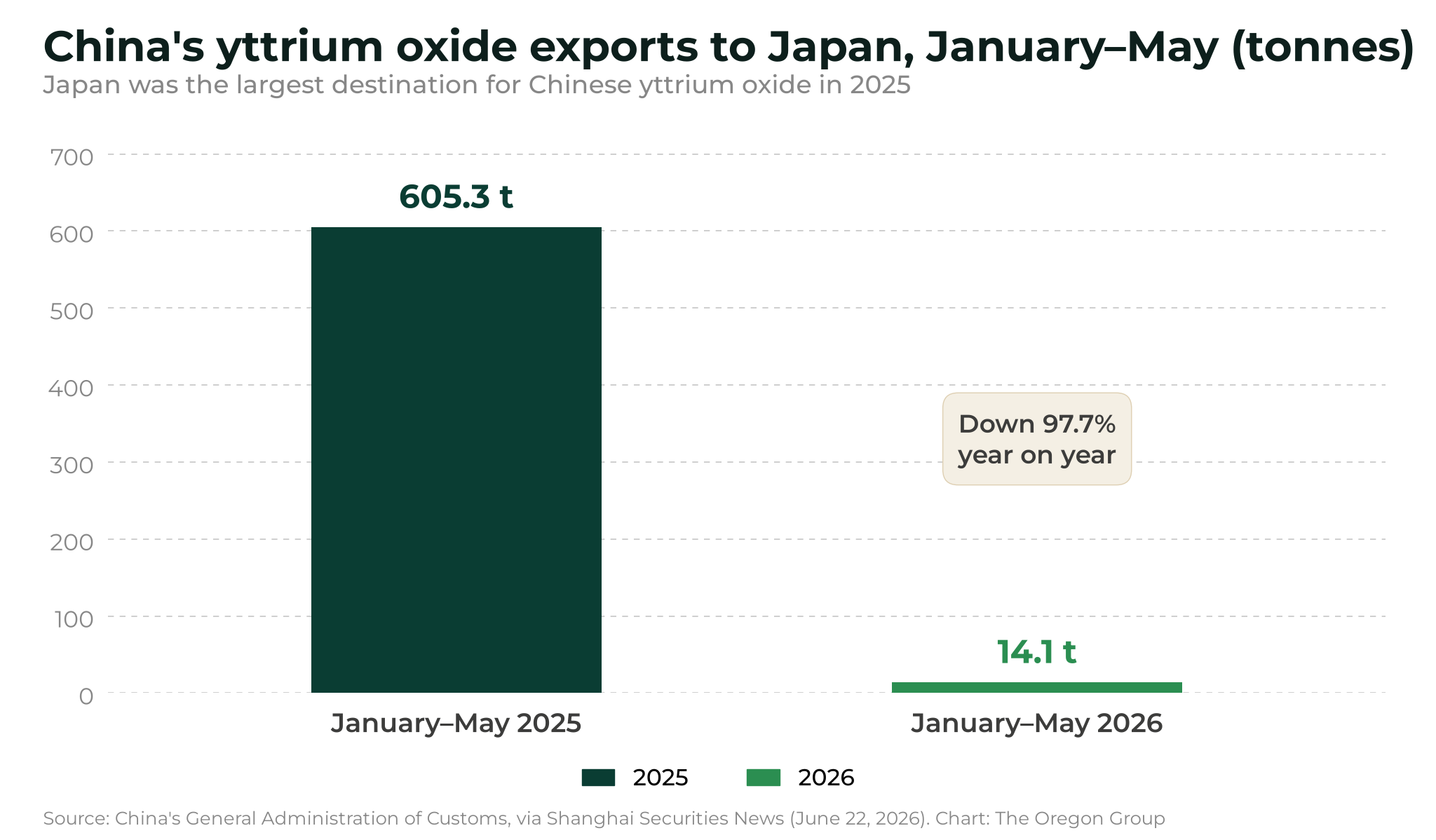
The same official warned that “if everyone ignores the problem, then it will be a systemic risk to the world economy”, as China’s yttrium oxide exports to Japan fell 97.7% in January-May 2026.
How Japan was cut off
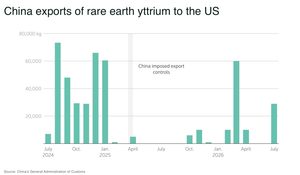
China put yttrium under licence in April 2025, as one of seven medium and heavy rare earths that exporters must now get permits to ship.
In February, China added 20 Japanese entities to its export control list, including Mitsubishi Heavy Industries Aero Engines and several IHI aerospace units.
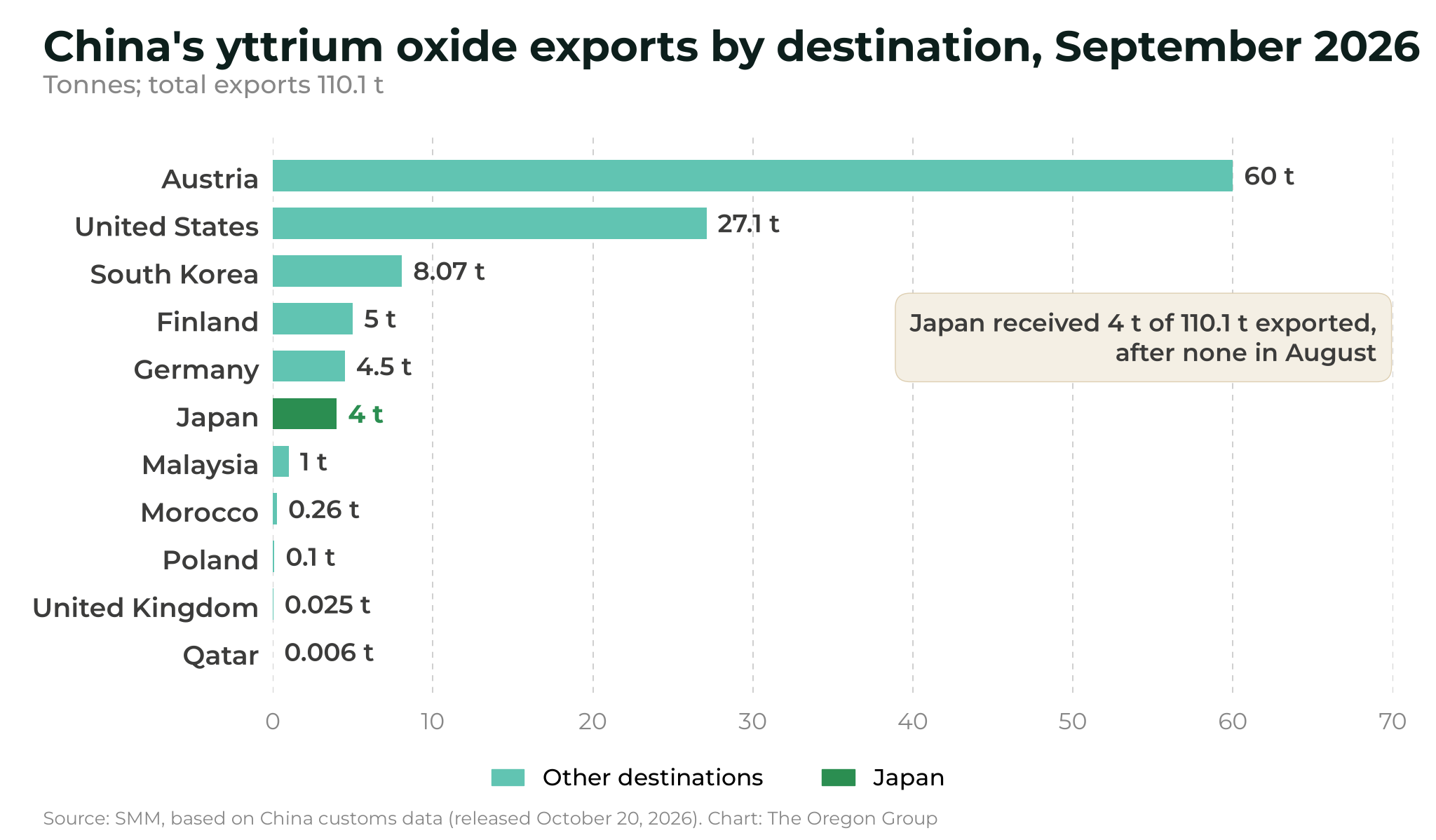
Japan was the largest buyer of Chinese yttrium in 2025, according to the US Geological Survey, which estimates China exported about 1,600 tonnes of yttrium compounds and metal last year, but China sent Japan no yttrium oxide at all in August and, in September, Japan received just 4 tonnes of the 110 tonnes China exported. Austria, the US, South Korea, Finland and Germany all got more.
Japan received 4 tonnes of the 110.1 tonnes of yttrium oxide China exported in September 2026. Source: SMM, based on China customs data
Japanese manufacturers are already impacted by the disruption, dor example:
67.6% of respondents in a June survey of 400 procurement managers and executives at manufacturers said yttrium was hard to obtain, and 17.5% reported production stoppages linked to rare earth shortages
Tosoh told Chinese dental-materials maker Aidite it was suspending supplies of zirconia powder, according to Aidite; yttrium oxide is a key input for the powder
yttrium oxide prices outside China had already reached nearly US$1,100/kg by May, as we reported in June
Japan’s rare earth seabed mud near Minamitorishima is further off still. A month-long trial is planned for February 2027, with an economic assessment due by March 2028, as we reported in July.
This is rationing, not an embargo
China is still licensing some yttrium. It shipped 110 tonnes in September, mostly to Europe, the US and South Korea, and Japan got a small amount — Japan’s own import data also show some Chinese-origin yttrium still arriving, but at much higher prices and lower volumes.
The trend of China’s use of export restrictions, especially over metals and minerals, to gain geopolitical and trade leverage is clear. The question is whether it is a short-term — or long-term — crisis.
Subscribe for Investment Insights. Stay Ahead.
Investment market and industry insights delivered to you in real-time.
The Oregon Group maintains full editorial control over all content published on this website. While sponsored and advertised placements may be featured, the content remains the sole opinion of The Oregon Group. The author may receive compensation or remuneration for providing content, but all statements and expressions are made independently and are not influenced by sponsors or advertisers. From time to time, The Oregon Group and its directors, officers, partners, employees, authors, or members of their families, as well as persons who are interviewed for articles on this website, may have a long or short position in securities or commodities mentioned and may make purchases and/or sales of those securities or commodities in the open market or otherwise. By accessing and using this website, readers are cautioned to assume that each of the foregoing persons may have a financial interest in all companies and sectors mentioned on this website. Any projections, market outlooks or estimates herein are forward looking statements and are inherently unreliable., and any such statements are based upon certain assumptions and should not be construed to be indicative of the actual events that will occur. Other events that were not taken into account may occur and may significantly affect the returns or performance of the securities or commodities discussed herein. The information provided herein is based on matters as they exist as of the date of preparation and not as of any future date, and The Oregon Group undertakes no obligation to correct, update or revise the information in this document or to otherwise provide any additional material. The information provided on this website is for informational purposes only and is not, directly or indirectly, an offer, solicitation of an offer and/or a recommendation to buy or sell any security or commodity, and the information provided on this website should not be construed as any advice or an opinion as to the price at which the securities of any company or commodity may trade at any time. The Oregon Group is a publisher of financial information, not an investment advisor. We do not provide personalized or individualized investment advice or information that is tailored to the needs of any particular recipient, and the information provided on this website is not and should not be construed as personal, financial, investment or professional advice. Readers are cautioned to always do their own research and review of publicly available information and to consult their professional and registered advisors before purchasing or selling any securities or commodities and should not rely on the information contained herein. Neither The Oregon Group nor any of its affiliates accepts any liability whatsoever for any direct or consequential loss howsoever arising, directly or indirectly, from any use of the information contained herein. By using the Site or any affiliated social media account, you are indicating your consent and agreement to this disclaimer and our terms of use. Unauthorized reproduction of this newsletter or its contents by photocopy, facsimile or any other means is illegal and punishable by law.
Investment intelligence and in-depth reports on critical minerals, mining, energy and geopolitics — from capital-markets professionals with boardroom and institutional experience.