- Ontario has committed to eliminate or streamline 50 per cent of key permits and authorisations outside its One Project, One Process framework, a change the government says would cut about 31,000 to 47,000 calendar days a year from permitting timelines
- mining leases that sit idle would not be renewed under a “use it or lose it” rule the government intends to put in legislation; fewer than half of leases now have exploration plans or permits, and only 15 per cent of land with high mineral potential is open to new staking, according to Energy and Mines Minister Stephen Lecce
- the package was announced on November 24 and has not yet been tabled; Lecce said the bill would come next week
Ontario plans to speed up approvals for new mines and take back mining leases that sit unused, under a package of reforms announced on November 24.
The centrepiece is a commitment to eliminate or streamline 50% of the key permits and authorisations a company needs to take a mine from discovery to production. The government says this would cut application timelines by about 31,000 to 47,000 days a year across the sector, though it has not yet said which permits would go.
The aim is to bring faster approvals to the bulk of Ontario’s pipeline.
Since October 2025, the province’s One Project, One Process framework has given designated major mines a single, coordinated review that the government says halves review times — but only four projects have qualified so far: Frontier Lithium’s PAK deposit north of Red Lake, Kinross Gold’s Great Bear near Red Lake, Canada Nickel’s Crawford near Timmins and Mayfair Gold’s Fenn-Gib east of Timmins. The government says those four could support nearly 5,500 jobs and add an estimated C$78 billion to the provincial economy.
Everyone else has been waiting their turn, and now Energy and Mines Minister Stephen Lecce says the industry’s main question was what the government would do “for the 98% of projects not captured by the 1P1P”, according to The Northern Miner.
The second measure targets land, so under a “use it or lose it” rule, mining leases that sit idle would not be renewed, freeing Crown land for companies ready to explore. The government says fewer than half of leases have exploration plans or permits.
Lecce said the legislation would be introduced next week. As of November 26, no such bill had been tabled at Queen’s Park.
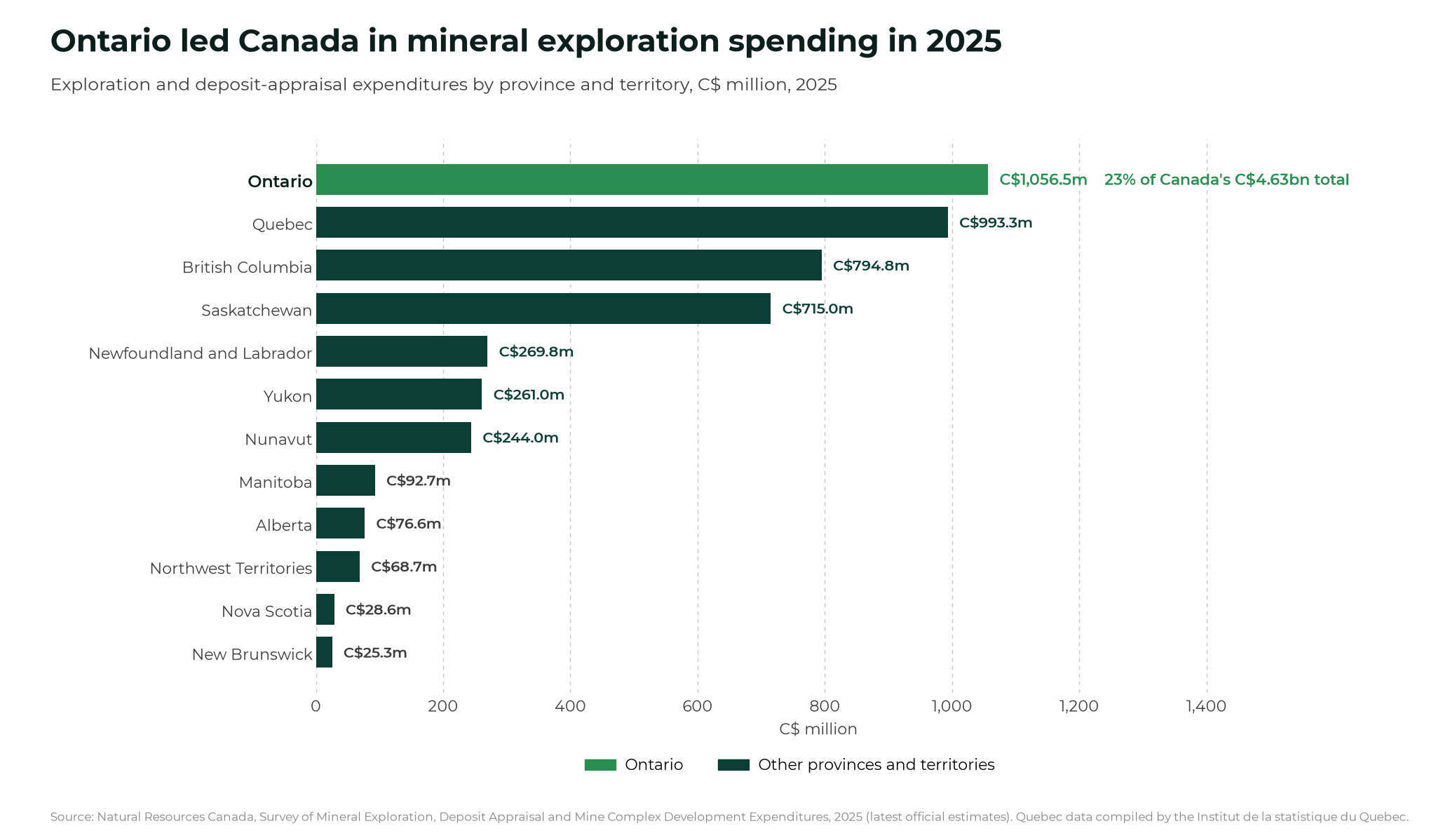
Ontario already leads the country in mineral exploration spending.
Natural Resources Canada estimates the province spent C$1.06 billion on exploration and deposit appraisal in 2025, or 23 per cent of the Canadian total of C$4.63 billion, ahead of Quebec, British Columbia and Saskatchewan. Spending was a little lower than Ontario’s C$1.09 billion in 2024, but enough to keep the province in first place. The provincial news release rounded the 2025 figure to C$1.1 billion, or roughly 25 per cent. Citing the Fraser Institute’s Annual Survey of Mining Companies, the government says Ontario rose from 15th in the world in 2024 to second in 2025, and first in Canada.
The latest announcement comes as gold trades at about US$3,581 an ounce, after briefly falling below US$3,500 this week for the first time since September 2025, according to Reuters. Comex copper was around US$5.46 a pound on November 26, equivalent to about US$12,050 a tonne. Ottawa is also trying to draw capital into the sector, with a federal plan that targets C$1 trillion of investment through tax breaks and incentives, and a streamlined federal approval process for major mining and infrastructure projects.
Use it or lose it
The proposed legislation would let the Crown refuse to renew mining leases that sit idle, so the land can be opened to companies ready to explore. Lecce said fewer than half of existing leases have exploration plans or permits, and that only 15 per cent of land with high mineral potential is available for new staking. The government has not defined what counts as idle, or said whether exemptions would apply.
Garry Clark, director of the Ontario Prospectors Association, told CBC News that most mining leases last 21 years, and that the province can only go so far. “I think they can move the needle to a certain point,” Clark said. Companies often wait for prices to justify development, he added, but unused ground should be opened to others:
“If there’s properties out there that aren’t being adequately looked at, I think they should be freed back up and see if people are interested in taking a look at them,” he said.
What the bill does not settle
The package is an announcement, not yet a law, with Lecce stopping short of offering minimum-price guarantees, pointing instead to Ottawa’s work with G7 partners on a critical minerals buyers’ club. Whether the reforms speed up mines will depend on the bill the government tables, how it defines an idle lease, and whether the 98% of projects outside One Project, One Process actually see shorter reviews.
But the policy direction of travel is consistent: Canada is working to accelerate a North American critical mineral supply chain.