- fusion start-up Marathon Fusion said on October 21 it turned mercury into stable gold in September at 10 times CERN’s 2025 record, but has published no mass or cost
- its 2025 paper models about 2 tonnes of gold a year per gigawatt of thermal power; its reference plant needs 622 tonnes of mercury-198 and up to 17.7 years of cooling
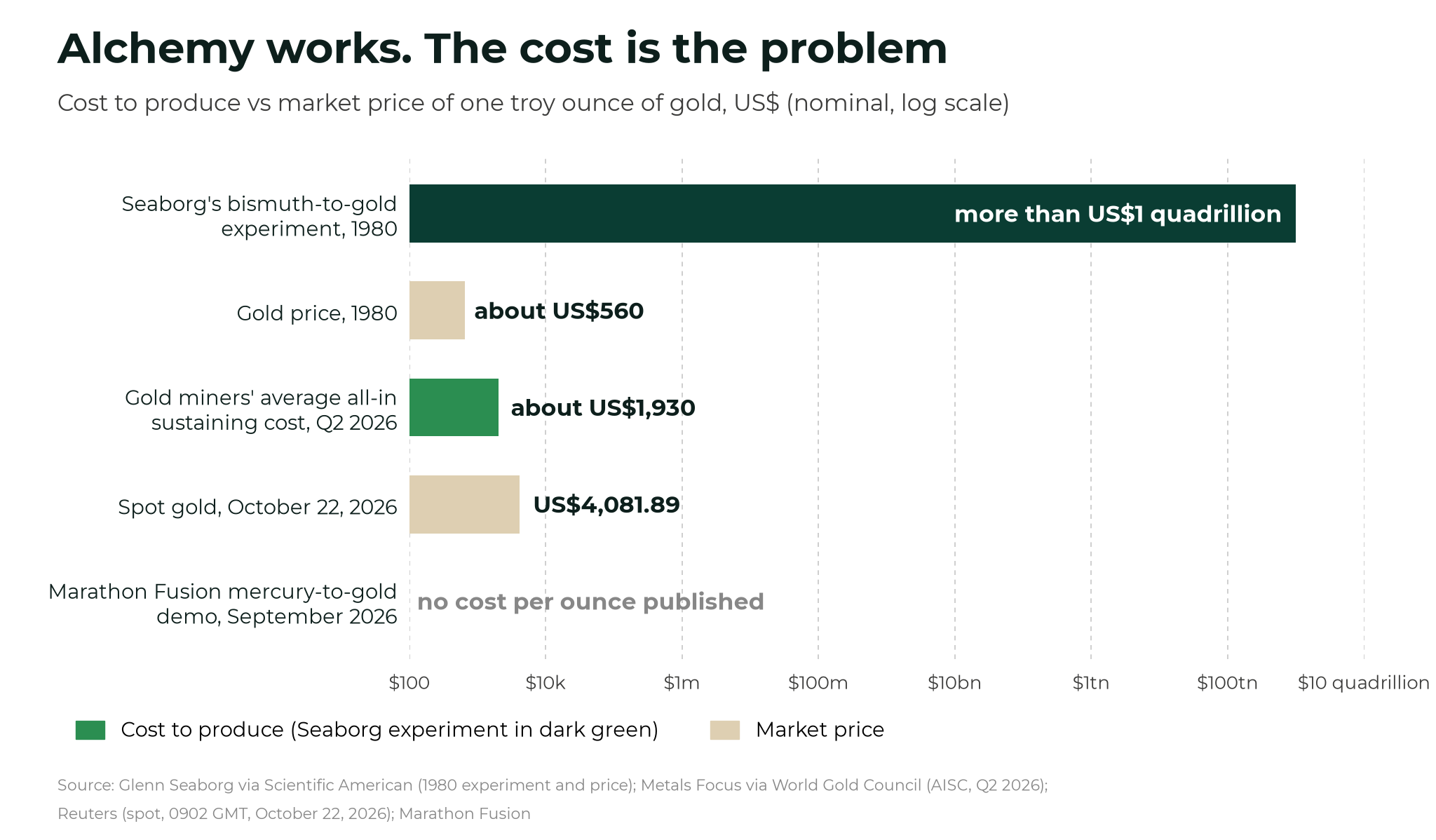
- spot gold traded at US$4,081.89 an ounce on October 22, against miners’ average all-in sustaining cost of about US$1,930
San Francisco start-up Marathon Fusion says it turned mercury into stable gold last month using fusion neutrons, at what it calls 10 times the record CERN set in 2025.
The alchemists finally have a press release. They still don’t have a price.
“Last month, we demonstrated high-rate alchemy: turning mercury into real, stable gold, beating CERN’s record by a factor of 10,” the company posted on X on October 21.
The thread drew more than 2.4 million views in under a day. It did not say how much gold was made, or what it cost.
What Marathon actually showed
The evidence so far is a single gamma-ray spectrum posted in the thread, that labels mercury-197 and gold-197 signatures measured between 8 and 44 hours after irradiation which is consistent with the reaction Marathon proposed in 2025. But the plots do not establish the quantity of gold, its purity or whether the process can scale.
The thread has reportedly “offered no experimental data”, and the claim “has not been independently verified in public reporting.”
Marathon says it has “reduced alchemy to a series of difficult but tractable engineering problems.”
What ‘10 times CERN’ means
The bar is very low.
CERN’s ALICE experiment reported in May 2025 that near-miss lead collisions at the Large Hadron Collider made about 86 billion gold nuclei during 2015-2018, which is 29 picograms, or 2.9 × 10⁻¹¹ grams. The collider peaked at about 89,000 gold nuclei a second.
Marathon’s “high-rate” wording suggests its 10-fold claim compares rates, but the company has not yet clarified.
To make one gram that way, the LHC would have to run for “around 100 billion years”, ALICE deputy spokesperson Kai Schweda told LHC Deutschland.
In other words, beating CERN by a factor of 10 still leaves fusion gold a very long way from a bullion bar.
How fusion gold is supposed to work
Marathon’s 2025 paper proposes lining a fusion reactor’s blanket with mercury-198.
The physics is (acutally) quite simple: a fast 14 MeV neutron from deuterium-tritium fusion hits a mercury-198 nucleus, and two neutrons come out. One in, two out, as the nucleus loses one neutron and becomes mercury-197.
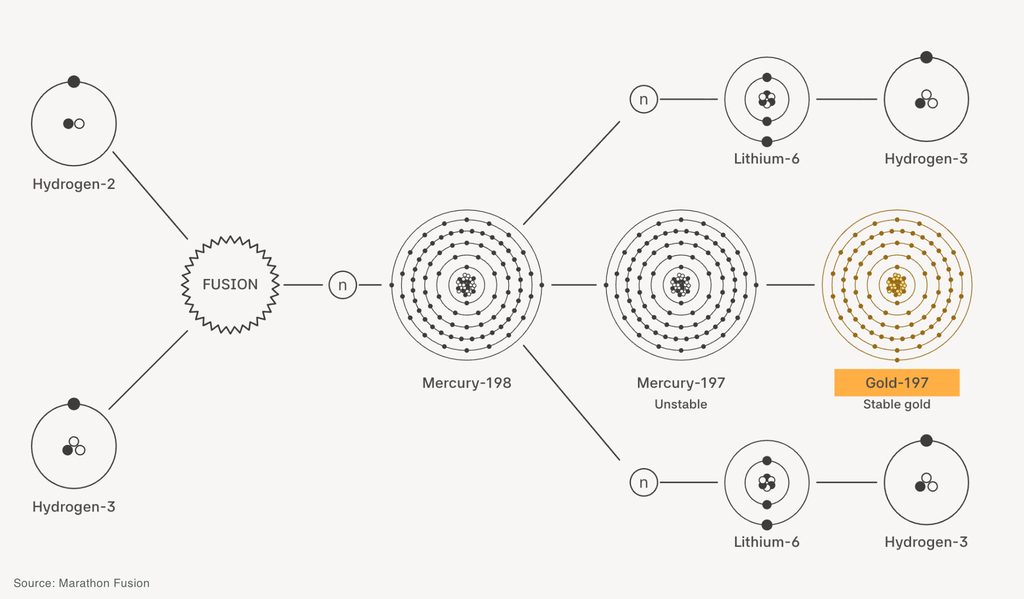
Mercury-197 is unstable, with a half-life of about 64 hours. It decays by electron capture: a proton grabs one of the atom’s own electrons and becomes a neutron. That leaves 79 protons, which makes it gold-197, the only stable gold isotope.
The neutrons also multiply, helping the plant breed its own tritium fuel — and that is the trick: gold becomes a by-product of a reactor that has to exist anyway.
In simulations, a 1.5 GW (thermal) tokamak made 2,953 kg of gold a year, which the company markets as 5,000 kg a year per gigawatt of electricity.
Marathon’s alchemy page says gold would lift a gigawatt-scale plant’s revenue from US$223 million a year to US$482 million.
The costs nobody has priced yet
No one, including Marathon, has yet published a production cost per ounce for fusion gold — the paper models revenue, not cost.
Its plant case assumes a US$3 billion, 1,500 MW (thermal) reactor selling gold at US$100,000/kg. But the bill comes from several directions, for example:
- feedstock: mercury-198 is only 9.97% of natural mercury, and the reference design needs 622 tonnes of it; today enriched mercury-198 is sold in research quantities, priced on quote
- enrichment: it must be enriched to about 90%, “a technically demanding process”, said Karl Lackner, emeritus director at the Max Planck Institute for Plasma Physics; Marathon’s paper estimates the energy cost of one separation stage at about US$2.4/kg of mercury-198, but concedes that “details of scalable mercury isotope separation need to be fully defined”
- radioactivity: traces of mercury-196 produce radioactive gold-195, so the gold needs about 6.8 years to fall into the least hazardous class of low-level waste, 13.7 years before it no longer needs labelling as radioactive, and 17.7 years to be “less radioactive than a banana”, according to the paper
- the reactor: no commercial fusion plant yet exists, and the World Nuclear Association lists the earliest grid targets as Helion’s Orion (start-up 2028, full power 2029-30) and Commonwealth Fusion’s ARC (early 2030s), with ITER not running deuterium-tritium until 2039
“Even using all the mercury in the Earth’s crust would yield only about 600 tonnes of gold a year” — Karl Lackner, emeritus director at the Max Planck Institute for Plasma Physics
Marathon co-founder Adam Rutkowski told the FT in 2025 the gold may have to be stored for 14 to 18 years before it is “completely safe”. Lackner puts it at “at least 18 years” before it can be worn as jewellery.
Lackner also said mercury-based blankets “probably wouldn’t be done in the first generation of fusion reactors.”
And Marathon’s own reactor is far smaller, with its website lists a fusion power of 1 kW for the high-power-density reactor it is building in San Francisco.
Alchemy has always cost more than gold
This is not the first time transmutation has worked and lost money, for example:
- 1941: Harvard physicists bombarded mercury with fast neutrons and made gold, but only radioactive isotopes that decayed within days
- 1980: Glenn Seaborg’s Berkeley team turned bismuth into gold, at “more than one quadrillion dollars per ounce”, he said, when gold sold for about US$560, according to Scientific American
- 2015-2018: CERN’s lead-to-gold run made 29 picograms that fragmented in a fraction of a second
“The problem is the rate of production is very, very small and the energy, money, etcetera expended will always far exceed the output of gold atoms,” David Morrissey, a member of the Berkeley team, told Scientific American in 2014.
Marathon’s claim is that fusion changes the rate, but until it publishes a cost, that remains a hypothesis.
What it means for the gold price
The news is unlikely to have much of an impact on the gold price, for now.
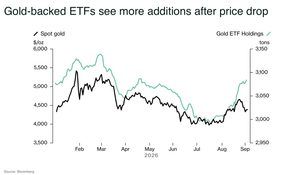
Spot gold slid 1.4% to US$4,081.89 an ounce by 0902 GMT on October 22, its lowest in more than two weeks, Reuters reported — but interest rates, geopolitics, inflation, etc have a much more tangible impact on those moves.
And, meanwhile, gold miners’ average all-in sustaining cost was about US$1,930/oz in the second quarter, according to World Gold Council data from Metals Focus. In the first quarter, their average margin hit a record US$3,076/oz.
That is the benchmark fusion gold has to beat, and it has no number to put against it.
Meanwhile, mine supply reached a record 3,672 tonnes in 2025, and the World Gold Council puts above-ground stocks at about 222,600 tonnes, worth US$29 trillion at end-June prices.
Marathon’s paper concedes the scale gap. At 2 tonnes per gigawatt (thermal), the world would need 1.65 TW of fusion capacity before fusion gold matched 2024 mine output.
Lackner is blunter. Even using all the mercury in the Earth’s crust would yield only about 600 tonnes of gold a year, he said: “Gold would therefore not become worthless, contrary to some media claims.”
Notably, his estimate for the near term is about 20 tonnes a year, made from the 20,000 tonnes of mercury currently stored as waste.
The WGC’s model suggests every ~25 tonnes of extra supply moves the price by about 1%.
Scarce things don’t stay scarce
History is full of materials that were precious until someone found a cheaper way to make them, for example:
- aluminium: in 1855 it was valued at US$115 a pound, “more expensive than gold”, and Napoleon III showed off aluminium cutlery at state banquets, according to the American Chemical Society; after Charles Hall and Paul Héroult found an electrolytic process in 1886, ingot prices fell from US$4.86 a pound in 1888 to 78 cents by 1893
- fertiliser: the world fought wars over Peruvian guano and Chilean nitrate until the Haber-Bosch process came online in 1913, after which “the Chilean nitrate industry was no match”, according to the Science History Institute, when nitrate prices fell by two-thirds between 1913 and 1937
- diamonds: lab-grown wholesale prices fell 13% year on year in the second quarter of 2026, leaving analyst Edahn Golan’s wholesale index down 96% since 2018
- gold itself: in the 16th century, the discovery of South America’s gold “led to an enormous fall in the value of gold”
The difference is scale. Each of those shocks came from a cheap, fast process. Fusion gold, so far, is neither.
Gold as a fusion by-product
The more interesting idea is not cheap gold, but that gold might pay for fusion.
If Marathon’s numbers hold, gold more than doubles the value of a fusion plant’s output which could help finance plants that struggle to compete on power prices alone. But, the risk runs the other way too, with a by-product’s price set by the main market, so fusion gold would only help fusion while gold stays expensive.
As we argued in our earlier article, What has to break for gold to hit $10,000, the bull case rests on:
“a world that is gradually, then suddenly, more comfortable holding a bigger share of its wealth in an asset the system can’t print.”
Marathon is, in effect, proposing a very slow, expensive printing press. It just needs a reactor that doesn’t exist yet, 622 tonnes of mercury-198 and nearly 18 years in storage.
For now, the gold price has more to fear from the Federal Reserve than from the alchemists.