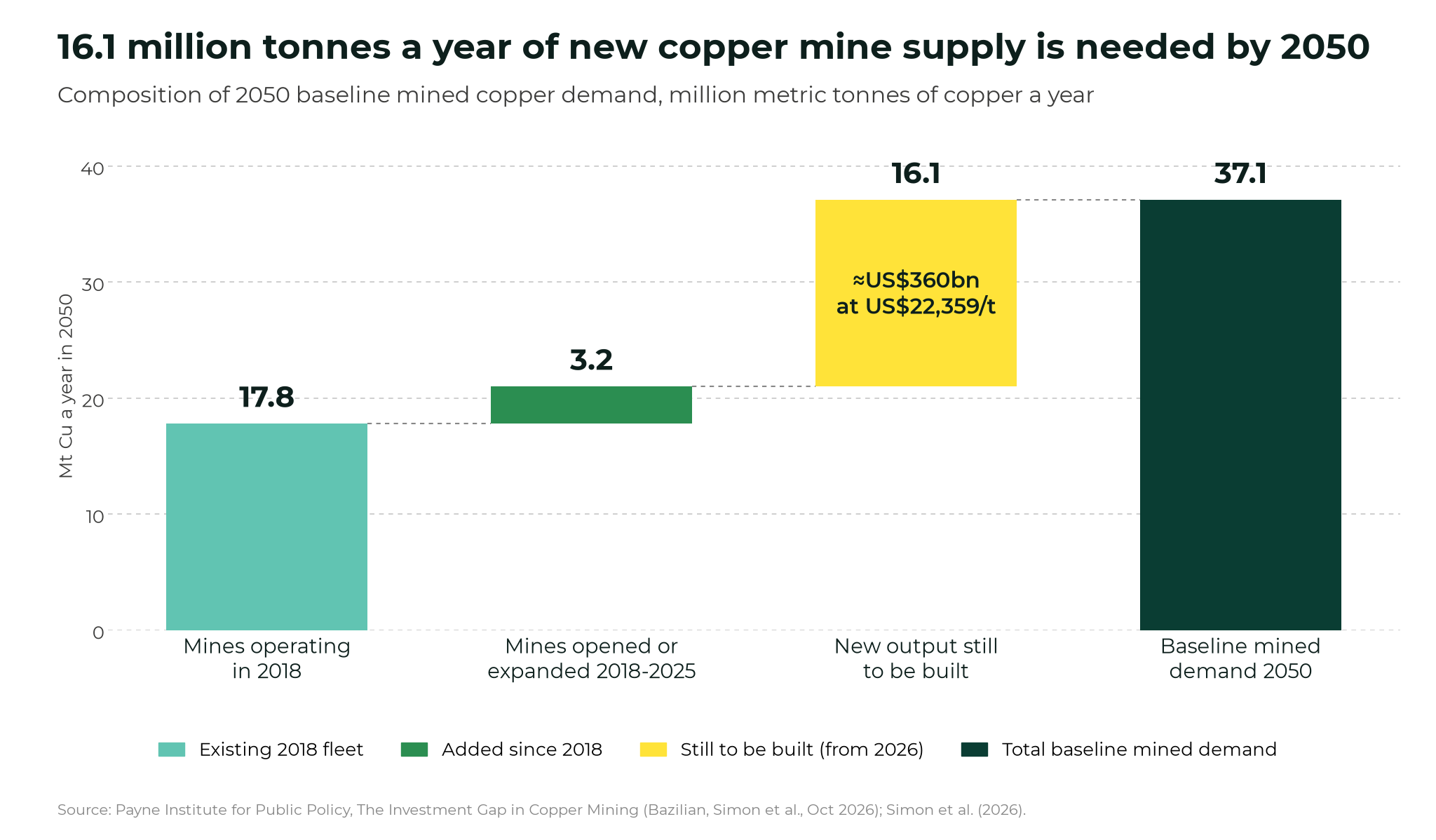
- the world will need to build 16.1 million tonnes a year of new copper mine output by 2050, at a cost of about US$360 billion, according to a Payne Institute paper published October 26
- at baseline demand, the estimate ranges from US$304 billion at the lowest benchmark project cost to about US$545 billion if real mine costs keep rising 3.4% to 3.6% a year
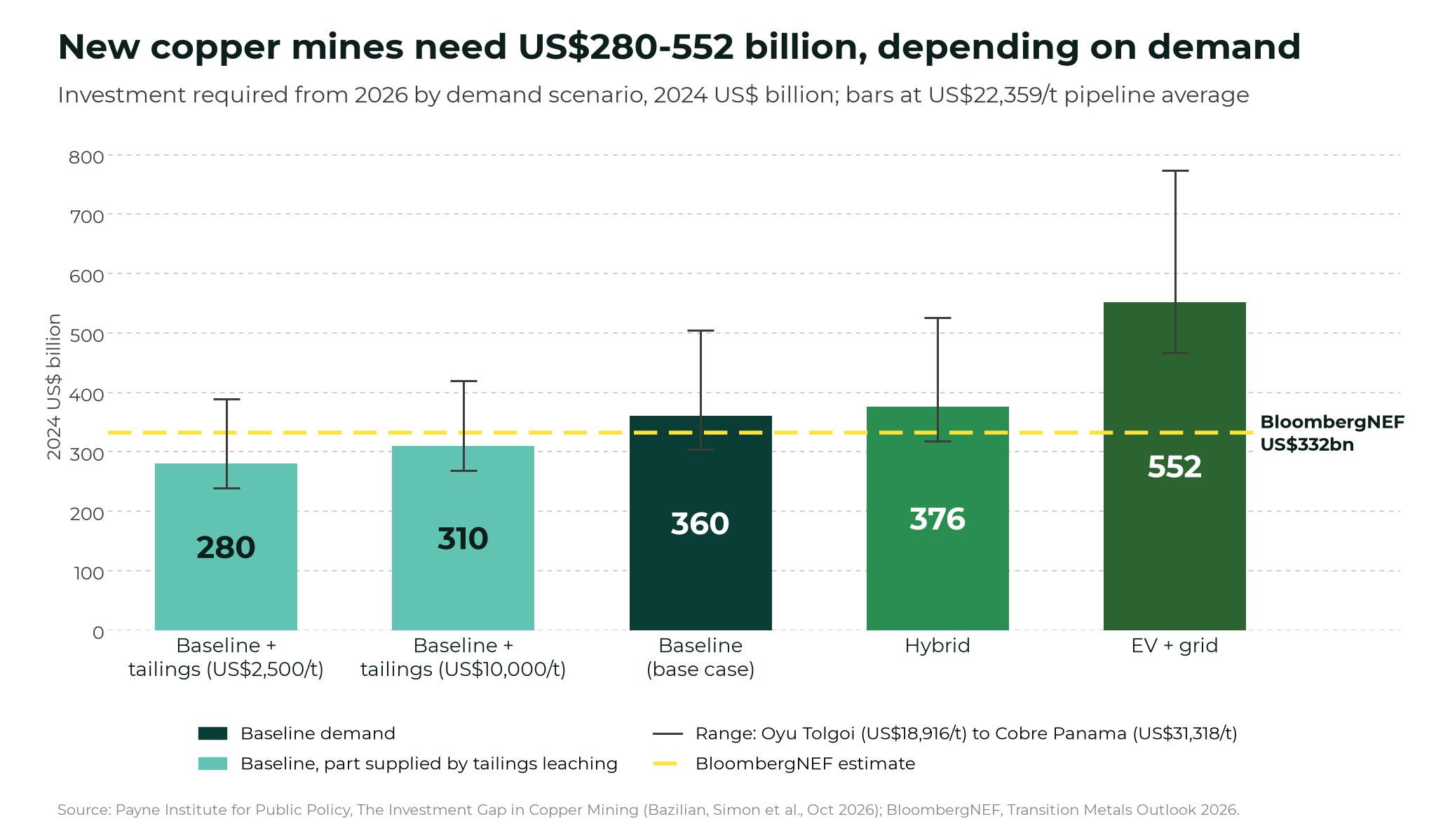
- that puts the bill above BloombergNEF’s US$332 billion estimate, which the authors say assumes mine costs 26% below the current project average
The world will need about US$360 billion of new copper mines by 2050 to meet demand, according to new research from the Payne Institute at the Colorado School of Mines.
At baseline demand, the paper puts the range at US$304 billion to about US$545 billion. The low end prices new mines at the cheapest benchmark project; the high end assumes real building costs keep rising at 3.4% to 3.6% a year.
The research comes six days after BloombergNEF put the cost of the new copper mines needed by 2050 at US$332 billion.
How big is the gap?
Demand for mined copper is projected to reach 37.1 million tonnes a year by 2050, but mines that were operating in 2018 will produce only 17.8 million tonnes of that by 2050 as they deplete and close. Mines opened or expanded since 2018 have added about 3.2 million tonnes a year, which leaves 16.1 million tonnes a year still to be built from 2026 onwards. That is more than two-thirds of the 23.5 million tonnes the world mined in 2025, based on WBMS data cited in the paper.
How much will it cost?
Priced at the US$22,359-a-tonne average of the 26 projects due to start by 2030, the 16.1 million tonnes costs about US$360 billion in 2024 dollars.
The bill also depends on how fast demand grows. Across the paper’s demand scenarios, it runs from US$280 billion, if leaching tailings and stockpiles supplies 4 million tonnes a year at US$2,500 a tonne, to US$552 billion under full vehicle electrification with grid expansion.
What BloombergNEF found
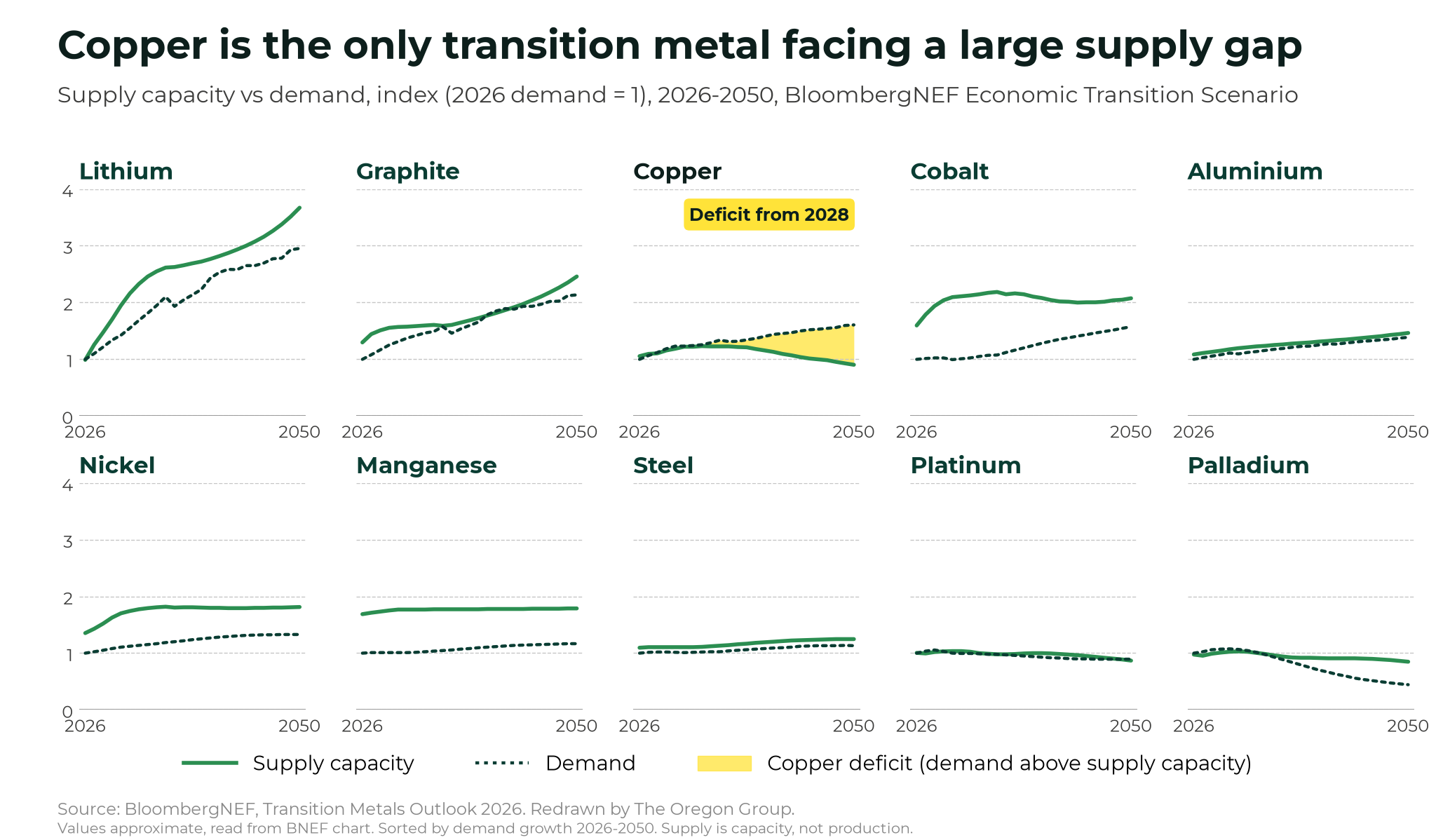
BloombergNEF’s Transition Metals Outlook 2026, published October 20, found that nine of the 10 materials it studies are on track to have sufficient supply capacity through 2050.
That is an improvement on last year’s outlook, when three materials were projected to face deficits.
Copper is the exception.
BNEF forecasts a copper supply deficit beginning in 2028 and widening to 20 million metric tonnes by 2050, equal to 44% of projected demand. Copper demand is expected to rise 61% between 2026 and 2050, to almost 46 million tonnes, with copper use in electrified transport alone up 244% to 11.4 million tonnes.
Closing that deficit could require US$332 billion of new mines — but even then, new mines take an average of 17 years to come into operation, so the shortfall could persist for decades.
Martin Tengler, head of metals and mining at BloombergNEF, said:
“The challenge now is less about whether the world can produce enough metals overall, and more about whether the right materials will be available when and where they are needed.”
Martin Tengler, head of metals and mining, BloombergNEF
The Payne authors say BNEF’s physical gap is close to theirs, but the difference is cost with BNEF’s totals imply about US$16,600 per tonne of capacity, 26% below the pipeline average and below Oyu Tolgoi, the cheapest benchmark project in the paper.
Why mines are getting more expensive
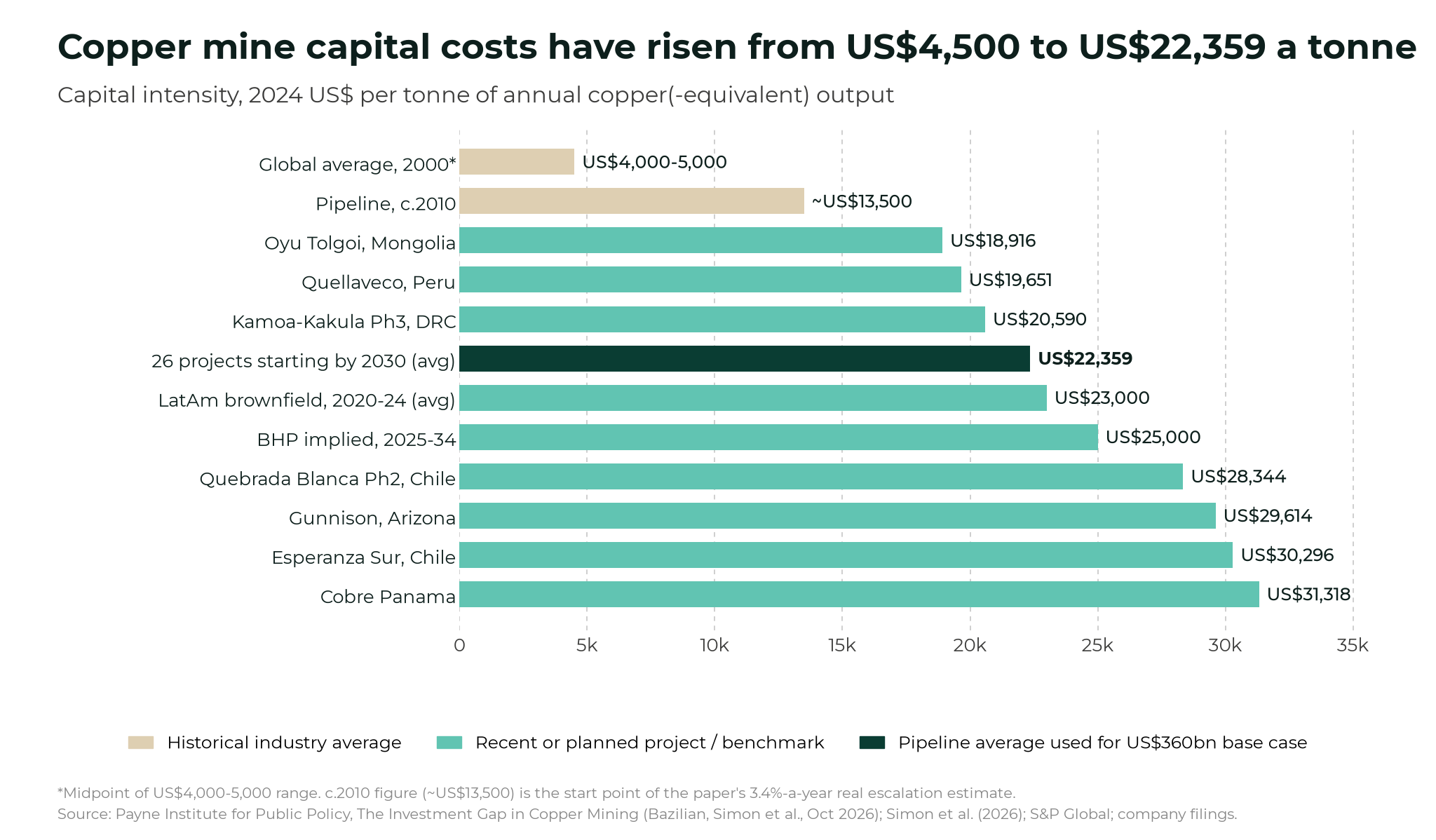
The cost comes from capital intensity, meaning how much it costs to build one tonne of annual production.
The 26 copper projects due to start by 2030 average US$22,359 per tonne of annual output, in 2024 dollars, with the global average in 2000 was US$4,000 to US$5,000.
Falling grades mean miners have to dig and process far more rock for every tonne of copper.
For example, in Chile, the world’s largest copper producer, the average grade of ore processed fell from 1.10% in 2002 to 0.58% in 2025. New supply is increasingly coming from deep underground block caves and high-altitude projects that need desalinated water pumped inland.
Cost overruns add to the bill, for example, Teck’s Quebrada Blanca Phase 2 in Chile was sanctioned at US$4.74 billion in 2018 and finished at US$8.6 billion to US$8.8 billion.
If real capital costs keep rising at 3.4% to 3.6% a year, as they have since 2010, the total cost could climb to US$545 billion.
Where the money would go
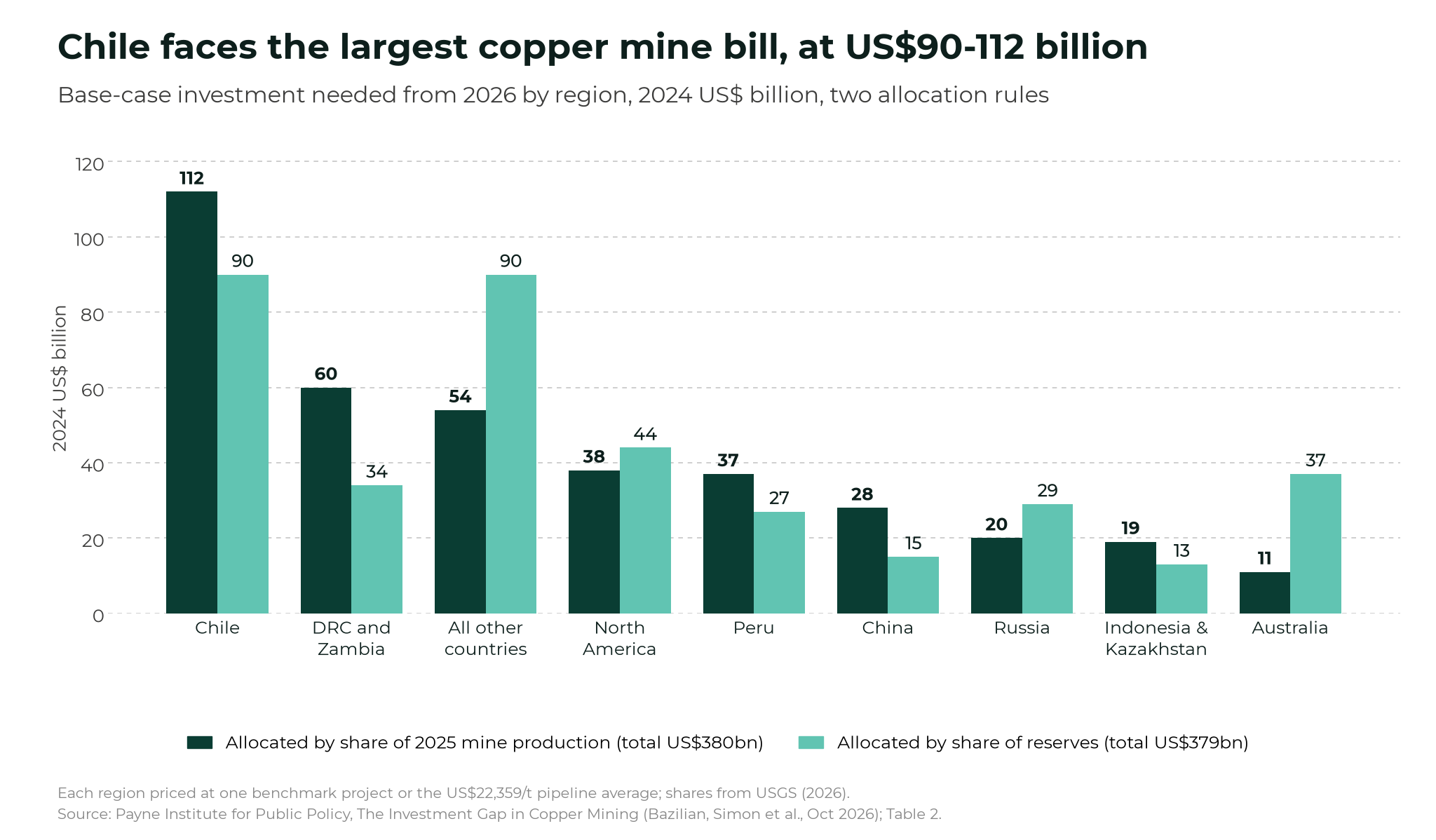
Chile has the largest single-country requirement, at US$90 billion to US$112 billion, because it combines the biggest production base with some of the highest building costs.
A large share of the remaining capital would fall in jurisdictions such as Argentina, Mongolia and Panama, where permitting and political risk are high.
Deposits alone are unlikely to fill the gap, with the 149 undeveloped deposits in their database average just 0.37% copper, against 0.50% for mines operating in 2018 — most of them have been known for decades without being built.
The case that the gap is manageable
Despite the significant headline cost figure, if spread over 2026 to 2050, the financial requirement works out at US$14 billion to US$18 billion a year, which is within what the industry has spent on copper projects in recent years.
Leaching copper from existing stockpiles could also cut the bill; for example, Freeport-McMoRan aims to add about 360,000 tonnes a year this way for roughly US$1 billion, against about US$10 billion for a new mine of similar size.
The near-term market also looks well supplied with the International Copper Study Group expecting a refined copper surplus of 104,000 tonnes this year, widening to 368,000 tonnes in 2027.
But that surplus sits on top of fragile mine supply: in the September quarter, BHP’s copper output fell 19% led by a 23% drop at Escondida, where BHP had planned for lower grades.
And because even a permitted project needs several years to reach first output, there is a risk that capital committed now could close little of the 2030 shortfall.
The constraint on copper is not necessarily financial, but the permits, community consent and prices needed to commit it in time.