
The world’s 50 biggest listed mining companies added US$18 billion in July 2026, taking their combined market capitalization to US$2.17 trillion, according to Mining.com’s ranking of the Top 50.
However, the headline move conceals one of the most turbulent periods in recent mining-market history.
The ranking reached US$2.33 trillion at the end of March 2026 before falling to US$2.15 trillion in June. Valuing every company at its highest month-end level of 2026 would put the Top 50 at US$2.44 trillion. Using each company’s lowest valuation produces a total of just US$1.9 trillion. That US$545 billion gap is equal to roughly one-quarter of the sector’s current value.
What the US$2.17 trillion figure measures
The ranking is now calculated monthly and covers companies primarily exposed to mined metals and minerals. Coal-dominated groups have been removed, with earlier rankings recalculated on the same basis.
It also excludes unlisted and state-owned producers for which comparable market data is unavailable, and so leaves out major companies including Chile’s Codelco, Uzbekistan’s Navoi Mining, EuroChem and several state-owned Chinese miners.
The US$2.17 trillion figure is therefore best understood as the public equity value of the world’s largest investable mining companies, not the value of the entire global mining industry.
BHP builds a US$50 billion lead
BHP finished July at US$216 billion after adding US$62 billion, or 41%, during 2026. No other large-cap miner came close to matching that increase in dollar terms.
The company now represents almost 10% of the Top 50’s combined value and sits approximately US$50 billion ahead of Rio Tinto. It is the widest gap between first and second place recorded by the ranking, compared with just US$15 billion in 2024.
BHP’s rerating has been supported by production as well as commodity prices. Its 2026 operational review reported record iron ore production and approximately 2 million tonnes of copper output for a second consecutive year. Realized copper prices were about 35% higher, while the company expects each asset to remain within unit-cost guidance despite inflation, fuel prices and supply-chain disruption.
Rio Tinto also reported first-half attributable profit of US$6.7 billion, up 47%, while underlying earnings rose 43% to US$6.9 billion and operating cash flow increased 32% to US$9.2 billion.
Zijin’s third growth engine
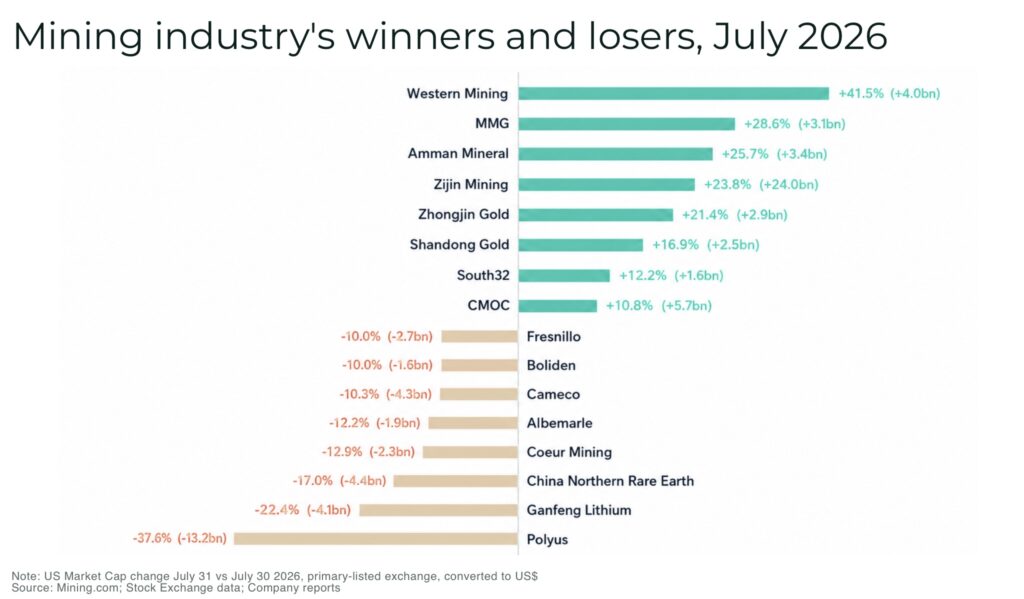
The largest July winner was Zijin Mining, which added US$24 billion of market value in one month.
Its shares gained 23.8%, lifting Zijin past Newmont into fourth place at approximately US$125 billion.
The catalyst was a first-half profit forecast of RMB39.1 billion, up 68% year on year. Mined gold production was expected to increase 15%, while lithium production reached 43,000 tonnes of lithium carbonate equivalent, 514% above the prior-year period.
Lithium is now emerging as Zijin’s third growth pillar alongside gold and copper. The timing matters: the production surge arrived as the battery-metal market began recovering from a prolonged downturn.
The result also demonstrates why diversified miners are attracting capital. Zijin is no longer being valued solely as a copper or gold producer. Investors are assigning value to its ability to move capital between commodities and bring new capacity online as market conditions change.
Polyus shows the cost of capital-allocation risk
At the other end of the ranking, Russian gold producer Polyus lost US$13.2 billion in July.
Its market capitalization dropped 37.6%, pushing the company down eight positions to number 28 after management announced it would recommend suspending dividends until 2030.
Polyus said it needed to prioritize large investment projects amid high borrowing costs, rising production expenses, a heavier tax burden and weaker gold prices.
The reaction is a reminder that commodity exposure alone does not determine mining valuations. Shareholder returns, financing requirements and confidence in capital deployment can overwhelm movements in the underlying metal.
The cost of joining the Top 50 has quadrupled
The minimum valuation needed to enter the ranking increased to US$13.56 billion in July, up from US$13.1 billion in June and more than four times the US$3.2 billion required in 2020.
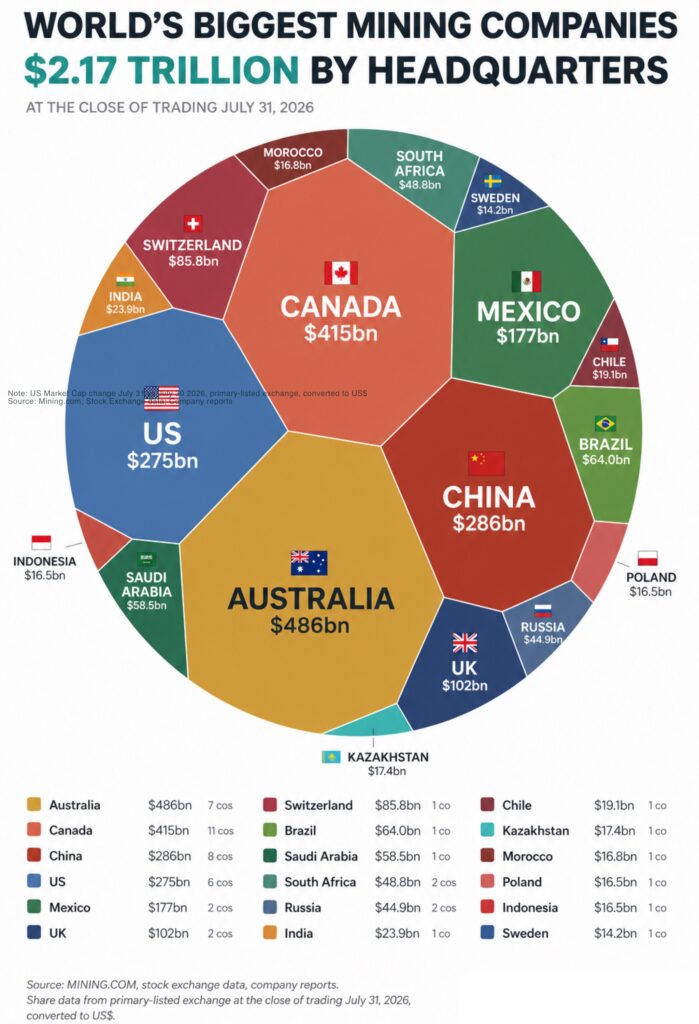
Western Mining took the final position after gaining 41.5% during July. Morocco-based Managem entered at number 39 after more than doubling in value during 2026, while MMG and South32 returned to the list.
South32’s rerating followed its agreement to sell most of its aluminium business to Alcoa and receipt of the final federal approval for the Hermosa zinc-silver-manganese project in Arizona. The company is becoming smaller, but more concentrated around commodities to which investors are assigning higher strategic value.
Glencore provides another example. The company reached US$86 billion, ranking seventh after gaining 7.6% in July and 34% in 2026. Its half-year results were supported by stronger copper production, elevated commodity-market volatility and the earnings contribution from its trading division.
The copper consolidation is not finished
The Top 50 could soon be reshaped again by Anglo American’s merger with Teck Resources.
The two companies currently rank separately, but their combination would create a top-five global copper producer headquartered in Vancouver. Under the Anglo Teck transaction, Anglo American shareholders would own 62.4% of the combined company and Teck investors 37.6%.
The group is expected to offer more than 70% exposure to copper, bringing together approximately 1.2 million tonnes of annual production with significant growth assets in Chile, Peru and Canada.
The mining rerating is becoming selective
The US$2.17 trillion valuation confirms that public capital has returned to mining, but it is not flowing evenly. So, the result is a market in which commodity prices remain important, but are no longer sufficient.
The companies attracting the largest premiums are those that can convert higher metal prices into production, cash flow and credible growth without losing control of costs or shareholder returns.
Mining’s combined valuation may appear stable near US$2.2 trillion. Underneath it, the sector is being repriced company by company.