

Critical Minerals and Energy Intelligence

AI Has A Commodity Problem—And The Technology Industry Isn’t Ready For It

For most of the past two decades, the technology industry has operated as if the physical world were somebody else’s problem.

Software companies scaled without building factories. Cloud computing let businesses add capacity without worrying much about what sat behind it. Even when technology companies moved into hardware, global supply chains generally delivered what they needed.

The AI boom gets discussed mostly in terms of semiconductors, computing power and electricity. All three matter. But underneath them sits a constraint that receives far less attention: commodities.

Data centers are physical infrastructure. So are the power plants, transmission lines, substations, transformers and cooling systems required to run them. Building all of this requires enormous quantities of copper, aluminum, steel and other materials. Expanding electricity generation brings uranium and natural gas into the equation. Semiconductor manufacturing depends on its own set of specialty metals—including gallium, germanium, palladium, and silicon—whose supply chains are heavily concentrated outside Western control.

Technology companies are becoming dependent on industries that move very slowly. That’s a new problem for an industry accustomed to moving at digital speed.​

AI Is More Physical Than It Looks

When a user types a question into a phone and gets an answer in seconds, the experience feels almost entirely digital.

AI requires large data centers filled with advanced computing equipment. Those facilities need enormous electricity. Electricity requires generation. Generation needs transmission. Transmission requires copper, aluminum and electrical equipment. Data centers require construction materials, cooling infrastructure and backup power.

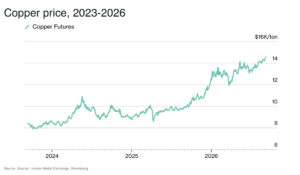
Copper is the clearest example of how these layers connect. It sits in transformers, transmission systems, data centers and power generation. Copper demand is already being pulled simultaneously by electrification, grid modernization and renewable energy—and AI infrastructure is now adding to that pressure. If AI electricity demand keeps growing, the industry won’t just need more chips. It will need considerably more of the infrastructure surrounding those chips.

READ FULL STORY

Subscribe for Investment Insights. Stay Ahead.

Investment market and industry insights delivered to you in real-time.

Disclaimer

The Oregon Group maintains full editorial control over all content published on this website. While sponsored and advertised placements may be featured, the content remains the sole opinion of The Oregon Group. The author may receive compensation or remuneration for providing content, but all statements and expressions are made independently and are not influenced by sponsors or advertisers. From time to time, The Oregon Group and its directors, officers, partners, employees, authors, or members of their families, as well as persons who are interviewed for articles on this website, may have a long or short position in securities or commodities mentioned and may make purchases and/or sales of those securities or commodities in the open market or otherwise. By accessing and using this website, readers are cautioned to assume that each of the foregoing persons may have a financial interest in all companies and sectors mentioned on this website. Any projections, market outlooks or estimates herein are forward looking statements and are inherently unreliable., and any such statements are based upon certain assumptions and should not be construed to be indicative of the actual events that will occur.  Other events that were not taken into account may occur and may significantly affect the returns or performance of the securities or commodities discussed herein. The information provided herein is based on matters as they exist as of the date of preparation and not as of any future date, and The Oregon Group undertakes no obligation to correct, update or revise the information in this document or to otherwise provide any additional material. The information provided on this website is for informational purposes only and is not, directly or indirectly, an offer, solicitation of an offer and/or a recommendation to buy or sell any security or commodity, and the information provided on this website should not be construed as any advice or an opinion as to the price at which the securities of any company or commodity may trade at any time. The Oregon Group is a publisher of financial information, not an investment advisor.  We do not provide personalized or individualized investment advice or information that is tailored to the needs of any particular recipient, and the information provided on this website is not and should not be construed as personal, financial, investment or professional advice. Readers are cautioned to always do their own research and review of publicly available information and to consult their professional and registered advisors before purchasing or selling any securities or commodities and should not rely on the information contained herein. Neither The Oregon Group nor any of its affiliates accepts any liability whatsoever for any direct or consequential loss howsoever arising, directly or indirectly, from any use of the information contained herein. By using the Site or any affiliated social media account, you are indicating your consent and agreement to this disclaimer and our terms of use. Unauthorized reproduction of this newsletter or its contents by photocopy, facsimile or any other means is illegal and punishable by law.

Share this article

about the author

Picture of Anthony Milewski

Anthony Milewski

Anthony Milewski has spent his entire career in the capital markets, including as company CEO, board director, advisor, founder and investor, with a focus on the energy transition and commodities.

Tags

Subscribe Now

Subscribe for in-depth market and industry intelligence you won’t find in the headlines.

Recommended to Read NEXT

GET FREE INVESTMENT INSIGHTS

Investment intelligence and in-depth reports on critical minerals, mining, energy and geopolitics — from capital-markets professionals with boardroom and institutional experience.