- Chile mined 387,870 tonnes of copper in September, down 15.1%, its steepest monthly fall since March 2017, and Cochilco forecasts 4.94 million tonnes for 2026, the lowest annual output since 2003
- Ivanhoe Mines has cut 2027 copper guidance at Kamoa-Kakula in Congo to 300,000-350,000 tonnes, from 380,000-420,000 tonnes
- forecasters do build in allowances for copper mine disruptions, but in 2025 and 2026 those allowances have been overrun
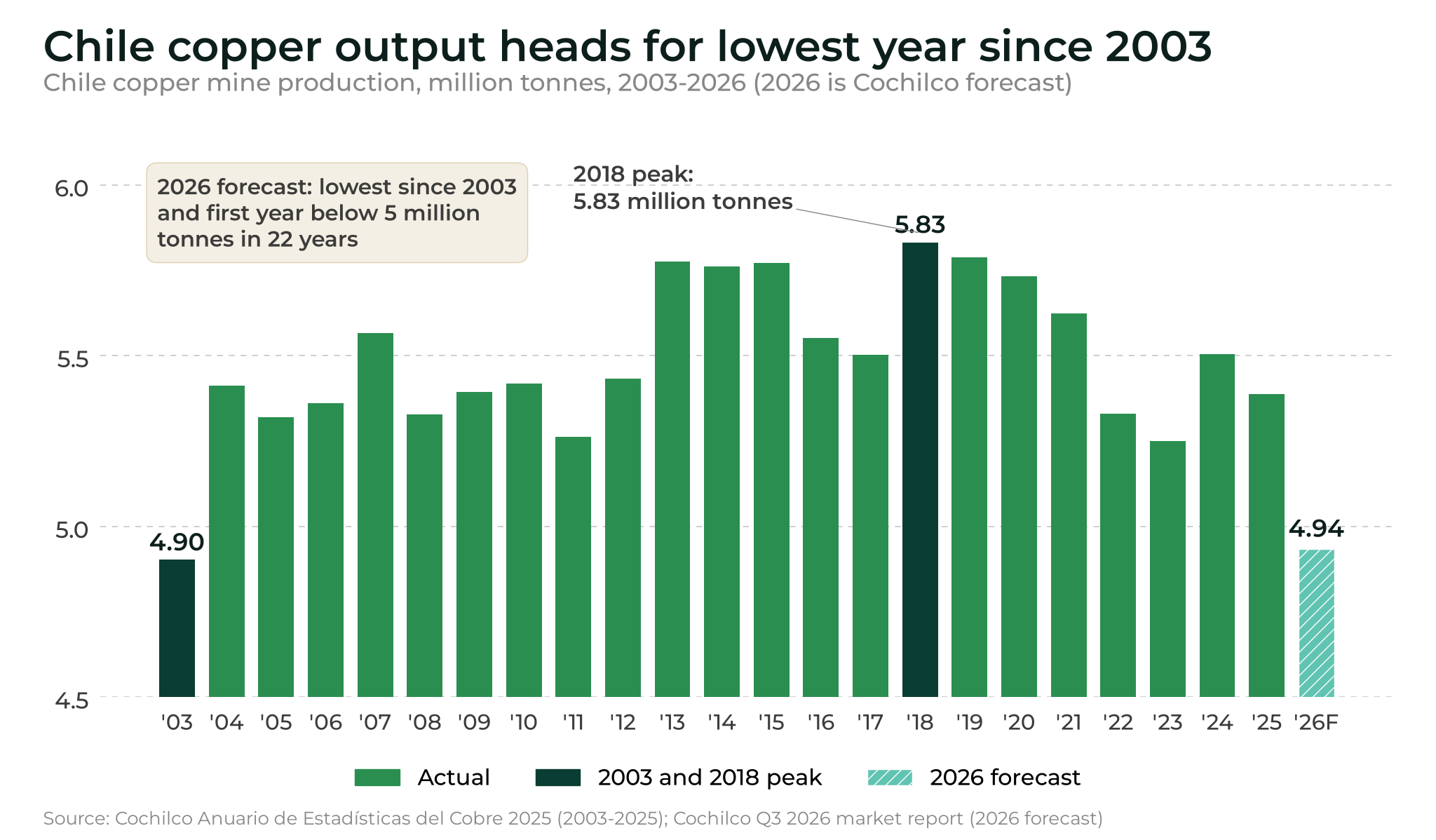
Chile’s copper output fell 15.1% in September from a year earlier to 387,870 metric tonnes, its steepest monthly drop since the Escondida strike in March 2017, putting the world’s top producer on course for its lowest annual output since 2003.
It was also the lowest September in the national statistics institute’s series, which starts in 2018, and below every September in Cochilco data going back to 2003, where the previous low was 392,500 tonnes in 2006. August was worse still: at 366,301 tonnes, it was the lowest single month in Cochilco’s series since 2003.
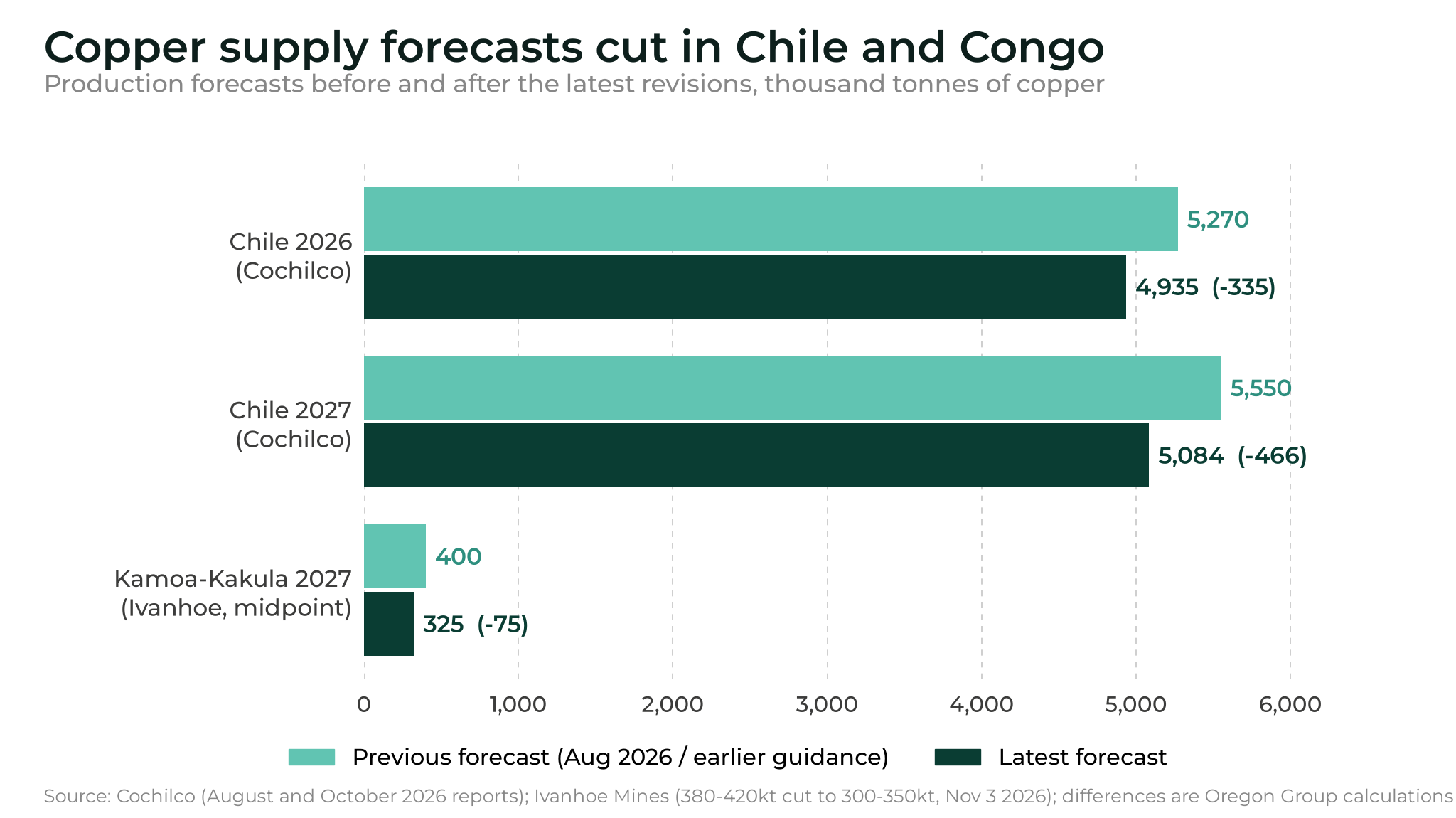
The Chilean Copper Commission (Cochilco) now forecasts 4.94 million tonnes for 2026, down 8.4%. That would be the first year below 5 million tonnes in 22 years, and nearly 900,000 tonnes below the record 5.83 million tonnes Chile mined in 2018.
Output for January-September was down 8.6% at 3.66 million tonnes. The national statistics institute blamed a temporary suspension at a large mine and lower ore grades at several others.
Meanwhile, in Congo, Ivanhoe Mines has cut 2027 copper guidance at Kamoa-Kakula to 300,000-350,000 tonnes, from 380,000-420,000 tonnes. It is the second cut this year at one of the world’s biggest new copper mines.
Together, the two announcements put a question mark over the copper forecasts that expect supply to recover next year.
Why Chile’s copper output fell
Cochilco says Escondida, Codelco and Spence account for 77.3% of the net fall in Chile’s output in January-September. Escondida produced 127,000 tonnes less, down 12.5%; Codelco 84,000 tonnes less, down 9.0%; and Spence 51,000 tonnes less, down 25.7%.
In the September quarter alone, Escondida, the world’s biggest copper mine, produced 252,600 tonnes, down 23%, as BHP reported a planned fall in ore grade to 0.81% copper from 0.94%, severe winter weather and a suspension of mining after a fatal accident.
At state-owned Codelco, the biggest falls were at Ministro Hales, down 32.4%, and El Teniente, down 17.1%, a division still restricted after its fatal accident in 2025.
Notably, much of this is not a one-off accident. Lower grades mean miners have to move and process more rock for the same amount of copper, and that problem does not reverse quickly.
Cochilco expects Chile to recover only to 5.08 million tonnes in 2027, still 5.7% below 2025. As recently as August, it expected 5.27 million tonnes this year and 5.55 million tonnes in 2027. In other words, in about two months, Chile’s own copper agency cut its 2027 forecast for the country by roughly 470,000 tonnes.
Kamoa-Kakula’s path back to 500,000 tonnes gets longer
Kamoa-Kakula is expected to produce about 290,000 tonnes of copper in 2026, after the seismic events and flooding at the Kakula mine in 2025.
Ivanhoe said the slower 2027 ramp-up was mainly due to a delay in mining the eastern side of Kakula until late in the first quarter of 2028, and a lower maximum mining rate there. It also raised 2027 cash-cost guidance to US$2.50-3.00 a pound, from US$2.10-2.50, citing diesel prices, lower grades and lower output.
The operation itself is improving, with Kamoa-Kakula produced 76,401 tonnes in the third quarter, up from 64,328 tonnes in the second.
But Ivanhoe now expects its three existing processing plants to reach only 400,000-450,000 tonnes a year, and the route back to about 500,000 tonnes depends on a Phase 4 expansion that has not yet been approved and would take 18-24 months to build once it is.
Craig Hutchison, an analyst at TD Cowen, put it plainly:
“The path back to about 500,000 tonnes per year has become longer, more capital intensive and more dependent on future execution,” he wrote in a note, downgrading Ivanhoe to hold from buy.
Do copper forecasts allow for falls like this?
They do, but the allowances keep proving too small.
The International Copper Study Group (ICSG) cuts its mine supply forecasts by an allowance for supply disruptions based on its average forecast errors over the previous five years. For 2027, that takes its world mine output forecast from 25.18 million tonnes to 24.22 million tonnes, a cut of about 960,000 tonnes.
Banks do the same: Macquarie’s 2026 copper balance includes a 531,000-tonne disruption allowance.
The problem is that recent disruptions have run past those buffers. For example, after Grasberg’s mudslide in September 2025, Goldman Sachs said the 525,000-tonne production loss exceeded its typical allowances for global supply disruptions and cut its mine supply growth forecasts.
Sprott estimates the Grasberg and Kamoa-Kakula disruptions alone removed about 600,000 tonnes of expected 2026 production, around 2.5% of global mine supply, before Chile’s latest falls.
Even the ICSG has had to keep cutting, so in October it lowered its 2026 world mine growth forecast to 1.3% from the 1.6% it expected in April, mainly on Chile, China and Indonesia.
Its 2027 outlook still relies on better output in Chile and Zambia and a recovery in Indonesia and Congo, and both Cochilco’s Chile cut and Ivanhoe’s Kamoa-Kakula cut came after that forecast was published.
Why the downgrades matter
The ICSG still expects a refined copper surplus of 368,000 tonnes in 2027, and Cochilco forecasts a surplus of 215,000 tonnes, about 0.8% of global consumption.
Those surpluses are thin. Cochilco’s own report says that if 2027 demand came in just 1% higher than expected, with supply unchanged, the surplus would turn into a deficit of about 65,000 tonnes.
Cochilco also expects Chile and Congo to add 148,000 and 145,000 tonnes respectively of the 786,000-tonne rise in world mine output it forecasts for 2027. By our calculation, that is about 37% of the total, from exactly the two countries where expectations have just been cut.
The market is already tight. LME copper traded at US$14,103 a tonne on November 4, and Cochilco forecasts an average of US$6.18 a pound in 2026 and US$5.95 in 2027.
New supply is coming, but slowly. Freeport-McMoRan has approved a US$4.5 billion expansion of its Bagdad mine in Arizona, adding about 225 million pounds (roughly 102,000 tonnes, by our conversion) a year, but first production is not expected until mid-2030.
For investors, the wider point is that miners with reliable production, and projects in stable jurisdictions that can actually be built, become more valuable each time a big operation falls short. As we have noted, the world will need US$360 billion of new copper mines by 2050.
What could prove this wrong
Chile’s fall is partly temporary. Escondida’s suspension has ended, the winter weather has passed, and Cochilco expects Chile’s output to rise 3% in 2027.
Kamoa-Kakula’s recoveries and mining rates are improving, and open-pit ore from the third quarter of 2027 could lift output faster than guided.
And, not every analyst agrees the buffers are too small. Panmure Liberum has said reported copper mine disruptions for 2025-26 amount to only 30%-50% of published disruption allowances.
Demand could also disappoint, with the ICSG cut its 2026 refined copper usage forecast, and high prices, US tariff policy and slower economic growth could all reduce consumption — but as we highlighted in our recent analysis, the same report flags how copper mines are struggling to keep up.
Even so, two years running, big copper mines have fallen well short of plan, and the supply recovery (depending on America’s copper tariffs) for 2027 now rests on the same countries that have just disappointed.