
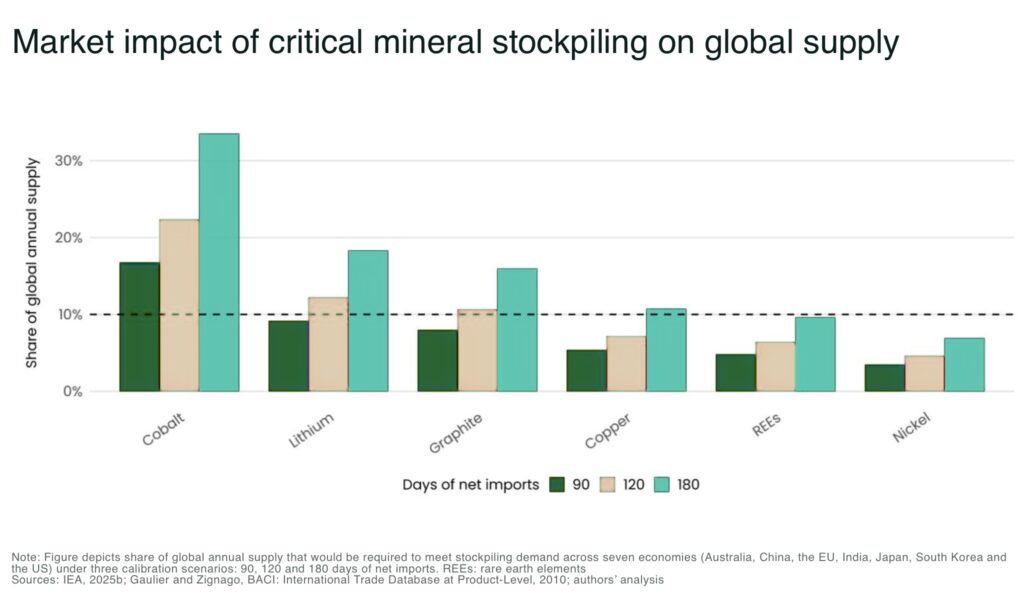
- a modelled 180-day reserve across seven economies could absorb 34% of annual cobalt supply and more than 10% of lithium, graphite and copper supply
- the US has launched Project Vault with up to US$10 billion in government financing; the G7 has committed to coordinate stockpiling through the IEA; Canada and Japan are discussing joint stockpiling arrangements for minerals including graphite and gallium
A new report by the London School of Economics warns that simultaneous buying by Australia, China, the EU, India, Japan, South Korea and the US could consume up to 34% of global cobalt supply under a modelled 180-day net-import scenario.
Lithium, graphite and copper would each face stockpile demand exceeding 10% of annual supply.
In other words, a global race to build critical mineral stockpiles could create the supply shock governments are trying to prevent.
Governments are already starting to stockpile
And significant global and state level efforts to stockpile critical minerals are already underway, with some of the latest critical mineral stockpiling, as of June 30, 2026, including:
- United States: Project Vault will establish a commercial critical-minerals reserve through a public-private partnership backed by an Export-Import Bank loan of up to US$10 billion. Boeing, GE Vernova, Clarios and Western Digital have indicated interest. The Oregon Group has previously examined the US strategic minerals reserve
- Canada–Japan: Ottawa and Tokyo are discussing joint mining projects, offtake agreements and stockpiling arrangements for graphite and gallium. Japan already operates a national rare-metals stockpile through JOGMEC
- G7: leaders agreed on June 17 to increase domestic stockpiling capacity, exchange procurement and release methods, and establish a joint crisis-response mechanism with the IEA. The agreement coordinates national reserves rather than creating a single G7 stockpile
- Canada–South Korea: the two governments will develop a joint critical-minerals stockpiling plan by the end of 2026, alongside investment and supply-stabilisation measures
- China: regulations issued in May strengthened state control across mining, processing and strategic mineral stockpiling. Beijing’s reserve volumes and mineral holdings remain largely undisclosed
- EU: the EU has reportedly shortlisted tungsten, rare earths and gallium for its first joint critical-minerals stockpile and is discussing storage infrastructure with the Port of Rotterdam. The move comes as pressure builds across the tungsten supply chain
- India: the National Critical Mineral Mission provides for a national stockpile containing at least five critical minerals. The programme is in force, although New Delhi has not disclosed its final mineral list or procurement timetable
- Australia: Canberra’s A$1.2 billion Critical Minerals Strategic Reserve is scheduled to become operational in the second half of 2026. It will initially cover antimony, gallium and rare earth elements, using production rights, offtake agreements and selective physical stockpiling
Trade restrictions are already resetting prices
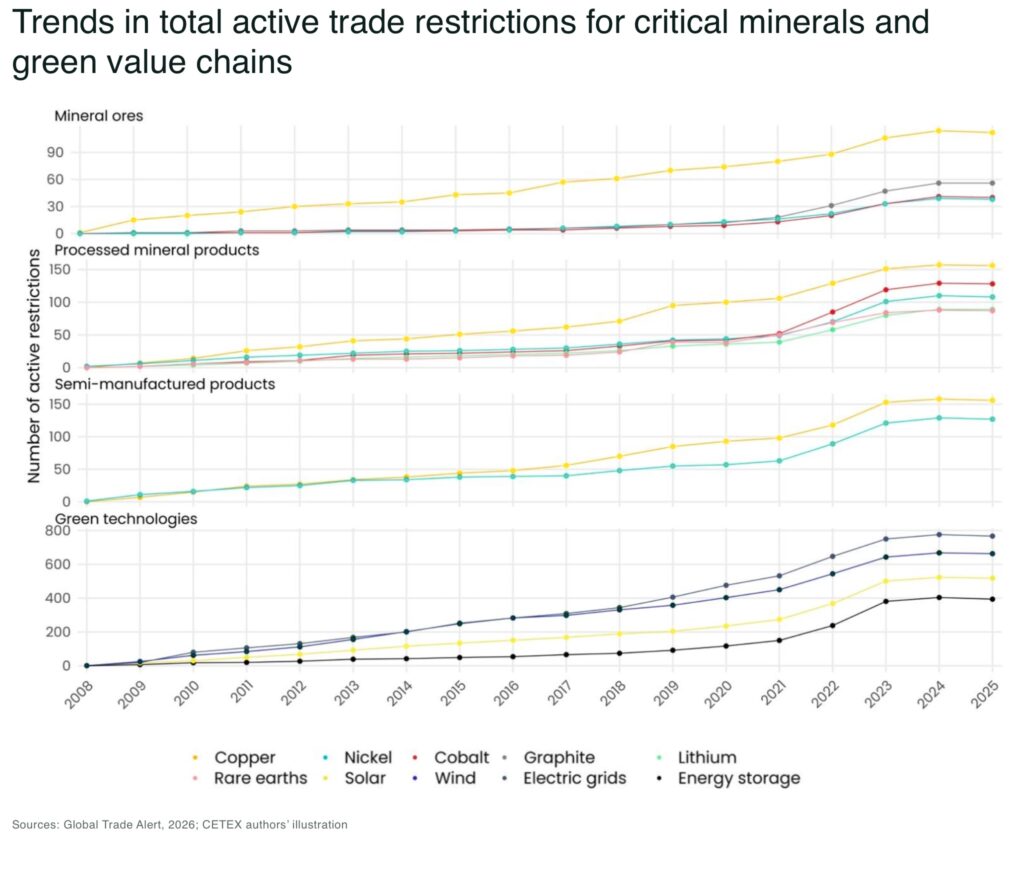
The price impact is no longer theoretical. The LSE study finds that critical-mineral trade restrictions have accelerated since 2021, particularly for processed and semi-manufactured products.
Recent market moves show the effect:
- cobalt: The Democratic Republic of Congo replaced its 2025 export suspension with quotas. By April 2026, cobalt prices had risen 160% from February 2025 to US$26 per pound
- tungsten: Chinese export controls and lower mining quotas pushed Rotterdam ammonium paratungstate above US$3,000 per metric ton unit in April, more than 200% higher since the start of 2026
- gallium: Chinese unwrought gallium exports fell 94% during 2025. Ex-China spot prices subsequently reached a record US$1,850 per kilogram in April 2026—more than triple their level at the beginning of 2025
The restrictions are creating two-tier markets: lower prices inside producing countries and scarcity premiums for material available to Western manufacturers. Stockpile procurement would concentrate additional demand in that already constrained ex-China market.
The price matters because the report’s indicative modelling suggests a sudden 10% demand increase could lift prices by roughly 29–31% for highly inelastic minerals before new supply responds. Strategic reserves may protect manufacturers from the next disruption, but buying too aggressively could make the current shortage more expensive.
The insurance policy is becoming a market force
The figures are scenarios, not announced government targets. But they show how quickly strategic reserves could alter relatively small and concentrated mineral markets.
The report’s indicative modelling suggests a concentrated 10% demand addition could produce price increases of roughly 29–31% for highly inelastic metals before miners or processors can respond.
The pressure may also emerge downstream. Recent trade restrictions have increasingly targeted refined materials and intermediate products rather than ore, making processed material more useful for emergency reserves — and potentially more vulnerable to a procurement squeeze.
Why now? China dominates the chokepoints
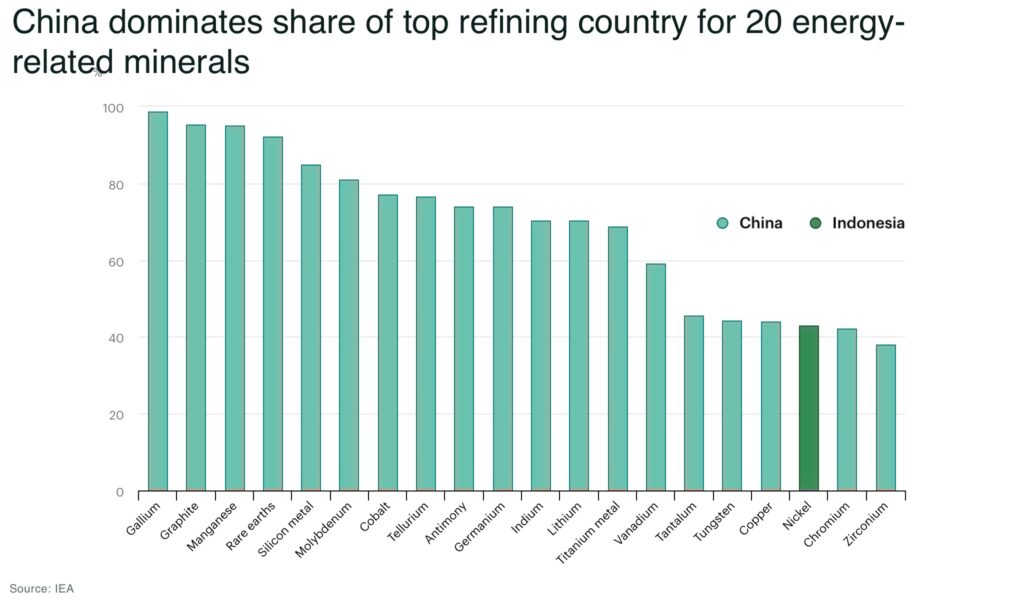
China’s leverage is significant and concentrated across mining and refining of key critical minerals, including roughly 60–90% of global rare earths and battery materials.
And, Beijing has increasingly converted its industrial position into geopolitical leverage. Export controls have covered gallium, germanium, graphite, antimony, tungsten and rare earths, while China restricted dual-use exports to 20 Japanese entities in February 2026. Despite a partial US-China trade truce, Chinese unwrought gallium exports fell 94% during 2025 and ex-China prices more than tripled by April 2026.
That is why governments are moving from supply-chain strategies to physical reserves. Stockpiles can bridge a temporary disruption.
Conclusion
The first framework of internationally co-ordinated stockpiling is emerging. On June 17, G7 leaders committed to increase domestic stockpiling capacity, exchange procurement and release methodologies and establish a joint cooperation mechanism with the IEA. That follows a February mandate directing the IEA to help members develop stockpiles, monitor markets and coordinate responses to supply disruptions.
Government procurement is meant to support processors, traders and near-term producers capable of delivering qualified material, with critical mineral stockpiles planned to reduce exposure to supply at risk of insecurity and geopolitical leverage.
However, the very same security policy risks becoming the next commodity demand shock.