
More than a dozen asset managers overseeing a combined US$27 trillion have increased their gold exposure or maintained bullish allocations — with Amundi, Europe’s largest asset manager, expecting bullion to return to US$5,000/oz by the end of 2026.
But the gold demand story is no longer being driven by one type of buyer:
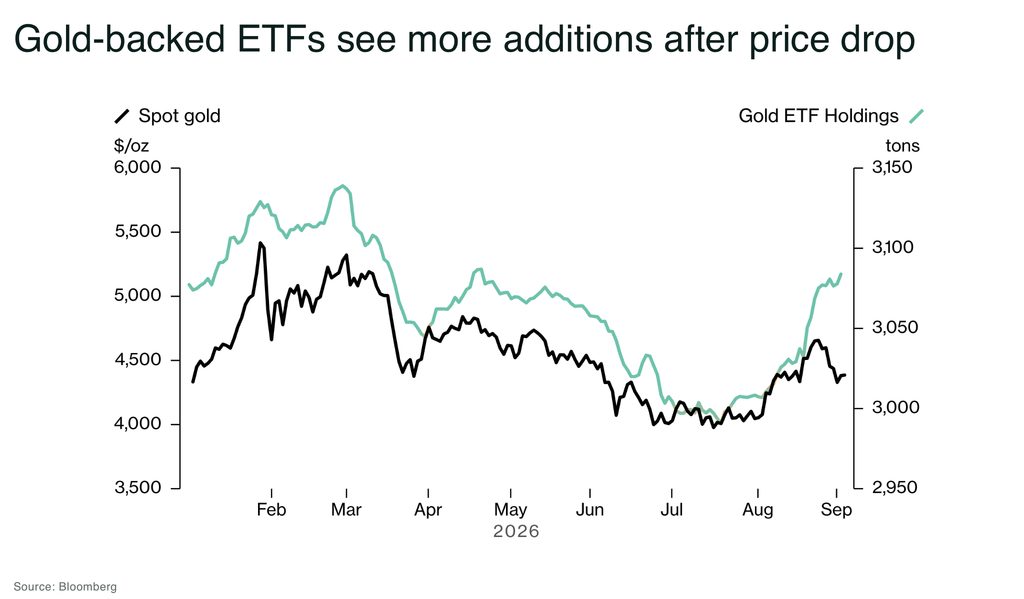
- global gold ETFs attracted US$3 billion in July, reversing two months of outflows and lifting their collective holdings by 23 tonnes to 4,068 tonnes
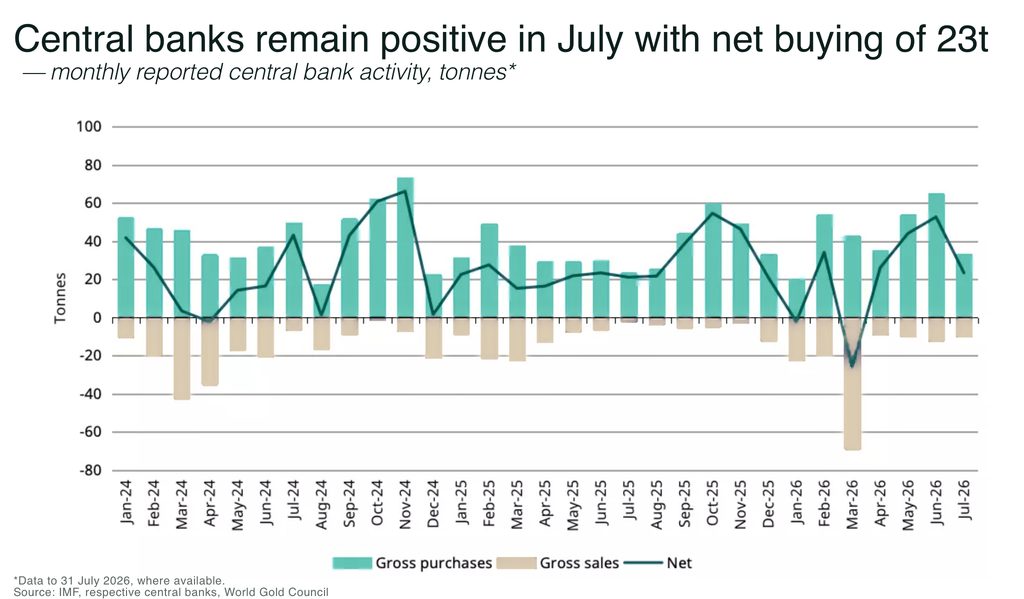
- central-bank and official-sector demand hit estimated 289 tonnes in Q2 2026, up 62% year-on-year — and continued their gold accumulation in July with net buying reported at 23 tonnes
A record 45% of central banks in the World Gold Council’s Central Bank Gold Reserves Survey 2026 expect to increase their own gold reserves, while 74% anticipate a lower US dollar share in global reserves over the next five years.
Fund managers, gold ETFs and central banks are rebuilding positions at the same time. More importantly, their decisions are beginning to reinforce one another: asset managers are citing official-sector purchases as a reason to return, while reserve managers increasingly view gold as protection against inflation, geopolitical risk and currency concentration.
Fund managers bought the pullback
Gold reached an all-time high near US$5,600/oz in January, before elevated energy prices, inflation concerns and changing US interest-rate expectations drove the metal back towards US$4,000/oz in June. Some of the world’s largest money managers treated that decline as a buying opportunity.
In a recent report, Bloomberg found that every manager in a group of more than a dozen firms overseeing a combined US$27 trillion had either added gold recently or maintained a bullish allocation, including BNP Paribas Asset Management and Manulife John Hancock Investments.
Amundi, Europe’s largest asset manager, Pictet Asset Management, Robeco and Fidelity International also rebuilt positions reduced during the earlier retreat.
The broader fund market is showing the same pattern with global gold ETFs recorded US$3 billion of net inflows in July. European-listed funds contributed US$2 billion and UK funds attracted US$875 million and Swiss funds US$657 million.
The recovery remains uneven. North American ETFs added only US$71 million in July and were still in net outflow territory for the year. But the direction changed: investors returned after two consecutive months of selling.
For Robeco, the acceleration in central-bank purchases during Q2 was one reason to buy gold again.
Central banks are validating the institutional trade
The World Gold Council estimated Q2 central-bank and official-sector demand at 289 tonnes, compared with 178 tonnes a year earlier.
Its separate reported-activity series recorded 23 tonnes of net central-bank buying in July with reported purchases totalling about 130 tonnes in the first seven months of 2026, below roughly 160 tonnes over the same period in 2025:
- Poland remained the largest reported buyer, adding 90 tonnes during the first seven months of 2026. Its holdings reached 640 tonnes — around 28% of total reserves and approaching its 700-tonne target
- China added 20 tonnes in July, its 21st consecutive month of purchases. The People’s Bank of China bought 60 tonnes during the first seven months, taking reported holdings to approximately 2,366 tonnes, or 8% of total reserves
- new and returning buyers are also entering the market with the Bank of Korea announcing an estimated US$250 million, or roughly two-tonne, gold allocation through exchange-traded funds after 13 years without an addition; Namibia wants to increase gold from 1% to 3% of its reserves by March 2027
Although, Russia reported 50 tonnes of sales during the first seven months of 2026, while Turkey sold 85 tonnes — and reported purchases were also lower than during the equivalent period of 2025.
Conclusion
Interest rates remain the immediate risk.
Higher Treasury yields and growing expectations of another Federal Reserve rate increase reduce the appeal of non-yielding bullion. Fund managers have warned that a sustained move above the recent US$4,600/oz ceiling may therefore be difficult, even if the longer-term diversification case remains intact.
However, gold is moving from a tactical inflation trade towards a more permanent allocation across private and sovereign portfolios. If fund managers and central banks continue buying together, the buyer base, not any single price forecast, may become the strongest support for the next leg of the market.
Our article at the start of the year: What has to break for gold to hit $10,000