
- Australia reports 37 days of national diesel cover; major Pilbara mines may hold only seven to ten days on site; and Western Australia has just 29 hours of diesel stock
- the Asian diesel crack remains around US$36 per barrel, more than twice its pre-war level despite Brent returning to US$78
- global oil inventories are at “operational stress levels” as conflict continues in the Strait of Hormuz
Australia officially has 37 days of diesel stocks, but mines in Pilbara region may only 7-10 days of stocks — just as the world hits “operational stress levels” for global oil inventories due to the ongoing Middle East crisis.
The gap matters because mining in Australia consumes 9.6 billion litres of diesel a year, with up to 40% of Australia’s diesel is consumed by mining (the sector runs more than 50,000 large diesel-powered trucks)
52 service stations were reporting diesel stockouts on June 26, but Australia is not running out of diesel today.
Instead, there are warning signs that national averages may conceal how quickly disruption across the oil and diesel industry could reach the mines producing the country’s iron ore, gold and lithium, especially in the more remote regions of Australia.
Is Australia running out of diesel?
As of June 23, Australia held 37 days of diesel cover, above the March-quarter average of 30 days. Another 3.6 billion litres of crude and refined fuel were scheduled to arrive over the following four weeks.
Official data also showed 52 service stations without diesel on June 26, less than 1% of the 8,118 sites monitored nationally, less than in March when Australians started to panic buy. And, only four were in Western Australia — the country’s mining engine that accounts for about half of Australia’s resource exports, especially iron ore. The Western Australian government says fuel distribution to key industries remains uninterrupted, with June and July diesel supplies secured.
Diesel prices have also fallen since the start of the Middle East crisis and closure of the Strait of Hormuz. Across Australia’s five largest cities, average retail diesel reached A$1.801 per litre on June 24, just 3.5 cents above February levels and 44% below its March peak.
But Australia’s cheaper diesel has been supported by lower crude prices, weaker demand, emergency oil releases, a 32-cent-per-litre excise discount and the temporary release of additional domestic stocks. The concern is that these support measures are now running on fumes themselves, and masking a deeper crisis.
The Asian diesel crack remains at approx US$36 per barrel, more than twice its pre-war level, even as Brent retreated to US$78.
Australia is not running short of diesel nationally: stocks are nearly 17% above the 2024–25 average. The vulnerability lies in replacing those stocks and distributing fuel to Western Australia and remote mining operations, not in the headline national inventory.
| Fuel | 2025 average | 23 June 2026 | Change | Versus 2025 maximum |
|---|---|---|---|---|
| Petrol | 1,743 ML | 1,883 ML | +8.0% | 8.5% below |
| Jet fuel | 799 ML | 814 ML | +1.9% | 13.3% below |
| Diesel | 2,968 ML | 3,466 ML | +16.8% | 4.1% above |
Crude prices have recovered faster than fuel supply
Australia’s pump prices make the situation look more comfortable.
Average retail diesel across the five largest cities fell to A$1.801 per litre on June 24, just 3.5 cents above February and 44% below its March peak.
But crude oil has fallen faster than the products refined from it.
| Benchmark | February 20 | June 24 |
|---|---|---|
| Dated Brent | US$73 | US$78 |
| Singapore Mogas 95 | US$76 | US$105 |
| Singapore gasoil | US$89 | US$114 |
| Petrol crack | US$3 | US$27 |
| Diesel crack | US$16 | US$36 |
Calculated from ACCC international benchmark data.
The diesel crack has fallen from an extraordinary US$108 in March, but at US$36 it remains 125% above its pre-war level. Petrol is showing an even larger relative divergence. Its crack has widened from approximately US$3 to US$27 per barrel.
And it may widen further from July 1, when the exceptional government fuel-excise discount will fall from 32 cents to 16 cents per litre, and the ACCC expects petrol and diesel prices may rise. In particular, eligible off-road mining fuel receives fuel tax credits, so the excise restoration is not a simple 16-cent increase in mine-site costs, with road haulage, contractors and other parts of the supply chain remain exposed.
To be clear, this does not necessarily prove speculative short positions are solely suppressing crude. Crack spreads can rise because of refinery outages, seasonal demand, fuel specifications, transport constraints or declining product inventories, according to the US Energy Information Administration.
But the market signal is significant: crude has priced a recovery that refined-fuel markets have not yet received.
Global oil reserves are buying time
Australia’s immediate relief is part of a wider drawdown of global strategic inventories:
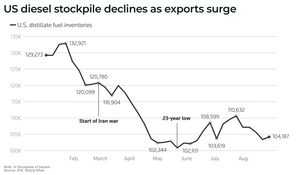
- the IEA says OECD government oil stocks fell by 163 million barrels after the conflict began, reaching their lowest level since December 1990. Global observed inventories fell another 143 million barrels in May alone
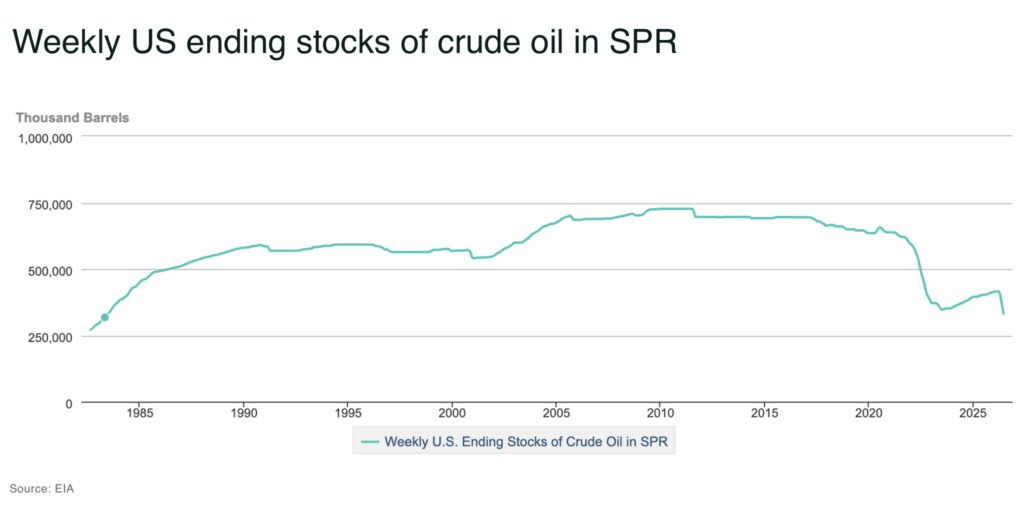
- the US Strategic Petroleum Reserve dropped by 9.1 million barrels in the week to June 19, reaching 331.2 million barrels, 71.3 million below a year earlier, according to the EIA’s petroleum stock report
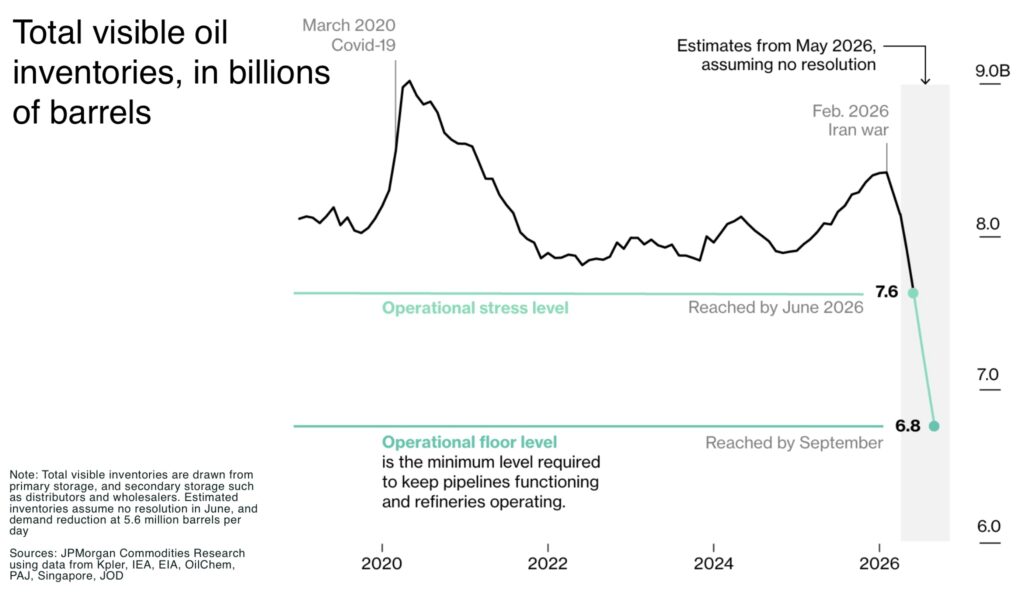
In May 2026, JPMorgan projected projected global visible inventories reaching a 7.6-billion-barrel operational-stress threshold in June and a 6.8-billion-barrel operational floor by September if disruption continued, leading to “operational stress levels.”
Strategic releases can suppress prices and replace missing supply, but they cannot indefinitely create new primary diesel supply as the Strait of Hormuz faces ongoing conflict.
Hormuz tanker recovery has weakened again
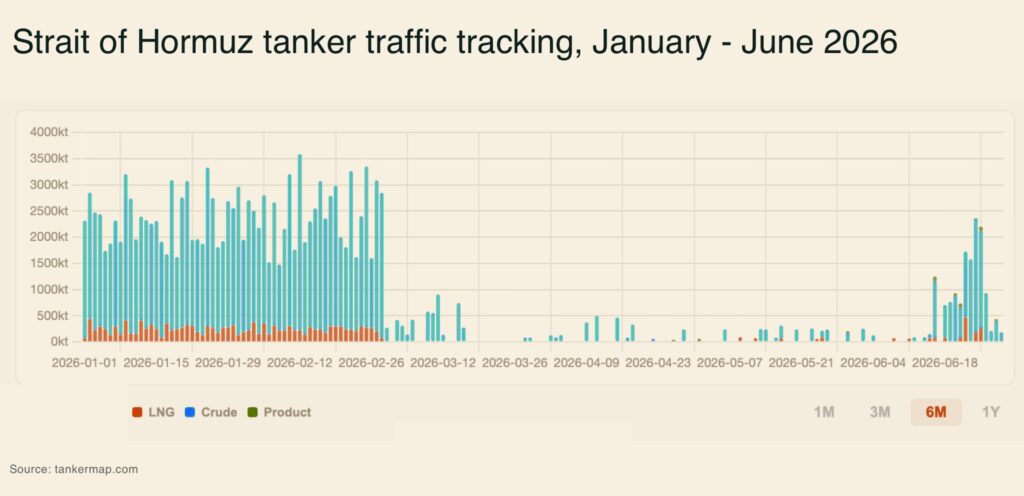
The expected reopening of the Strait of Hormuz helped drive crude prices lower after the signing of the MoU between the USA and Iran. However, both physical traffic and a reduction in conflict has not yet matched that optimism.
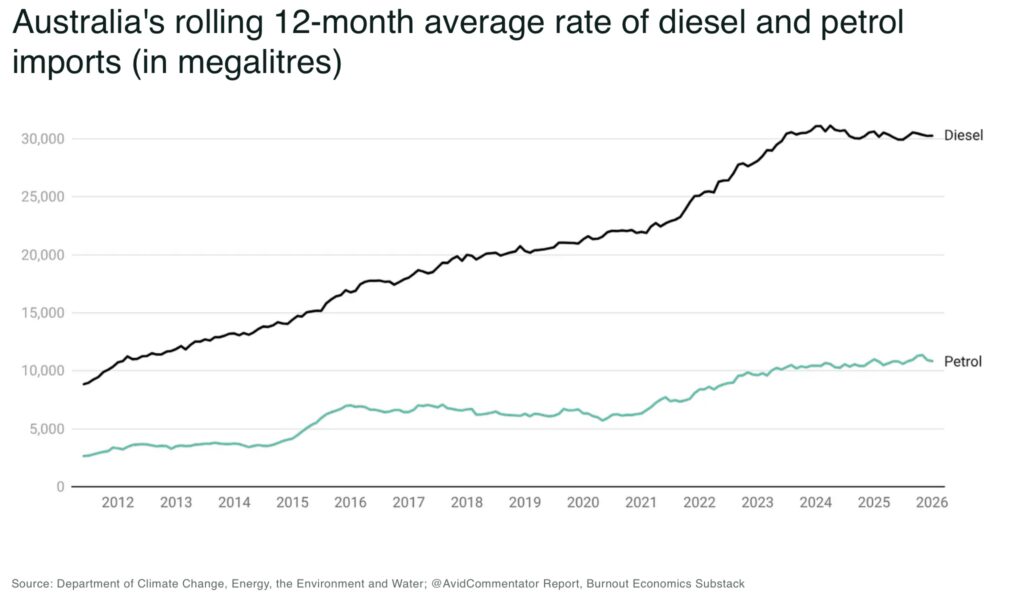
This matters in particular for Australia which imports 87% of its diesel, and is the world’s largest diesel importer.
AIS data show tanker traffic averaging 9.1 vessels per day, compared with a rate of approx 125 before February 2026. After reaching 16 tracked LNG, crude and product-tanker crossings on June 24, daily traffic fell back to between two and five vessels late in the week.
Australia’s own inbound clean-product pipeline has also shortened with 37 refined-product tankers heading to Australia on June 26, equivalent to 12 days of supply, down from 44 tankers and 16 days one week earlier.
This does not constitute a shortage (yet), but it does reduce the margin for error.
Western Australia’s reserve would last about 29 hours
The Western Australian government has assembled a state-controlled backup for “areas of acute need” of 20 million litres of diesel to support remote communities, agriculture, transport and mining during local supply failures, but western Australia consumes approximately 6 billion litres annually, or 16.4 million litres a day, according to figures reported when the state stockpile was established — that makes the entire reserve equivalent to roughly 29 hours of statewide demand.
And a recent Pilbara fuel-security analysis published by Craig Tindale estimates that major operations typically hold 7-10 days of diesel on site. Junior and mid-tier miners reportedly operated with approximately five days during the March disruption.
Near the start of the crisis in March 2026, Association of Mining and Exploration Companies (AMEC) CEO, Warren Pearce, warned some smaller mining companies had only five days’ of diesel supply.
“Many coal mines in Australia are operating near their break-even level, so there are concerns that a shortage or higher prices of fuel could affect operations and possibly impact supply… The mining industry runs on diesel and an interruption to fuel supply will potentially see mines having to shut down until fuel becomes available” — Warren Pearce, CEO, Association of Mining and Exploration Companies (AMEC)
The comparison reveals the scale problem: Australia’s fuel-security system can manage temporary local shortages, but it cannot replace sustained maritime imports.
The federal government recognises the issue and has extended a measure permitting suppliers to hold 20% less petrol and diesel in reserve until September if additional fuel is released into domestic and regional markets. The measure can free up to 762 million litres of fuel.
What does this mean for mining and metals?
Australian mining consumes almost 9.6 billion litres of diesel annually, around one-quarter of national use.
Singapore gasoil remains approximately A$0.23 per litre above February prices. If fully passed through across that consumption, the difference represents roughly A$1.8 billion of annualised gross exposure before contracts, hedging and tax treatment.
Fortescue, in an interview with Reuters, says every 10-cent movement in diesel changes its costs by approximately US$70 million. Across the four largest iron-ore miners, the combined effect may reach US$500 million, according to Reuters reporting on mining fuel exposure.
For now, major mines have fuel and falling cracks are easing costs. But, smaller operators, contractors and exploration programs remain especially vulnerable because they have less storage and weaker purchasing power.
If the maritime disruption continues, the likely sequence is straightforward: discretionary work is cut first, juniors ration fuel next, and major production is protected until site tanks approach minimum levels as we warn in our analysis on how the Strait of Hormuz diesel shock threatens mining industry.
The immediate conclusion is not that Australia has ten days before its mining industry stops. It is that 37 days of national diesel cover may translate into only seven to ten operational days at the mine that needs it.
Australia is not running out today, but the accumulation of reserves offers a warning, rather than hope — if the Strait of Hormuz stays closed and oil inventories keep running down — it doesn’t matter what the price of oil is, diesel will crack.