
- in the week ending July 3, the US Strategic Petroleum Reserve fell by 6.2 million barrels to 319.5 million, down 21% from a year earlier
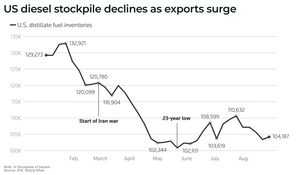
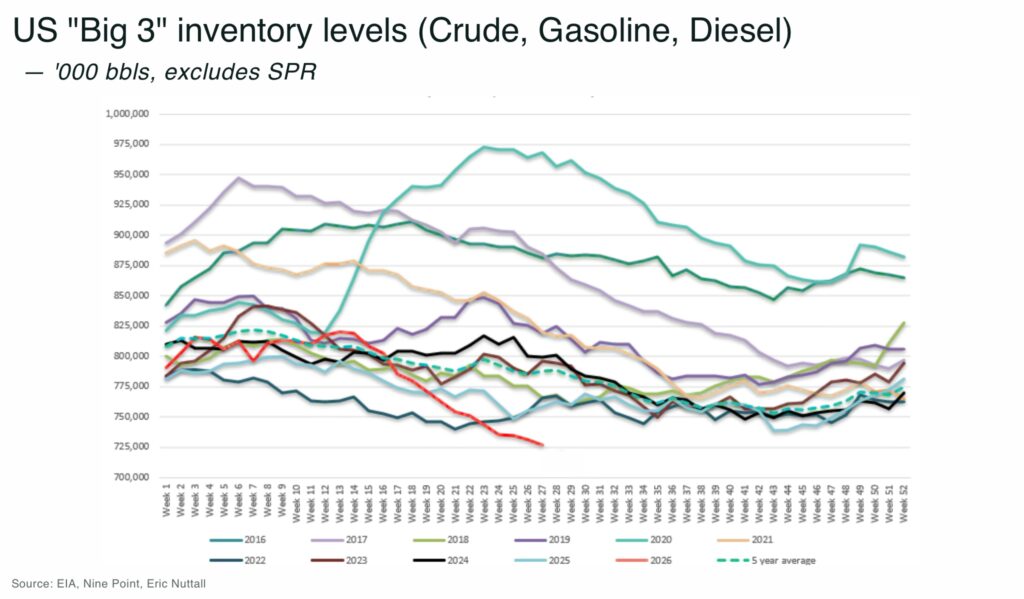
- distillate inventories plunged 5 million barrels to 103.6 million, leaving diesel supply 12% below its five-year seasonal average
- US refined-product exports reached a record 8.73 million barrels per day, accelerating the domestic draw
- Russia has restricted diesel exports by non-producers and is considering a complete ban covering refiners
The US is burning through two separate fuel buffers at once.
The US Strategic Petroleum Reserve has dropped 6.2 million barrels in the week ended July 3, and distillate inventories, primarily diesel and heating oil, fell another 5 million barrels.
Both stockpiles are critical to the global energy system, as the SPR cushions crude-oil disruptions and commercial diesel inventories keep trucks, mines, farms and industrial supply chains operating when refinery or trade flows break down.
As we warned in our analysis — Strait of Hormuz diesel shock threatens mining industry and Record oil drawdowns are masking mining’s fuel shock — record drawdowns risk the capacity of mining to actually function, especially in remote regions.
And, as the crisis escalates, there is no quick solution.
Diesel supply is running harder than the headline suggests
US distillate stocks now stand at 103.6 million barrels, 12% below the five-year average. Ultra-low-sulphur diesel accounted for 4.4 million barrels of the weekly decline.
The draw was concentrated in America’s most important refining and distribution regions. Gulf Coast inventories dropped 3.2 million barrels, while the East Coast lost 1.7 million barrels, according to the EIA’s regional diesel data.
Domestic distillate production held near 5.2 million barrels per day, but refineries were already operating at 95.8% of capacity. There is limited scope to increase output quickly without adding crude supply or pushing existing equipment harder.
Meanwhile, weekly distillate demand jumped to 4.3 million barrels per day and exports reached 1.68 million barrels per day. Total US petroleum-product exports climbed to a record 8.73 million barrels per day.
The US is therefore acting as the global fuel supplier of last resort while simultaneously drawing down its emergency crude reserve.
Middle East conflict flares up again
The Middle East conflict is flaring again, and commercial shipping is back in the firing line.
Three tankers were struck in separate attacks in the Strait of Hormuz over July 6–7, according to US and British maritime authorities. A fourth commercial vessel, the Singapore-flagged Ever Lovely, was hit by a projectile on June 25.
The attacks prompted the US to strike more than 80 Iranian targets, including air-defence systems, coastal radars, anti-ship missile capabilities and more than 60 Islamic Revolutionary Guard Corps boats. Iran subsequently launched attacks against US military facilities in Bahrain and Kuwait.
President Donald Trump has declared the agreement “over” and threatened further strikes, including the possible seizure of Kharg Island, Iran’s principal oil-export hub.
Tehran has responded by asserting control over the waterway. Iran’s military warned that tankers deviating from approved routes would face an “immediate and forceful response”. Iranian state media later reported, citing an unnamed informed source, that Iran would close the Strait of Hormuz if the US launched another attack.
Shipowners are already reacting. At least four oil and gas tankers have reportedly abandoned attempted Hormuz transits, including an Indian-flagged vessel carrying 2 million barrels of Kuwaiti crude.
Russia adds another diesel risk
Russia has introduced a diesel export ban through July 31. Russia normally exports roughly 40% of its diesel production and accounted for about 11% of global supplies last year.
China offers the principal relief valve. Beijing has lifted refined-fuel export restrictions for July, allowing Zhejiang Petrochemical to resume shipments after a four-month halt. However, the primary destination of this fuel exports is uncertain, but may well for Russia which has suffered from significant attacks on its refining infrastructure by Ukraine.
The pressure point is refined fuel
Four-week US distillate consumption remains 0.9% below last year, offering some protection against an immediate shortage. Retail diesel has also declined to US$4.578 per gallon, from US$5.640 in early May — but falling prices have not rebuilt inventories.
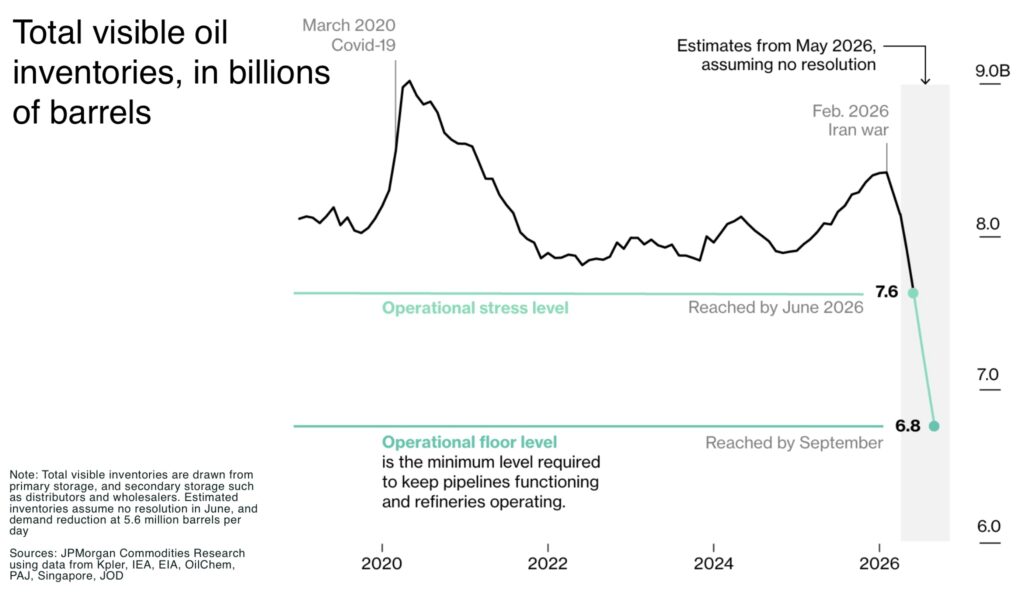
For the diesel-intensive mining industry, it keeps operating costs exposed. For example:
Australia officially has 37 days of diesel stocks, but mines in Pilbara region may only 7-10 days of stocks. The gap matters because mining in Australia consumes 9.6 billion litres of diesel a year, with up to 40% of Australia’s diesel is consumed by mining (the sector runs more than 50,000 large diesel-powered trucks).
(see our recent on report on Australia has 37 days of diesel stock, only 29 hours in Western Australia)
The strategic point is simple: the US is spending its crude insurance while exporting record volumes of refined fuel. Crude prices can fall without ending the diesel squeeze.
Q&A
How much oil remains in the US SPR?
The Strategic Petroleum Reserve holds 319.5 million barrels, down 83.5 million barrels from a year earlier.
How tight are US diesel inventories?
Distillate stocks stand at 103.6 million barrels, 12% below the five-year seasonal average.
Has Russia banned diesel exports?
Russia currently restricts exports by non-producers. A complete ban covering direct refiners remains under consideration.