
Critical Minerals and Energy Intelligence

China’s rare-earth restrictions push Japan to mine the Pacific seabed

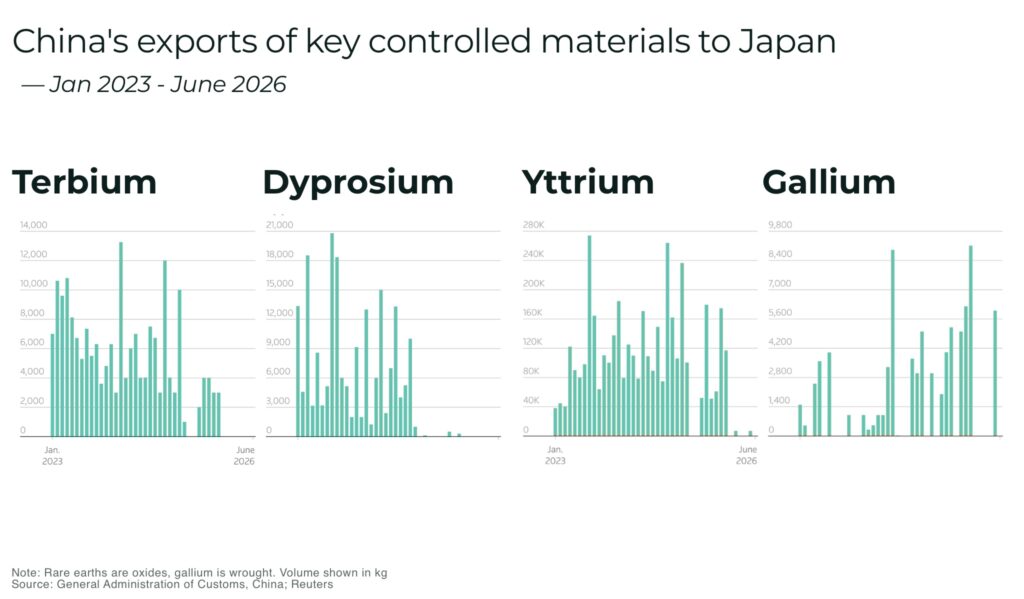
China shipped no gallium, dysprosium, terbium or yttrium to Japan in June, extending an eight-month halt in shipments of critical magnet materials — pushing Japan to search for alternative rare earth sources almost six kilometres beneath the Pacific Ocean.

Exports of dysprosium and terbium oxide to Japan have remained at zero since November, Chinese customs data show. The squeeze is targeted: China’s worldwide rare-earth magnet exports rose 19% month-on-month in June to 5,649 tonnes.
Chinas exports of key controlled materials to Japan rare earths 1 - The Oregon Group

Japan’s potential answer lies in rare-earth-rich mud near Minamitorishima, a remote island about 1,900 kilometres southeast of Tokyo.

Recent analysis found medium and heavy rare earths, including yttrium, gadolinium and dysprosium, made up 54% of the rare-earth content in mud recovered during a government-backed trial earlier this year.

The drilling vessel Chikyu raised about 50 tonnes of mud, excluding seawater added during extraction, from three deposits over a three-day test. Japan described it as the first continuous recovery of seabed sediment from a depth of 5,569 metres.

The deep-sea mining project plans to extract mineral resources from the ocean floor, but, for now, remains an experimental operation, not a commercial mine. This is possible as the deposit sits inside Japan’s exclusive economic zone, it is outside the jurisdiction of the International Seabed Authority, which regulates mining beyond national waters.

Yttrium, terbium and dysprosium are rare earth elements used in heat-resistant magnets for electric vehicles, wind turbines and weapons, and in coatings that protect aircraft and power-generation turbines. Japan has the world’s largest rare-earth magnet industry outside China and, before the latest restrictions, China accounted for 80% of Japan’s rare earth imports.

Beijing introduced licensing controls on seven medium and heavy rare-earth families in April 2025. It tightened restrictions on Japan early this year after Prime Minister Sanae Takaichi’s comments about Taiwan deepened a diplomatic dispute. China says the controls protect national security and support its non-proliferation obligations.

The impact is spreading beyond specialist materials companies. More than two-thirds of almost 200 Japanese corporate filings that mentioned rare earths in May and June said the controls were hurting business or could do so, according to a recent Reuters analysis.

Tokyo plans a month-long seabed trial in February 2027, covering extraction, dewatering, transport, separation and refining. It expects to complete an economic assessment by March 2028.

Commercial supply remains years away. Operating at extreme depth, transporting material from one of Japan’s most isolated territories and rebuilding domestic separation capacity will be expensive. The government’s closed-loop lifting system is designed to limit sediment plumes, but analysis of the wider environmental effects is continuing.

Japan is therefore pursuing several routes at once: stockpiling, recycling, financing overseas producers and working with the US and other Group of Seven countries on alternative supply. A Japanese-backed processing and recycling plant in France is expected to supply dysprosium and terbium equal to about 20% of future Japanese demand.


Subscribe for Investment Insights. Stay Ahead.

Investment market and industry insights delivered to you in real-time.

Disclaimer

The Oregon Group maintains full editorial control over all content published on this website. While sponsored and advertised placements may be featured, the content remains the sole opinion of The Oregon Group. The author may receive compensation or remuneration for providing content, but all statements and expressions are made independently and are not influenced by sponsors or advertisers. From time to time, The Oregon Group and its directors, officers, partners, employees, authors, or members of their families, as well as persons who are interviewed for articles on this website, may have a long or short position in securities or commodities mentioned and may make purchases and/or sales of those securities or commodities in the open market or otherwise. By accessing and using this website, readers are cautioned to assume that each of the foregoing persons may have a financial interest in all companies and sectors mentioned on this website. Any projections, market outlooks or estimates herein are forward looking statements and are inherently unreliable., and any such statements are based upon certain assumptions and should not be construed to be indicative of the actual events that will occur.  Other events that were not taken into account may occur and may significantly affect the returns or performance of the securities or commodities discussed herein. The information provided herein is based on matters as they exist as of the date of preparation and not as of any future date, and The Oregon Group undertakes no obligation to correct, update or revise the information in this document or to otherwise provide any additional material. The information provided on this website is for informational purposes only and is not, directly or indirectly, an offer, solicitation of an offer and/or a recommendation to buy or sell any security or commodity, and the information provided on this website should not be construed as any advice or an opinion as to the price at which the securities of any company or commodity may trade at any time. The Oregon Group is a publisher of financial information, not an investment advisor.  We do not provide personalized or individualized investment advice or information that is tailored to the needs of any particular recipient, and the information provided on this website is not and should not be construed as personal, financial, investment or professional advice. Readers are cautioned to always do their own research and review of publicly available information and to consult their professional and registered advisors before purchasing or selling any securities or commodities and should not rely on the information contained herein. Neither The Oregon Group nor any of its affiliates accepts any liability whatsoever for any direct or consequential loss howsoever arising, directly or indirectly, from any use of the information contained herein. By using the Site or any affiliated social media account, you are indicating your consent and agreement to this disclaimer and our terms of use. Unauthorized reproduction of this newsletter or its contents by photocopy, facsimile or any other means is illegal and punishable by law.

Share this article

about the author

Picture of The Oregon Group

The Oregon Group

The Oregon Group is an investment research team focused on critical minerals, mining, energy and geopolitics.

Tags

Subscribe Now

Subscribe for in-depth market and industry intelligence you won’t find in the headlines.

Recommended to Read NEXT

SUBSCRIBE FOR INVESTMENT INSIGHTS

Welcome to The Oregon Group, an investment research team focused on critical minerals, mining, energy and geopolitics.

Our independent capital markets experts are sharing their boardroom expertise and institutional experience to help you profit and hedge your investment exposure during this time of unmissable opportunity.