- the Democratic Republic of Congo will suspend all cobalt exports from November 30 until further notice, its second export ban in less than two years
- Congo mined an estimated 230,000 metric tonnes of cobalt in 2025, about 73% of world mine production
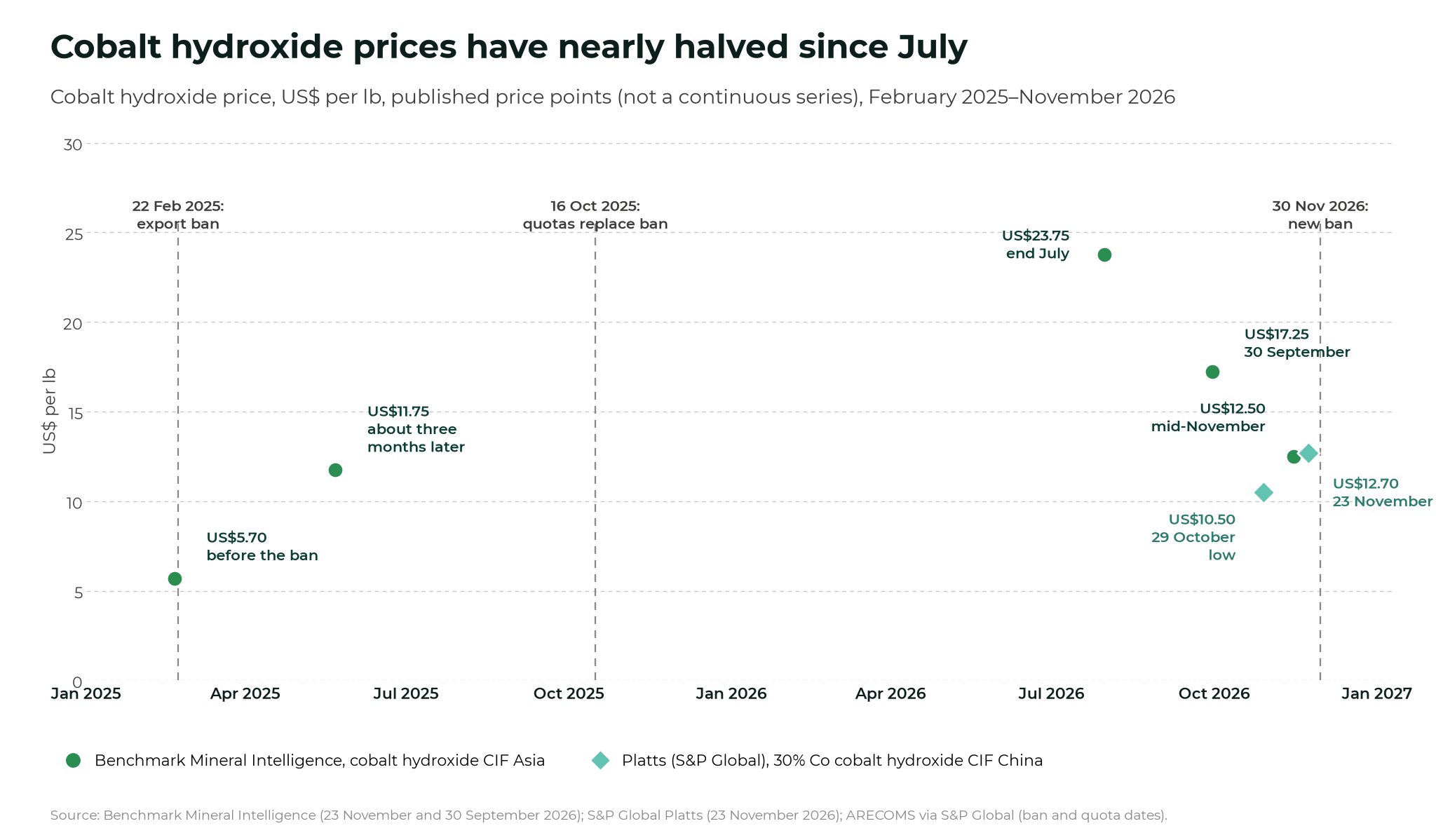
- cobalt hydroxide, the intermediate Congo exports, was assessed at US$12.70 a pound on 23 November, down 49% since the start of 2026
The Democratic Republic of Congo will suspend all cobalt exports from November 30, the second time in less than two years that the world’s largest producer has cut off supply to support prices.
The ban covers all cobalt produced in Congo, from industrial mines to artisanal operations, and will stay in place until the regulator, ARECOMS, formally lifts it. The regulator blamed “weak demand, rising inventories and excess supply“.
Harsher than the market expected
The decision, taken by ARECOMS on 9 November, also applies to cargoes that were already authorised but have not left the country by November 30. Allocated volumes that haven’t been shipped won’t be carried over, and quotas for 2026 and 2027 won’t be renewed automatically when exports restart.
Most market participants had expected ARECOMS to tighten quotas rather than impose an outright ban, according to Benchmark Mineral Intelligence. One trader told S&P Global the news was “causing a bit of pandemonium in the metals market”, and offers disappeared.
In fact, we flagged last month, in our article Glencore’s cobalt output falls 52% in nine months under Congo quotas, that ARECOMS was ready to tighten further. Its chair, Patrick Mpoyi Luabeya, had told Fastmarkets in August:
“If the imbalance between supply and demand were to persist or deteriorate, a reduction in export quotas may be considered in order to help restore market balance.”
How much cobalt is affected?
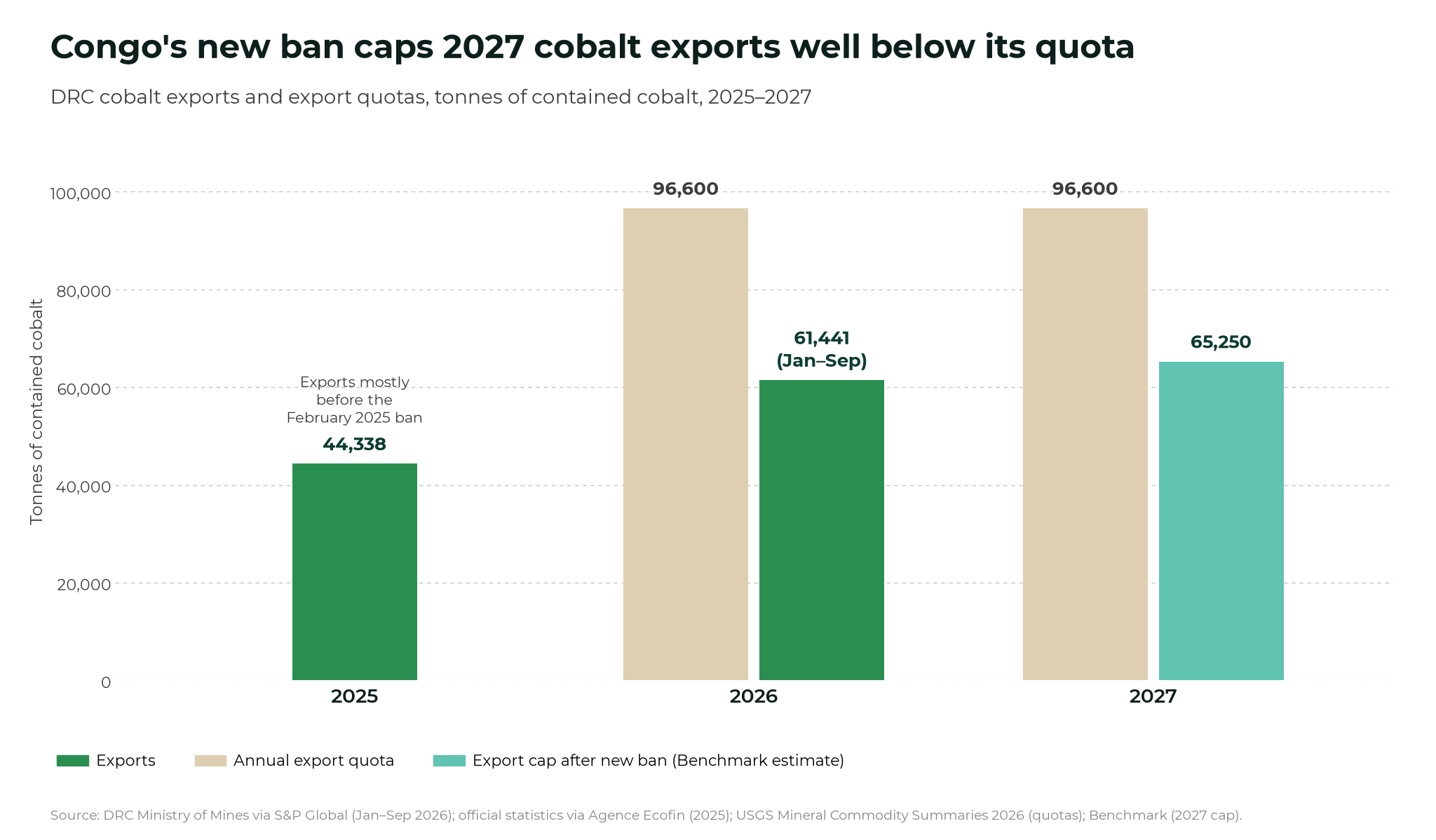
Congo exported 61,441 tonnes of contained cobalt in January–September 2026, according to Ministry of Mines statistics, against an annual quota of up to 96,600 tonnes for 2026 and 2027.
Benchmark estimates the ban caps Congo’s 2027 exports at 65,250 tonnes, removing 29,000 tonnes of cobalt from the market. That widens its forecast 2027 deficit from 22,000 tonnes to 40,000 tonnes.
Benchmark’s balance includes CMOC cobalt that cannot be exported; counting only material that can actually leave Congo, it puts the 2027 deficit at 127,000 tonnes.
ARECOMS will review the ban four months after it takes effect, but a review won’t automatically lead to a restart; any restart needs a separate decision setting volumes, quotas and conditions.
The last ban worked, then it faded
The first ban, from February 2025, more than doubled hydroxide prices within three months, from US$5.70 to US$11.75 a pound. Quotas replaced it in October 2025, and the cobalt price reached nearly US$58,000 a tonne in the first quarter of 2026, according to Agence Ecofin.
However, the rally didn’t last as higher prices pulled in recycled sulphate from black mass and mixed hydroxide precipitate (MHP) from Indonesia, while Chinese refiners held back from buying.
Hydroxide fell from US$23.75 a pound at the end of July to US$12.50 in mid-November, according to Benchmark, and Platts assessed it at an intra-year low of US$10.50 on 29 October.
Notably, those alternative supplies have not gone away. Congolese hydroxide has also built up in warehouses outside Congo, and Benchmark’s Roman Aubry said the ban gives miners and traders an opportunity to sell material already sitting in warehouses around China at higher prices.
In other words, the first months of the ban are likely to be met from stock rather than from new supply.
Indonesia, the second-largest producer with about 14% of mined supply, is the obvious place buyers will turn if the ban drags on. However, Jakarta signalled in early November a further cut to its 2027 nickel ore production quota, which could limit how much cobalt-bearing MHP it can add.
Kinshasa has shown it will hold cobalt back rather than sell it cheaply. Unless Indonesian MHP and the stocks already in China can cover a four-month gap, the cobalt price floor is now being set by Congo’s regulator, not by battery demand.