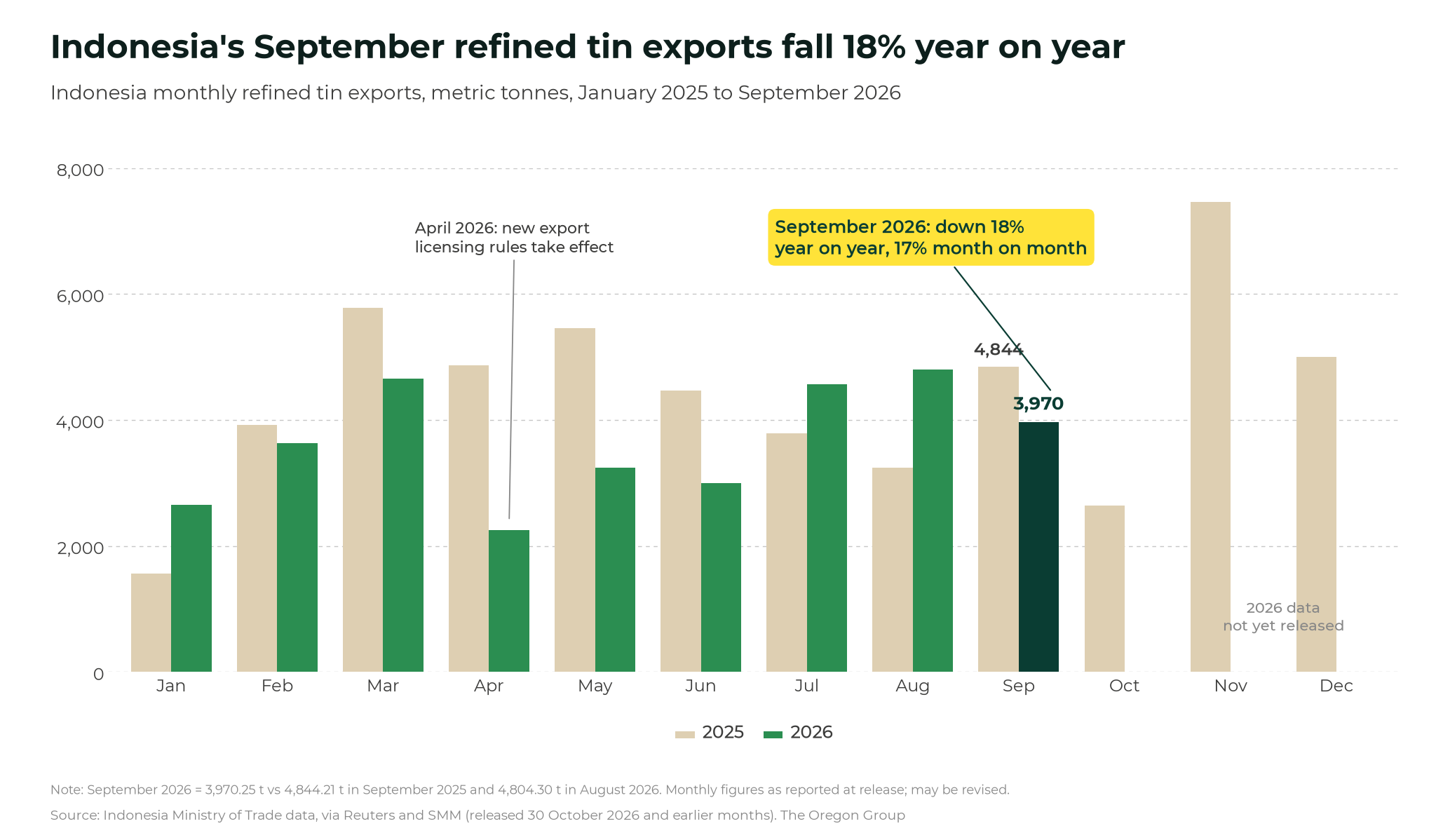
- refined tin exports from Indonesia, the world’s second-largest tin miner, fell 18% year on year to 3,970.25 metric tonnes in September 2026, from 4,844.21 tonnes in September 2025, trade ministry data released on October 30 show
- the premium for cash tin over the three-month contract on the London Metal Exchange (LME) reached US$350 a tonne on October 30, its highest since April 2024, even as three-month tin fell to US$48,505 a tonne, its lowest in more than six months
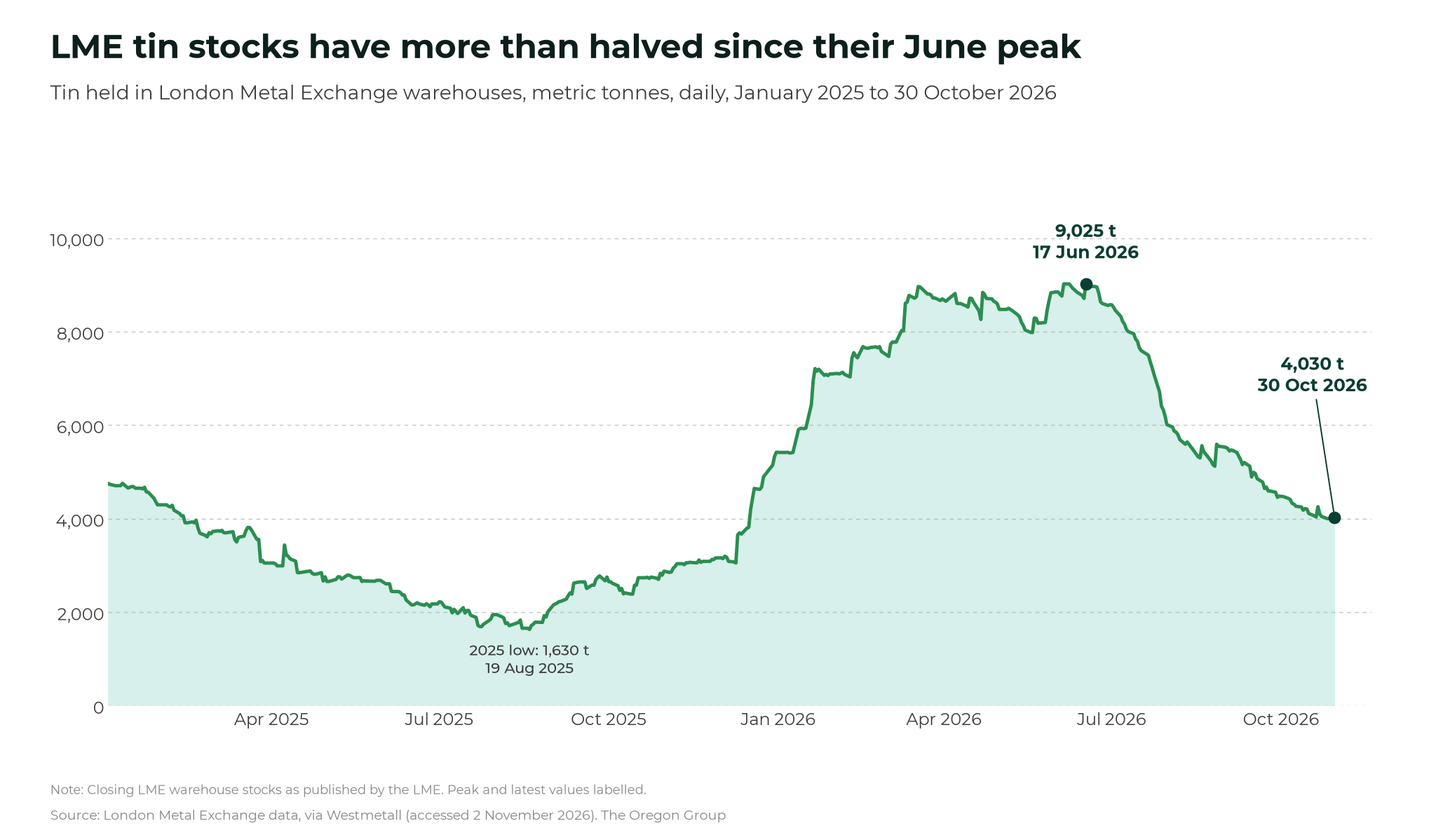
- Tin held in LME warehouses has more than halved, from 9,025 tonnes on June 17 to 4,030 tonnes on October 30, while China’s net imports of refined tin hit their highest level since the country became a net importer in February 2026
Indonesia’s refined tin exports fell 18% in September from a year earlier, tightening near-term tin supply even as prices sank to a six-month low.
Shipments dropped to 3,970.25 metric tonnes from 4,844.21 tonnes in September 2025, according to trade ministry data released on October 30. They were also down 17% from 4,804.30 tonnes in August.
Indonesia mined about 61,000 tonnes of tin in 2025, around a fifth of the world’s 290,000 tonnes and second only to China. It also holds the world’s largest tin reserves, at 1.4 million tonnes.
LME tin premium hits highest since April 2024
The market felt the squeeze just immediately with the premium for cash tin over the three-month contract on the LME hitting US$350 a tonne on October 30, its highest since April 2024, “signalling tight supply” according to Reuters.
(A cash premium, or backwardation, means buyers pay more for metal now than for delivery in three months.)
The same spread was in “wide contango” in early September, which suggested “little shortage of tin in the near-term”, International Tin Association (ITA) senior market analyst Tom Langston said at the time. But prices moved the other way, with three-month tin falling 1.9% to US$48,505 a tonne on October 30 after touching US$48,100, its lowest in more than six months, as worries about AI-related spending weighed on metals.
That compares with an official LME three-month price of US$57,775 a tonne on June 2, its highest this year.
Visible stocks also fell, with tin held in LME warehouses fell to 4,030 tonnes on October 30, from a 2026 peak of 9,025 tonnes on June 17.
China’s net imports of refined tin reached 2,571 tonnes in September, the highest since it became a net importer in February 2026, according to Shanghai Metals Market (SMM), citing Chinese customs data. Of the 3,890 tonnes of refined tin China imported that month, 2,734 tonnes came from Indonesia.
Why Indonesia is exporting less tin
Indonesia’s tin exports have been squeezed by Jakarta’s crackdown on illegal mining and smuggling, and by new export rules.
New trade ministry export licensing rules, issued on March 17 and effective from April 1, held up shipments while smelters waited for approvals. April exports fell 54% to 2,254.83 tonnes.
Exports rebounded in July as more smelters received licences, but “cumulative shipments remain 15% below last year, making any growth in global refined production this year increasingly unlikely”, Langston said in early September, based on data to July; and September’s fall keeps this year’s shipments well behind 2025’s pace.
Quotas are another constraint: Indonesia’s state miner PT Timah used up its 2026 production quota for Belitung island, about 3,000 tonnes, in roughly two and a half months, after a crackdown on smuggling pushed ore that once left the island illegally into its hands. When PT Timah could no longer pay mining contractors, unrest followed, and its Belitung office was burned on August 7. Presidential Regulation 79/2026, effective August 31, lets PT Timah produce above quota in Belitung for one year, subject to monthly independent verification.
PT Timah itself is growing fast, producing 16,190 tonnes of refined tin in the first nine months of 2026, up 49%, and sold 16,304 tonnes, up 72%, with 96% exported. So, the state miner is selling more while the country exports less — in other words, Indonesia’s crackdown is moving tin supply into PT Timah’s hands, not adding new tonnes to the market.
We flagged this risk in April 2024, in Is there enough tin supply to hold the tech revolution together?:
“The challenge is that 90% of reserves are located in regions where geopolitical risk is ranked as high, in particular, Indonesia and Myanmar.”
Myanmar and Congo feed China, not the LME
Elsewhere, supply is returning, but mostly into China.
China imported 161,300 tonnes of tin ore in January–September, up 76.7% on a year earlier, SMM said, citing customs data. Imports from Myanmar rose 194% to 57,000 tonnes, particularly after Myanmar’s Man Maw mine in Wa State, halted in 2023, is restarting slowly, although output “remains well below pre-suspension levels”, the International Crisis Group said in September.
In the Democratic Republic of Congo, Alphamin Resources produced 5,030 tonnes of contained tin at its Bisie mine in the third quarter. It kept annual guidance at 20,000 tonnes but warned that “El Niño conditions raise the risk of a more disruptive rainy season than usual” in the fourth quarter.
What it means for electronics, solar and investors
Tin is the metal that holds electronics together. Solder made up 51% of refined tin use in 2023, and solar ribbon accounts for about a fifth of solder production. This means chipmakers, data-centre builders and solar panel manufacturers are first in line when refined tin supply is squeezed.
Longer term, the ITA expects tin demand to grow 22% between 2026-2035, against 16% growth in refined supply, chief executive Helen Prins said on October 20. The World Bank also expects tin to average a record US$51,000 a tonne in 2026, before easing to US$45,000 in 2027.
Tin is getting cheaper on screen and scarcer in the warehouse. That gap will not last.
Caveats and counterpoints
- Monthly Indonesian export data swing widely, with shipments of 2,643.05 tonnes in October 2025 and 7,458.64 tonnes in November 2025, so October 2026 will be compared with a low base
- August 2026 exports rose almost 50% year on year, so one weak month does not confirm a new downtrend
- PT Timah’s above-quota permit in Belitung could lift Indonesian output in the coming months
- the US$350 backwardation is a single-day reading and can reverse quickly, as the swing from contango in early September shows
- Myanmar and Congo supply is rising, and higher Chinese refined output could eventually ease the market
- the price drop reflects real concern about AI-related spending, and the World Bank expects tin prices to fall in 2027