- Indonesia’s Forest Area Order and Enforcement Task Force (Satgas PKH) is taking enforcement action against companies linked to former Glencore trader Arif Kurniawan over alleged illegal forest use and mining-permit irregularities
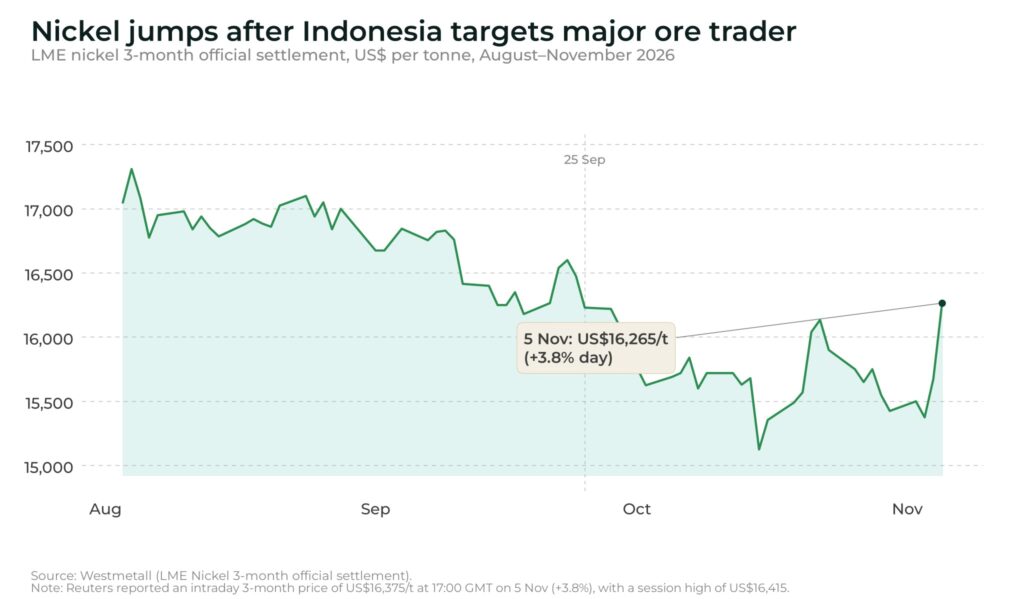
- LME three-month nickel rose 3.8% to US$16,375 a tonne at 17:00 GMT on November 5, with a session high of US$16,415, its strongest since September 25
- a 2025 Bloomberg investigation estimated his network handled about one-third of Indonesia’s domestic nickel ore trade and held interests in at least 20 concessions covering more than 71,000 hectares
Three-month nickel on the London Metal Exchange rose 3.8% to US$16,375 a tonne at 17:00 GMT on November 5 after Indonesia’s forest task force moved against companies linked to nickel trader Arif Kurniawan.
The metal hit a session high of US$16,415, its strongest since September 25. Westmetall’s LME three-month official settlement for the day was US$16,265, up from US$15,675 on November 4.
Indonesia’s Forest Area Order and Enforcement Task Force (Satgas PKH) has begun taking control of forest land allegedly used unlawfully by companies linked to Kurniawan, a former Glencore trader – as part of a wider crackdown on mining companies in Indonesia.
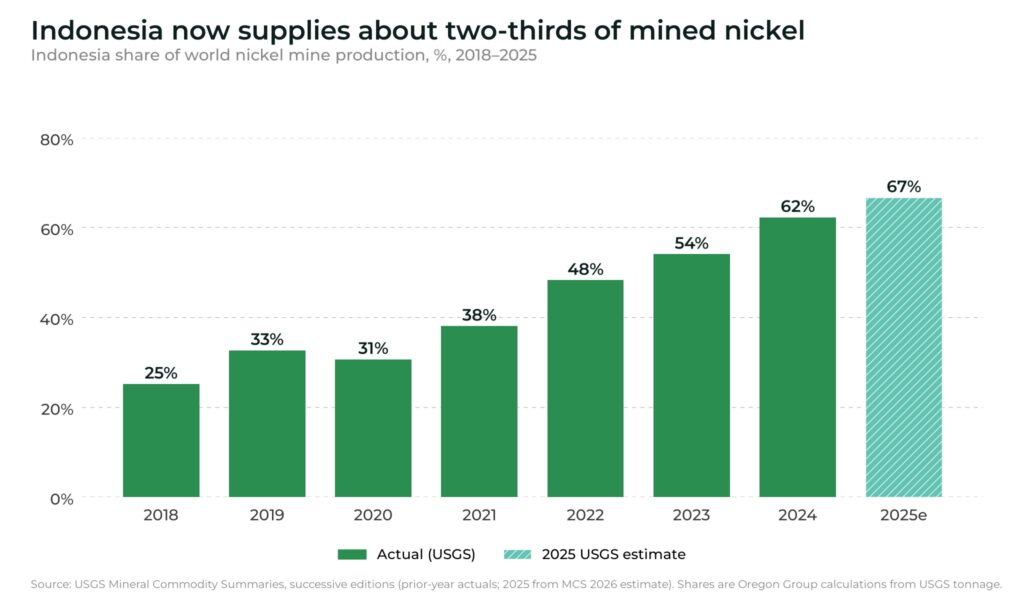
Indonesia accounted for about 62% of world nickel mine production in 2024 and an estimated 67% in 2025 — so, any disruption to a trader reported to have moved roughly a third of the country’s ore therefore matters far beyond Indonesia’s forests.
Task force spokesperson Barita Simanjuntak confirmed that the figure first identified only as “AK” is Kurniawan. Authorities say an initial review found irregularities in mining governance, licensing and forest use. Under Presidential Regulation No. 5 of 2025, the task force can reclaim land, impose administrative fines, recover assets and refer evidence for prosecution.
A 2025 Bloomberg investigation estimated that Kurniawan and his main business partner held interests in at least 20 mining concessions spanning more than 71,000 hectares, and that his businesses handled about one-third of Indonesia’s domestic nickel ore trade, although the task force has not confirmed those figures.
The Kurniawan case sits inside a wider Satgas PKH campaign:
- by 6 October 2026 the Attorney General said the task force had reclaimed about 14,634 hectares of forest used for mining since February 2025, up from about 5,209 hectares across 39 companies by 1 October 2025
- that is still a small slice of Indonesia’s mining footprint: over the same period Satgas reported more than 6.2 million hectares reclaimed in the palm-oil sector
- an early mining case was about 148 hectares at PT Weda Bay Nickel in Halmahera, North Maluku, sealed in September 2025
Forest rules are one lever among several under President Prabowo. For example, Jakarta revoked four nickel licences in Raja Ampat in June 2025, raised progressive mining royalties under Government Regulation No. 19 of 2025, and moved mining production quotas to a one-year approval cycle.
For investors outside Indonesia, the pattern matters more than any single hectare count as environmental and forestry enforcement can interrupt ore supply and leave more pricing power with producers elsewhere.
Indonesian producers were already facing tighter mining quotas and rising costs in 2026, with Macquarie now expects nickel and nickel-product exports to fall about 6% this year, more than it forecast at the start of the year, and says attention is shifting to the 2027 ore quotas.
That fits the theme we set out in Indonesia’s nickel dilemma is the West’s opportunity, with Indonesia’s scale has come with environmental and governance risk, and that opens the door for producers elsewhere. Going after a trader credited with a third of ore flows is a bigger test of whether enforcement becomes a lasting supply shock. It also lands on top of Jakarta’s tighter 2026 ore quota, which has already left smelters leaning on Philippine ore.
However, the task force has not named the companies or concessions, said how many hectares are involved or announced any criminal findings, and Glencore has not been linked to the latest action. So, if the land comes back into legal production quickly, the supply risk fades.
But, for now, the move fits a pattern in the world’s largest nickel producer — the government is moving in with greater regulation. And the nickel price is responding.