- two sulphur bulk carriers loaded in the UAE and Qatar crossed the Strait of Hormuz in the two days to October 19, despite as many as 12 incidents against shipping the previous week
- CRU estimated in early July that Middle East sulphur production losses had reached around 2.3 million metric tonnes since the war began, with regional exports down by more than 1 million tonnes a month
- oil is now clearing Hormuz at about 82% of its pre-war rate, but Gulf sulphur loadings fell to 392,000 tonnes in May from a monthly average of 1,170,000 tonnes in 2025
Two bulk carriers loaded with Gulf sulphur crossed the Strait of Hormuz in the two days to October 19, one of them likely bound for an Indonesian nickel producer, carrying cargoes from a region that normally supplies close to half of the world’s traded sulphur.
The crossings came despite as many as 12 incidents against shipping in the previous week, including a bulk carrier that was hit.
This matters because — as we’ve highlighted in our previous reports (please see “Strait of Hormuz is chokepoint for sulphuric acid and critical metal processing“) — sulphur is the feedstock for sulphuric acid, and sulphuric acid is what leaches nickel in Indonesia, copper in Chile and Congo, and phosphate for the world’s fertiliser.
How much Gulf sulphur has been lost?
Gulf producers have held close to half of traded sulphur every year from 2016 to 2025. The Middle East’s share of seaborne sulphur trade at over 45% in 2025, with most export ports located inside the Strait of Hormuz.
The war that began on February 28 has cut both production and exports.
CRU estimated in early July that Middle East sulphur production losses had reached around 2.3 million tonnes since the conflict started. Regional exports were down by more than 1 million tonnes a month, with production was running at around 60-70% of pre-conflict levels.
The export collapse shows up clearly in shipping data.
Kpler data show Middle East Gulf sulphur loadings averaged around 1,170,000 tonnes a month in 2025, peaking at 1,636,000 tonnes in August 2025 — but loadings fell to 668,000 tonnes in March 2026 and 392,000 tonnes in May.
IFPRI’s trade data tell the same story with world elemental sulphur exports falling 33% in the first half of 2026, from 13.5 million tonnes to 9 million tonnes — what IFPRI calls a “4.4 million MT drop” — Gulf suppliers accounted for almost three-quarters of it. By June 2026, Gulf shipments had fallen to 147,000 tonnes, below an 11-year June range of 730,000 tonnes to 1.2 million tonnes.
“The concentration follows the geography of gas sweetening and oil refining and drew little attention before the current disruption. Now it has become a serious chokepoint for the global sulfur market” — Joseph Glauber of IFPRI and Shawn Arita of North Dakota State University
And this is not just a shipping problem as sulphur is a by-product of refining oil and processing sour gas, so when Gulf plants shut, sulphur output stops with them.
For example:
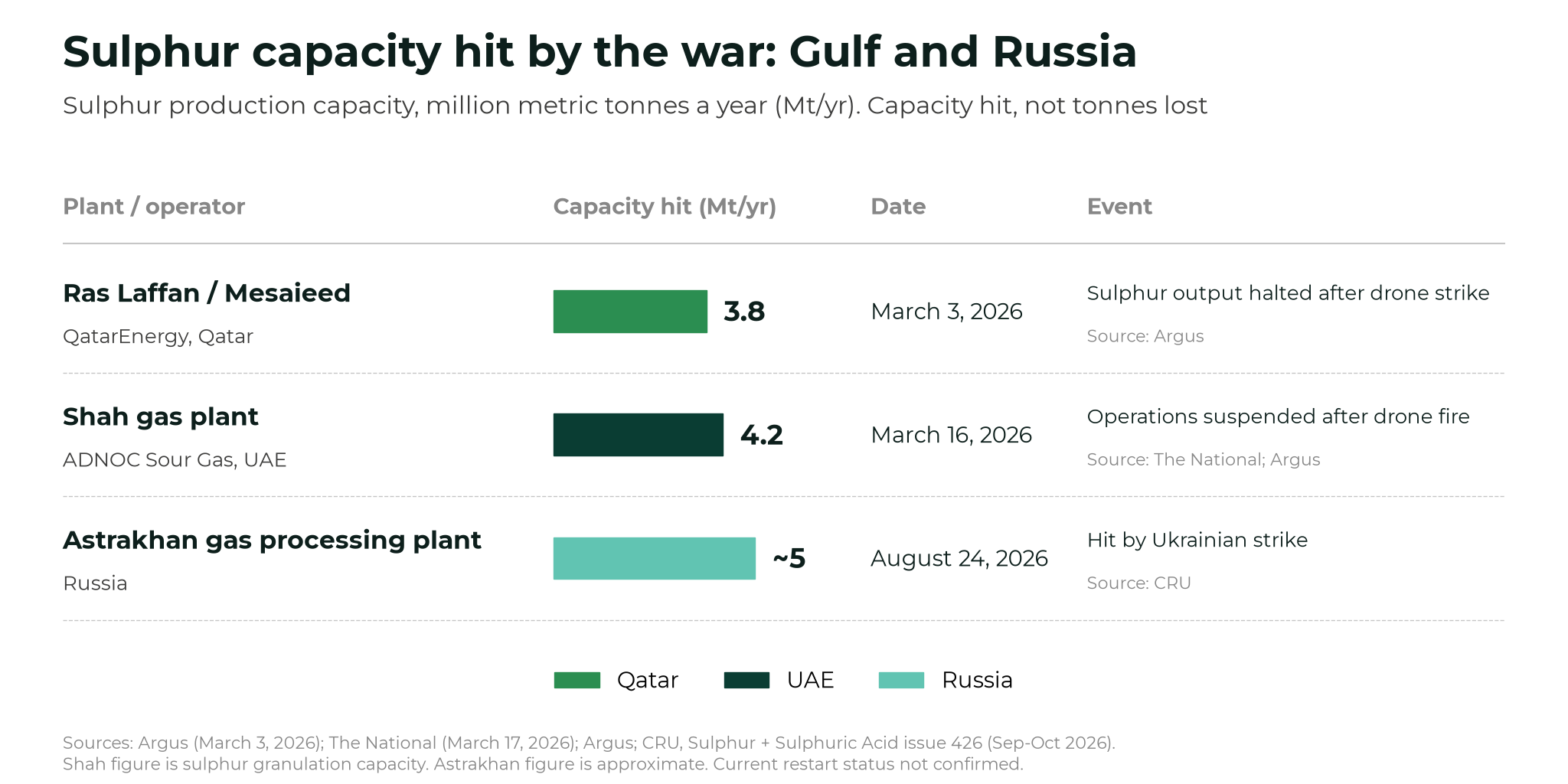
- QatarEnergy halted sulphur production on March 3. It has about 3.8 million tonnes a year of capacity and exported 3.4 million tonnes in 2025, around 8% of seaborne trade, Argus estimates
- ADNOC’s Shah gas plant, the world’s largest producer of granulated sulphur with about 4.2 million tonnes a year of capacity, suspended operations after a drone attack caused a fire on March 16
- Kuwait Petroleum Corporation cut refinery runs and declared force majeure in early March. Kuwait exported 2.4 million tonnes of sulphur in 2025
Bringing plants back is not simple either. For example, a fatal explosion at QatarEnergy’s Barzan gas facility, inside the Ras Laffan complex, killed 13 workers on June 21 two days after the plant restarted. And Barzan had been shut for maintenance since December 2025.
Meanwhile, supply outside the Gulf has also been hit. A Ukrainian strike on August 24 hit Russia’s Astrakhan gas processing plant, which CRU says accounts for over 60% of Russia’s sulphur output and has around 5 million tonnes a year of capacity.
Why oil is getting out of Hormuz, but sulphur is not
The information space is incredibly opaque at the moment, but oil prices suggest Hormuz is still largely closed. Brent settled at US$108.82 a barrel on October 21, near a five-month high, after at least 18 vessel attacks in two weeks.
But some shipping (and oil) is moving. Kpler’s measure of total Hormuz oil clearance, which excludes Iranian-origin cargoes, averaged 14,104,000 barrels a day over seven days to October 18, about 82% of the pre-war baseline. Tanker crossings still averaged 12 a day over seven days, against 50 a day before the war. Gulf crude exports are estimated recovered to within 10% of January-February levels, according to TankerTrackers.com.
This data suggests oil prices now reflect risk and thin inventories rather than a full blockade.
But, oil has workarounds that sulphur does not.
For example:
- Saudi Arabia diverts crude through its 7 million barrels a day East-West pipeline to the Red Sea port of Yanbu, bypassing the strait
- Red Sea exports, covering Saudi cargoes and unattributed ship-to-ship volumes, averaged 4,648,000 barrels a day over seven days, above a pre-war baseline of 2,804,000 barrels a day, according to Kpler
- Gulf of Oman ship-to-ship exports climbed from 642,000 barrels a day on October 16 to 9,670,000 barrels a day on October 18, Kpler data show
Sulphur has no pipeline. It moves as dry bulk from ports inside the strait, on a limited pool of ships willing to make the voyage, often with tracking switched off. Freight for a 30,000-50,000-tonne sulphur cargo is estimated at US$140s-200 a tonne because of the risk.
The backlog is large: at the start of September, CRU reported 600,000 tonnes of sulphur on 13 vessels still waiting to transit the strait.
As we warned in March, in Strait of Hormuz is chokepoint for sulphuric acid and critical metal processing, the oil price was always the wrong gauge:
“The Strait of Hormuz disruption is not just an oil-market story. It is a metals-processing story (and food security story).”
Who is exposed?
Indonesian nickel is arguably the metal most exposed as Indonesia sourced 76% of its sulphur imports from the Middle East last year.
Supply has improved since the second quarter, helped by better Hormuz shipping capacity and extra Canadian sulphur, according to Shanghai Metals Market (SMM), but high-pressure acid leach (HPAL) plants are now reportedly losing money.
Copper is arguably the second pressure point. For example:
- Chile lost 541,000 tonnes of Chinese sulphuric acid in the first half, more than a third of China’s entire export reduction, according to IFPRI
- China shipped 31,666 tonnes of acid to Chile in September, its first shipments since May, but total exports remained well below May’s 116,703 tonnes
- in Congo, Ivanhoe Mines’ average net realised acid price roughly doubled quarter on quarter to about US$900 a tonne in the third quarter, reflecting strong demand from copper and cobalt producers on the Congolese Copperbelt
Fertiliser makers are also cutting output. Mosaic idled phosphate production at its two Louisiana plants in late August, and Ma’aden cut its 2026 phosphate production guidance, both citing sulphur supply.
Phosphate fertiliser prices rose 25-30% after the strait closed and have stayed at those levels, IFPRI says.
Uranium is exposed too. As we reported in September, Russia’s sulphuric acid export ban raises risk for Kazakhstan uranium supply, after Russia supplied 93.6% of Kazakhstan’s acid imports in 2023. In July, an acid plant failure forced Cameco to suspend mining at Cigar Lake.
| Metal / sector | How sulphuric acid is used | Exposure to Hormuz‑linked sulphur |
| Nickel | HPAL and other laterite leach circuits are highly acid‑intensive, both for MHP and nickel sulfate production | Indonesia’s HPAL capacity is heavily reliant on Middle East sulphur imports and carries minimal inventory cover |
| Copper | Widely used in heap leaching, SX‑EW and other hydrometallurgical routes, especially for oxides and low‑grade ores | Central African copperbelt imports ~2 Mt/y sulphur from the Middle East; disruptions directly hit oxide leach capacity |
| Cobalt | Often co‑produced with copper and nickel in acid leach circuits | DRC supplies 70% of mined cobalt; reliance on imported sulphur links cobalt supply to Hormuz flows |
| Uranium | Sulphuric acid is a standard reagent in acid leaching and in‑situ recovery | Projects using acid ISR or leach, particularly where sulphur is imported, face rising reagent costs and potential curtailments |
| Rare earths | Used in acid cracking and leaching in several flowsheets | Projects outside China that rely on imported acid or sulphur are most exposed; Chinese operations are partly shielded by captive capacity |
| Lithium | Acid used in some leach‑based routes and in upstream reagents for conversion | China’s refining base is indirectly exposed via higher global sulphur and acid prices and any constraints on imports |
| Titanium dioxide | Sulphate process reacts ilmenite or slag with sulphuric acid | Pigment producers using the sulphate route face higher reagent costs; chloride‑route producers are less affected |
| Zinc, manganese, and others | Various hydrometallurgical flowsheets and secondary processing use sulphuric acid | Exposure is more asset‑specific; operations with captive acid are advantaged over toll buyers |
Sulphur prices are falling, but supply has not returned
The strongest counterevidence is price.
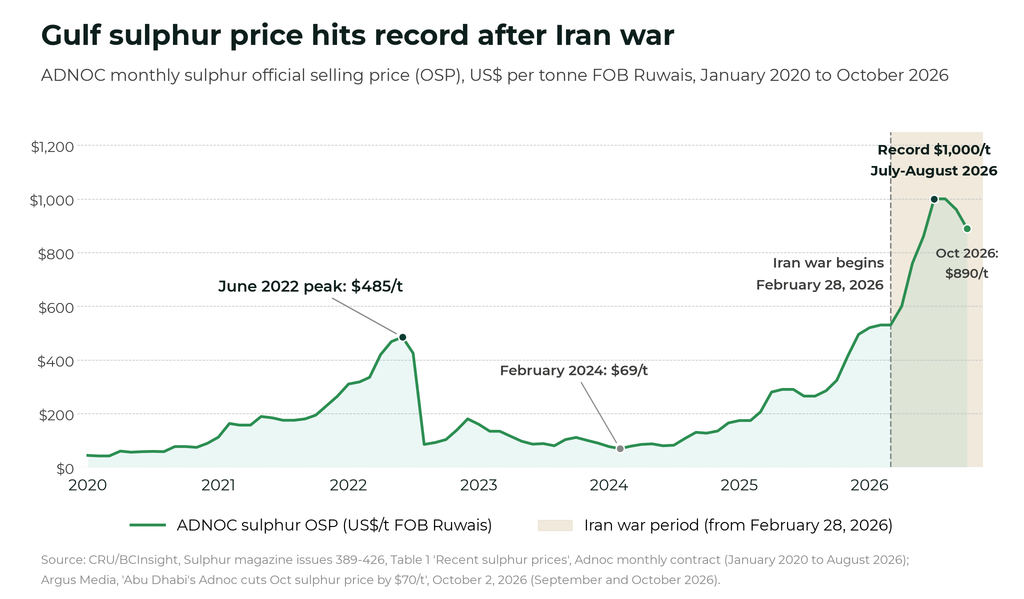
Middle East producers cut October contract prices by US$45-70 a tonne, with QatarEnergy at US$835 a tonne FOB, Kuwait at US$820 and ADNOC at US$890. Spot Middle East sulphur fell to US$740-790 a tonne FOB on October 15, from US$810-850 a week earlier. In China, sulphur prices have fallen 21.17% in a month but remain 108.16% higher than a year ago, according to Trading Economics data cited by Kontan.
But, notably, prices are still far above pre-war levels. eg Kuwait’s sulphur price was US$520 a tonne FOB in March.
Some supply is returning with, for example, Kazakhstan officially lifting its sulphur export ban on August 4, according to CRU.
But the fall in price most likely reflects weak demand rather than new supply; for example, Phosphate producers have cut output because they cannot afford the feedstock, with plants shut in Egypt and Brazil.
CRU forecasts sulphuric acid delivered to Chile falling to US$215 a tonne in the fourth quarter of 2027, from a record of US$451 earlier this year. CRU analyst Chris Lawson put it this way at LME Week:
“There’s a bit of relief for those that are more exposed to the spot and contract sulphuric acid markets”
The December 31 cliff
The next test comes at year-end, when several of the market’s biggest export curbs are due to expire, including:
- China’s sulphuric acid exports were reportedly suspended for May-December, and CRU expects them to fall from 4.64 million tonnes in 2025 to 950,000 tonnes this year
- Russia’s sulphur export ban, in force since November 1, 2025, has been extended until the end of 2026, with an allowance to export up to 300,000 tonnes of low-grade material by permit
- Russia’s temporary restrictions on sulphuric acid exports also run until December 31, as we reported in September
If Beijing and Moscow roll these curbs over while Hormuz remains contested, the October price relief may prove short-lived. If they lapse, acid buyers in Chile and Indonesia gain alternatives just as Gulf supply begins to recover.
Conclusion
Oil has found ways around Hormuz; sulphur has not. Until Gulf bulk carriers can sail freely, lower sulphur prices are a reprieve for miners and fertiliser makers, not a fix.