- on October 22, President Donald Trump declared US petroleum production, refining and logistics capacity essential to national defense and directed the Secretary of War to fund its expansion under the Defense Production Act
- it came as Mike Waltz, Trump’s ambassador to the UN, told the Financial Times the US could still face a stalemate with Iran a year from now, according to Investing.com
- US refining capacity fell by more than 250,000 barrels a day in 2025 to 18.2 million barrels per calendar day, according to the EIA
President Donald Trump has ordered the Pentagon to use the Defense Production Act to expand US oil production, refining, pipelines and storage — using the familiar toolkit Washington has used to finance critical minerals supply.
The memorandum to the Secretary of War authorises “purchases, commitments, and financial instruments” for projects ranging from exploration to marine terminals, warning that US industry cannot deliver that capacity in time “due to constrained financing, long lead times, permitting and infrastructure bottlenecks, and supply chain limitations.”
Washington has made much the same case for critical minerals, including rare earths, germanium and graphite.
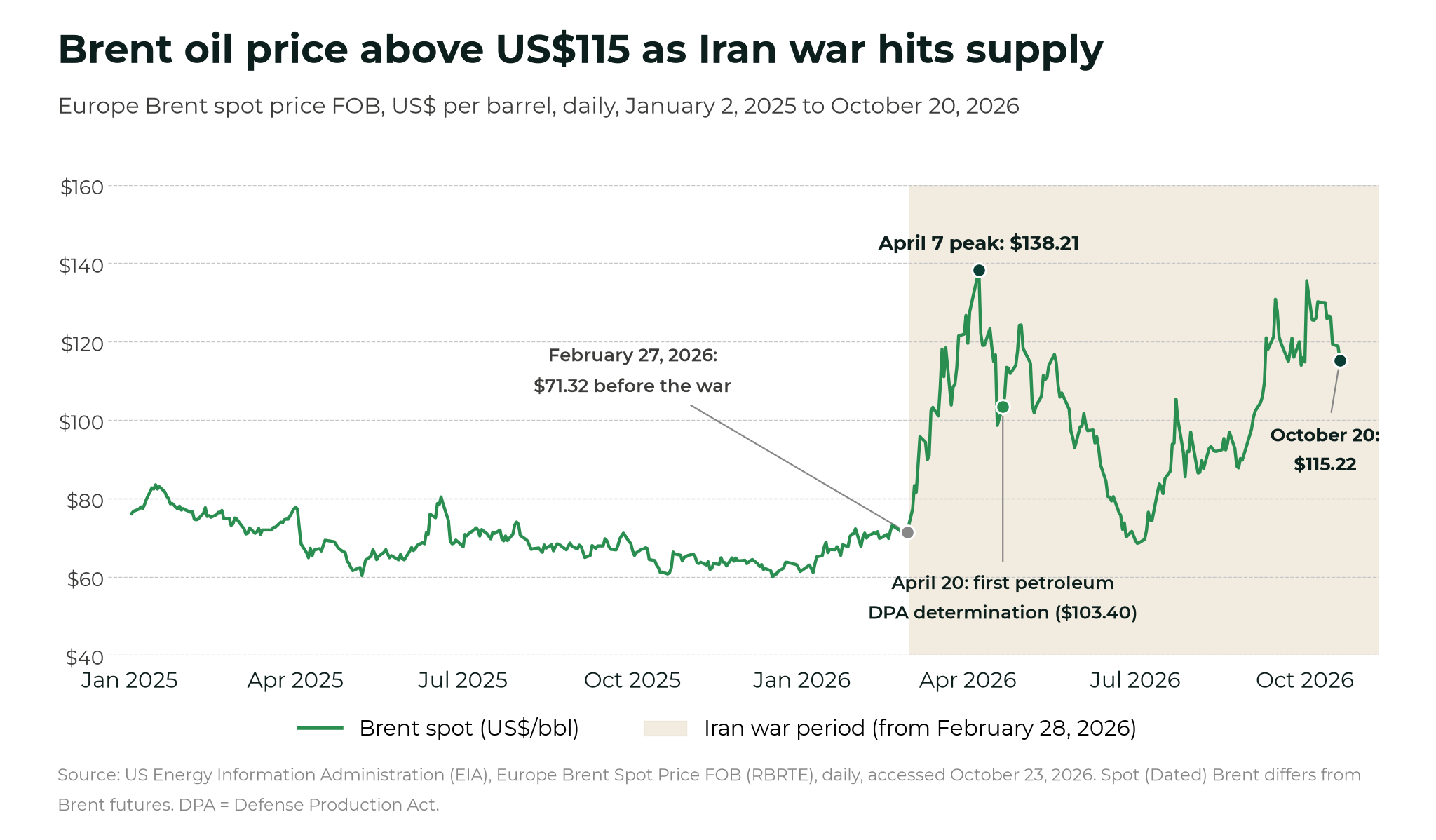
Prices for crude and diesel have surged since the US and Israel attacked Iran at the end of February, and the order comes as Brent crude futures rose 4% to US$113.17 a barrel on October 22, their highest close since May 4, after Houthi attacks on Saudi Arabia.
The order lands less than two weeks before the November 3 midterm elections.
The minerals playbook, now applied to oil
The move matters because the Defense Production Act has become a key Washington tool for financing supply chains that private capital will not build on its own.
Critical minerals were the testing ground, for example:
- in March 2022, President Joe Biden issued a Section 303 determination for lithium, nickel, cobalt, graphite and manganese used in large batteries
- in July 2025, the Pentagon agreed to buy US$400 million of MP Materials preferred stock, lend US$150 million and set a US$110-per-kilogram NdPr price floor
- in January 2026, the Pentagon announced a US$18.1 million DPA Title III award to 5N Plus to expand germanium refining sevenfold to more than 20 metric tonnes a year
- in June 2026, the Pentagon’s Office of Strategic Capital signed a US$500 million conditional loan commitment with Phoenix Tailings
On the same day as the oil order, the Commerce Department signed letters of intent for up to US$389 million of CHIPS R&D awards to four companies, including up to US$56 million for Sibelco’s ultra-high-purity quartz; it will take a minority, non-voting equity stake in each as a condition of the awards.
As we wrote in our earlier article America’s $27 billion push to break China’s minerals grip:
“The scale matters, but the more consequential shift is how Washington is putting its balance sheet to work: taking equity stakes, providing loans, supporting prices and backing customers’ purchases.”
Oil, it appears, is now to undergo the same treatment.
Why the Pentagon matters
The October order repeats Trump’s earlier April 20 memorandum on oil almost word for word. The difference is who it is addressed to: in April it went to the Energy Secretary, now it goes to the Secretary of War.
The Energy Department however, had not stepped aside; for example, on October 22, it announced up to US$150 million of DPA Title III funding for refineries under the April determination, with recipients still to be selected.
This will mean that refineries and pipelines can now compete for the same defence-industrial financing as germanium refiners and magnet plants.
Built for a long war
The order never mentions Iran, but it reads like a plan for a conflict that will not end soon. It sets no end date and, instead, it says warns “without immediate Federal action, United States defense capabilities will remain vulnerable to disruption.”
It is also the second time in six months that the White House has made the same finding — but this time it is addressed to the Secretary of War, whose department is waging the war.
Notably, the assets it covers, from oilfields and pipelines to storage, marine terminals and refineries, take a long time to build. The memo itself cites “long lead times”, and refinery expansions typically take many months, if not years.
In other words, the order suggests Washington expects fuel supply to stay under pressure well beyond the midterms.
And the administration is now saying as much with Mike Waltz, Trump’s ambassador to the UN, telling the Financial Times that the US could still face a stalemate with Iran a year from now, with no nuclear deal and no return to prewar shipping through the Strait of Hormuz.
Meanwhile, other geopolitical players also see a long disruption, for example:
- on October 5, Saudi Aramco chief executive Amin Nasser said rebuilding global oil inventories could take up to two years once the Strait of Hormuz fully reopens
- on October 8, former US defense secretary Mark Esper said he saw the conflict continuing “well into 2027”
- on October 9, the Washington Post reported that the Trump team is preparing for a long economic war with Iran
The G7’s 100-million-barrel emergency stock release, agreed on October 2, runs over four months, but building refineries is a bet that can take years.
Refining, not crude, is the bottleneck
The US is not short of oil, averaging around 13.6 million barrels a day of crude production in 2025, making it the world’s largest crude producer. The constraint is turning that crude into fuel. US operable refining capacity stood at 18.2 million barrels per calendar day on January 1, 2026, with 130 refineries, two fewer than a year earlier.
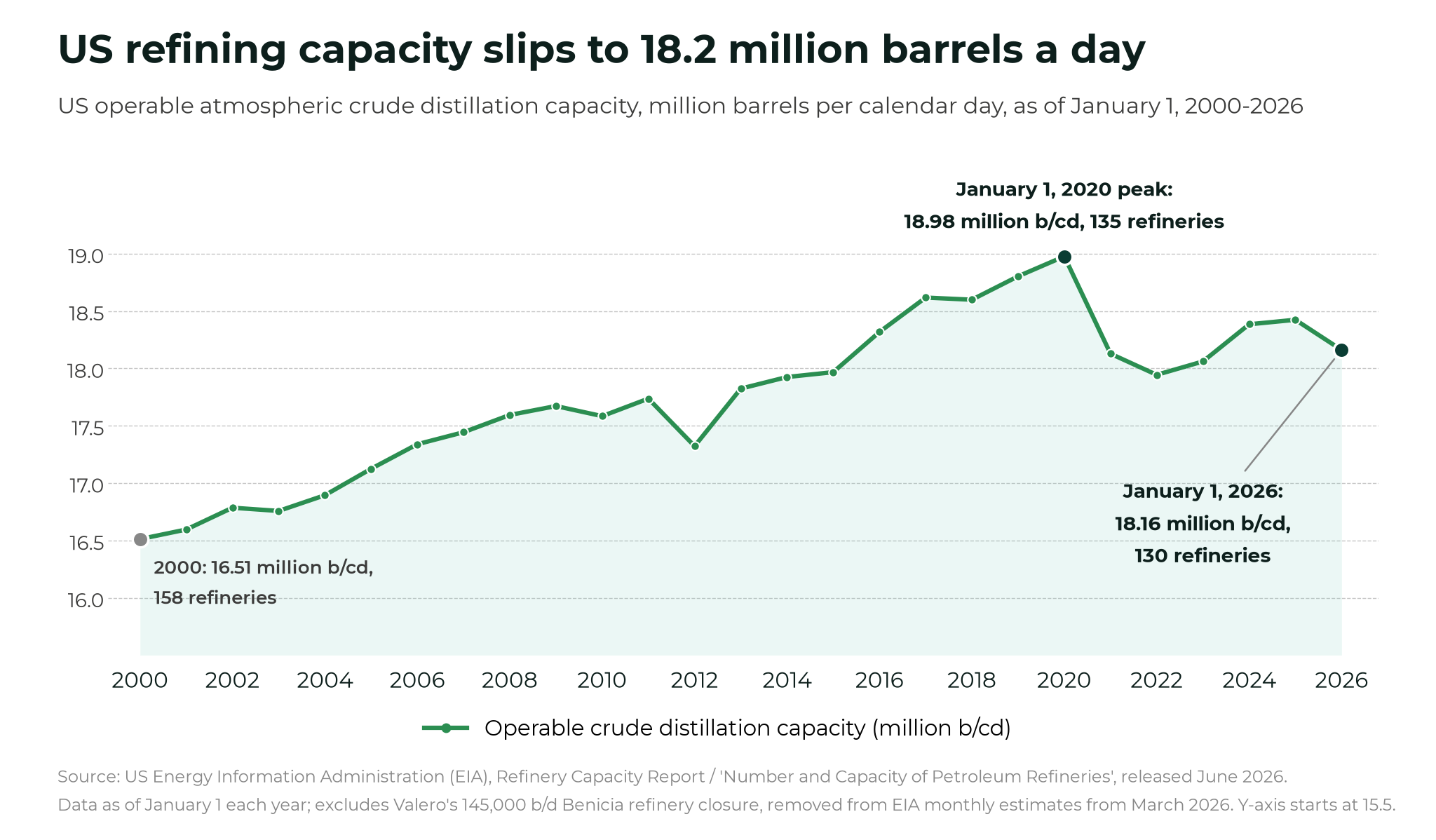
LyondellBasell closed its Houston refinery in March 2025 and Phillips 66 shut its Los Angeles plant in October 2025. Valero’s 145,000-barrel-a-day Benicia refinery has also since stopped refining. Meanwhile, the remaining plants are running hard. In an October 8 note, Mizuho said US refinery utilisation hit a record 96.3% in the third quarter and that refining stocks were up about 152% this year.
For miners, that squeeze lands on diesel, as we warned in US diesel crack tops $102 as global fuel squeeze threatens mining:
“The SPR can soften the price of crude, but it cannot directly refill a diesel tank.”
What it means for commodities investors
It is not yet clear whether the oil push comes with new money. The Energy Department’s US$150 million is drawn from an existing US$1 billion DPA fund that has already been tapped for coal, power lines and gas, Roll Call reported.
The memo itself does not name specific projects, and the Energy Department has yet to pick recipients for its US$150 million.
Higher oil is meanwhile hurting gold with spot gold prices sliding 2.2% to US$4,051.55 an ounce on October 22, a more-than-two-week low, as the oil rally raised inflation fears.
The bigger signal is for minerals policy: by putting oil into the same national-defence framework, Washington is treating energy and critical minerals as one industrial-security problem — and is willing to put public money, and potentially equity, behind both.
That supports the case that state financing for mines and processing plants is a durable policy, not a one-off response to China’s export controls.