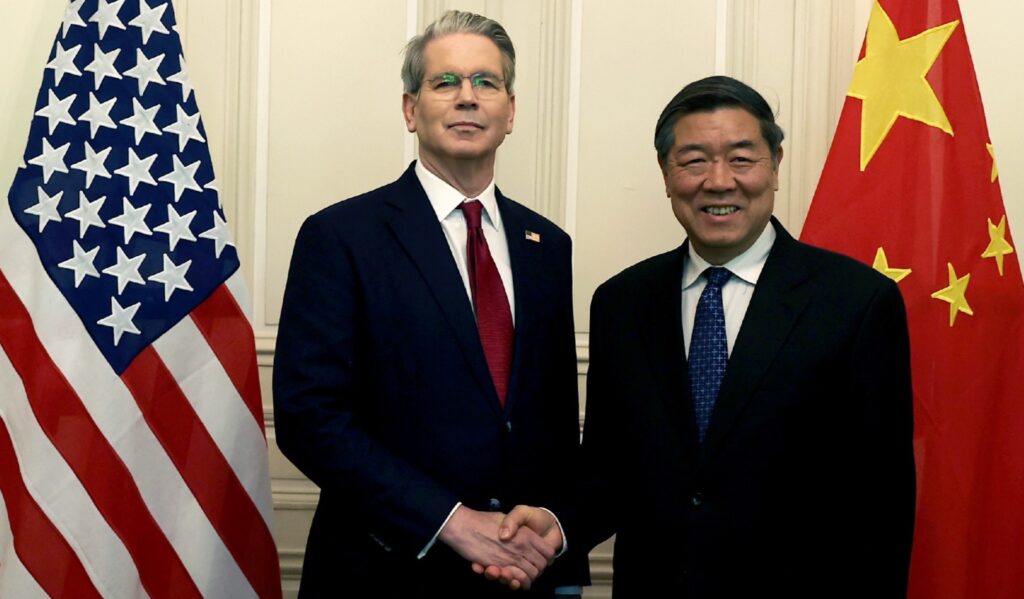
- the US warned China on Friday it must immediately meet its Busan trade commitments, after US officials said Beijing was fulfilling only about two-thirds of its rare-earth pledge
- Treasury Secretary Scott Bessent and USTR Jamieson Greer spoke with Vice Premier He Lifeng on November 6, with Bessent pressing China to fully and immediately implement its Busan commitments and Greer naming rare earths, other critical minerals and farm purchases
- China’s published suspension of its October 2025 rare-earth export controls still ends on November 10, 2026 under MOFCOM Announcement No. 70, even as the US says the wider truce now runs to January 10, 2027
The US warned China on Friday it must “immediately” meet its commitments under the Busan trade deal, after US officials told the Financial Times in September that Beijing was fulfilling only about two-thirds of its rare-earth pledge.
One person familiar with the talks said China had not raised rare-earth supply since Treasury Secretary Scott Bessent raised the issue directly with Vice Premier He Lifeng in New York in September, ahead of Xi Jinping’s meeting with Donald Trump in Washington.
On Friday morning, November 6, Bessent and US Trade Representative Jamieson Greer spoke with He Lifeng about the bilateral economic relationship and implementation of the Busan arrangement, the deal Trump and Xi struck in Busan, South Korea, in October 2025. Bessent emphasised “the importance of China fully and immediately implementing its commitments made in Busan” and raised concerns about recent Chinese actions. Greer emphasised “concrete actions” to fully implement past commitments, “particularly as they relate to agricultural purchases, rare earths, and other critical minerals.” The official readouts do not quantify the shortfall. China has rejected US claims that it is not fulfilling its rare-earth commitments, according to the FT.
One US official told the FT that Bessent and Greer made clear Trump viewed the situation as a “priority” and that China had to live up to its Busan pledges.
On X, Bessent put the same demand in his own words:
“I emphasized the importance of China fully and immediately honoring its commitments, raised concerns about recent Chinese actions and underscored that progress depends on concrete results.”
Greer named the commodities again:
“I underscored the critical importance of China taking concrete actions to fully implement its past commitments, particularly as they relate to agricultural purchases, rare earths, and other critical minerals.”
Separately, at MOFCOM’s November 5 regular press conference, spokesperson Huang Ling said China remains open to buying more US farm goods, but only if both sides implement their “US$30 billion for US$30 billion” reciprocal tariff-cut arrangement. The FT reports that Washington has concluded China is meeting its soybean pledges but falling short on other farm produce.
What the deal promised on rare earths
Under the White House Busan fact sheet, China agreed to suspend the expansive rare-earth export controls announced on October 9, 2025, and to issue general licences for rare earths, gallium, germanium, antimony and graphite for US end users and their suppliers worldwide.
That suspension is time-limited on China’s books. MOFCOM and Customs Announcement No. 70 of 2025 pauses the October 2025 package only until November 10, 2026. The April 2025 licensing regime on seven medium and heavy rare earths, including yttrium, dysprosium and terbium, was never suspended and still needs a MOFCOM licence for each shipment. When Xi visited Washington in September, the sides extended the original truce deadline by two months to January 10, 2027 after negotiators failed to resolve differences, according to the FT. China’s published Announcement No. 70 has not yet been amended to match that date.
The market picture
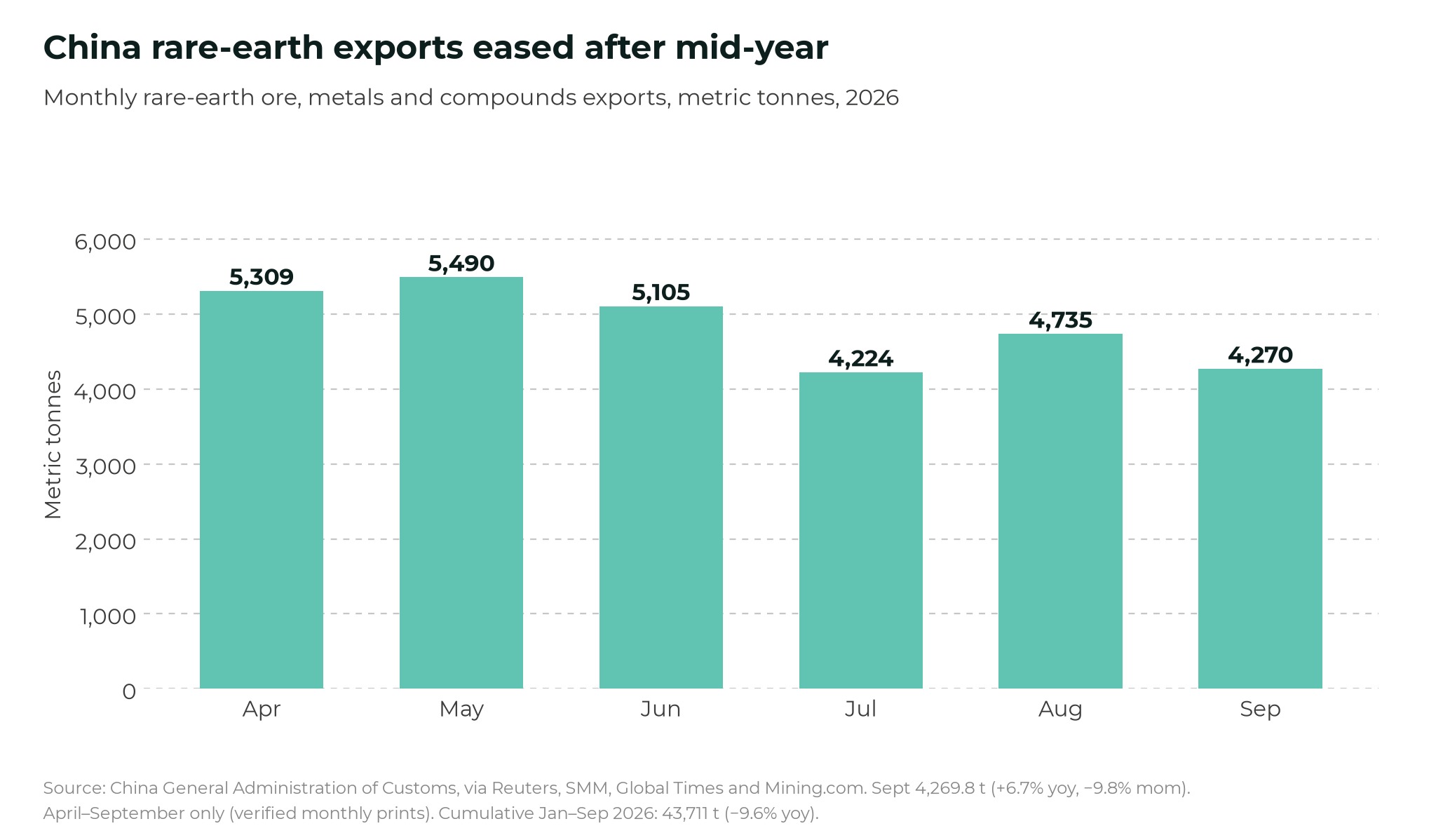
China’s overall rare-earth exports are not collapsing. Customs data via SMM show September shipments of 4,269.8 metric tonnes, up 6.7% from a year earlier but down 9.8% from August. January-September exports were 43,711 tonnes, down 9.6% year on year.
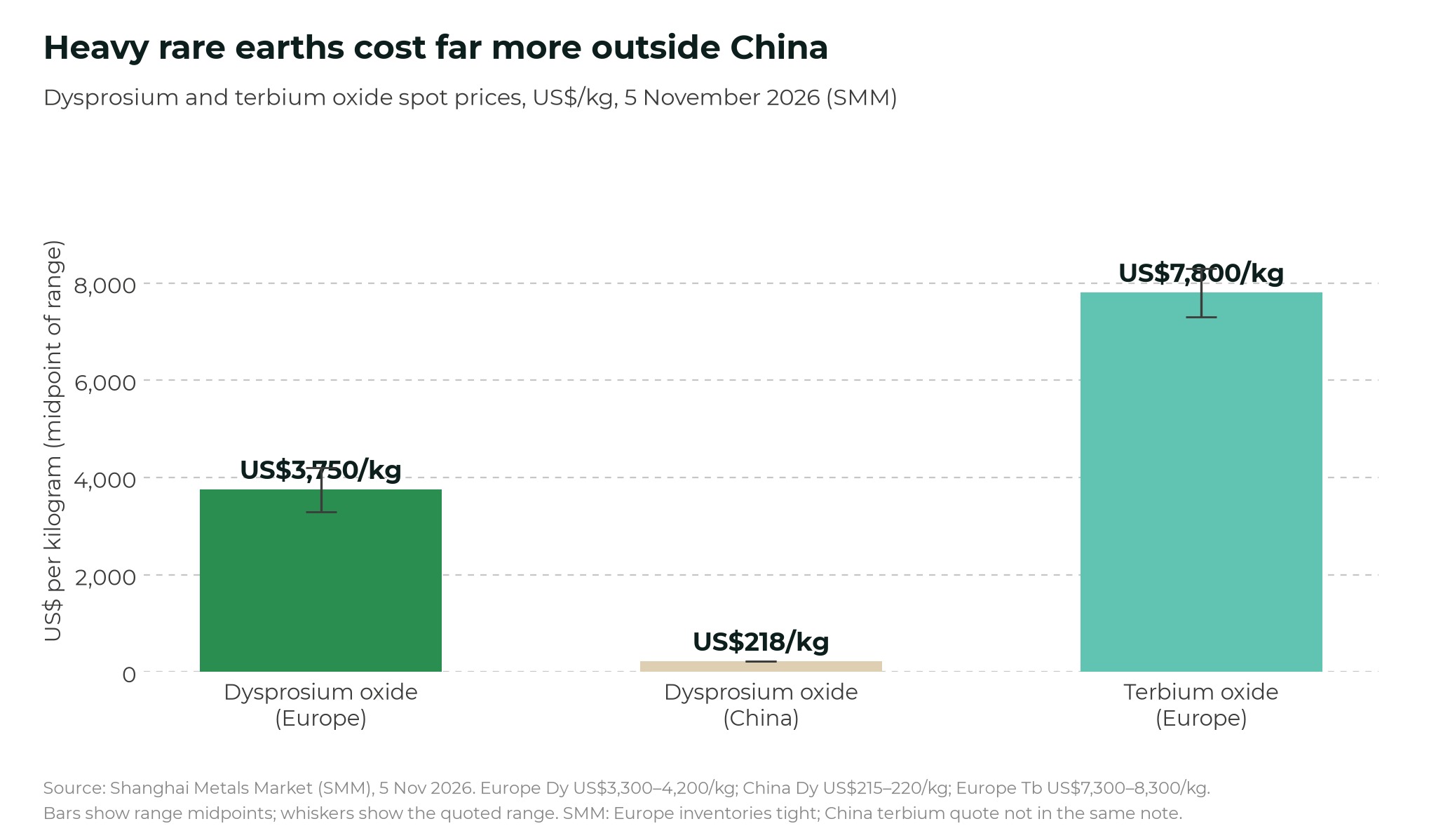
The squeeze shows up more clearly in heavy rare earths and prices outside China. As of November 5, SMM quoted European dysprosium oxide at US$3,300-4,200 a kilogram, against US$215-220 a kilogram inside China. European terbium oxide was US$7,300-8,300 a kilogram. SMM said inventories in Europe were tight and that dysprosium, terbium and gadolinium often had prices but no goods.
Washington is also concerned about Chinese restrictions on yttrium exports to Japan, which makes components for US-manufactured products. Japanese companies have warned their government that stockpiles are running dangerously low, the FT reports. That matches the picture we laid out in October: China’s yttrium oxide exports to Japan fell 97.7% in January-May 2026. China still accounted for 60% of mined magnet rare earths, 91% of refined output and 94% of sintered permanent-magnet production in 2024, according to the IEA.
Who is building outside China
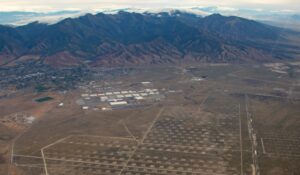
While Washington presses Beijing on licences, it is also building supply at home. On November 5 the Defense Logistics Agency said it had committed US$2 billion in fiscal year 2026 to acquire strategic and critical materials for the National Defense Stockpile. MP Materials still runs Mountain Pass, the only producing US rare-earth mine. Energy Fuels is building heavy rare-earth capacity at White Mesa in Utah. USA Rare Earth is developing a mine-to-magnet chain in Texas.
The calendar
The call lands four days before MOFCOM’s published November 10, 2026 end date for the October 2025 control suspension. Trump and Xi are expected at APEC in Shenzhen on November 18-19, about two weeks away. Trade is not expected to be a large part of that meeting, but it will likely be discussed in more detail at the G20 in Miami in December, according to the FT. Bessent and Greer are expected to meet their Chinese counterparts in person between APEC and the G20.
Conclusion
A Trump-Xi deal in Miami could redefine what full implementation means and push the argument into 2027, and in the meantime US stockpile buying and Mountain Pass / White Mesa output could ease the tightest defence grades faster than expected.
But, Bessent’s test is now public. Busan is only working if rare earths, other critical minerals and farm purchases show up as concrete results before the next Trump-Xi meeting.