
By 2030, antimony smelters outside China will be able to meet only 73% of projected ex-China demand — and that’s only if every project currently announced is built.
There are three proposed smelters outside China and Russia (one in Oman and two in the US) but, even if they are completed, total capacity would reach only 68,000 tonnes by 2030, against projected ex-China demand of approximately 93,000 tonnes, leaving a processing deficit of approximately 25,000 tonnes, or 27% of demand.
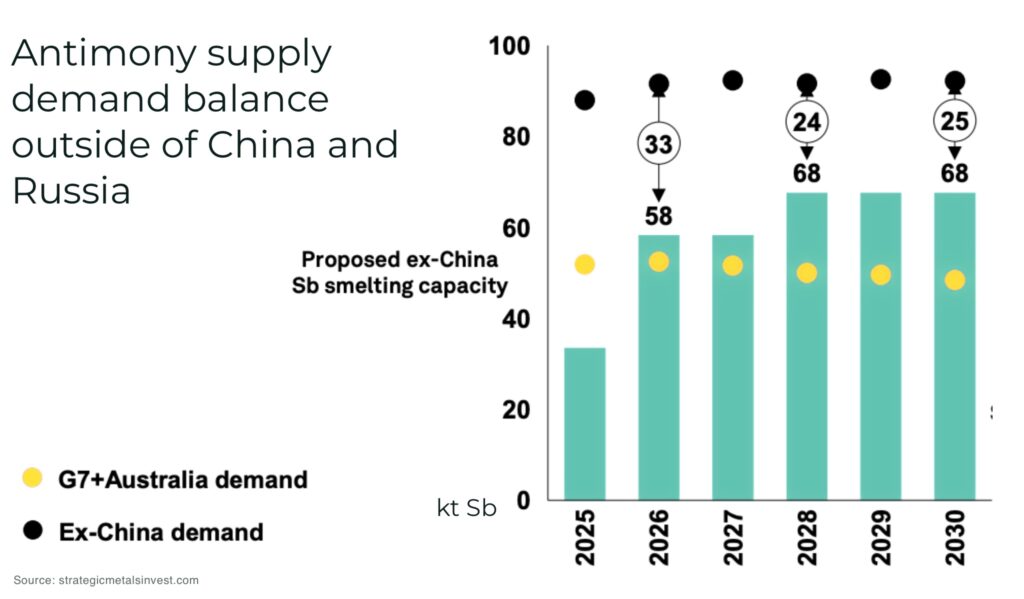
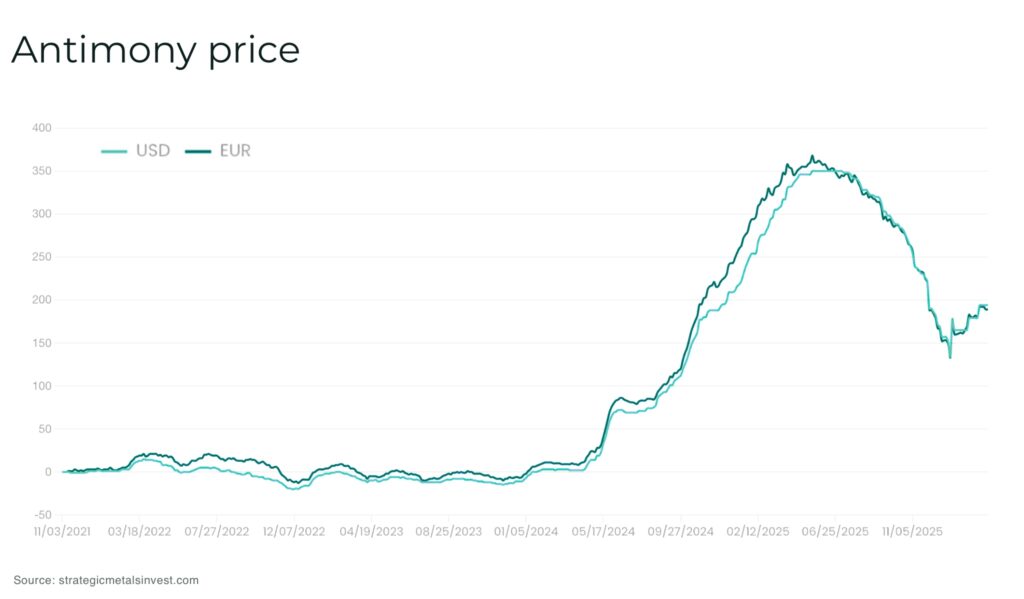
Antimony is currently trading at approx US$20 per kilogram in Europe, around 54% above the top of the US$11-13/kg range that S&P Global estimates is needed to sustain at least 80% of current and proposed smelting capacity outside China and Russia.
In other words, prices may be high enough to support new investment, but the project pipeline is still too small to break the West’s dependence on China and Russia.
And the problem is not only a shortage of mines, but also a shortage of processing capacity.
What is antimony
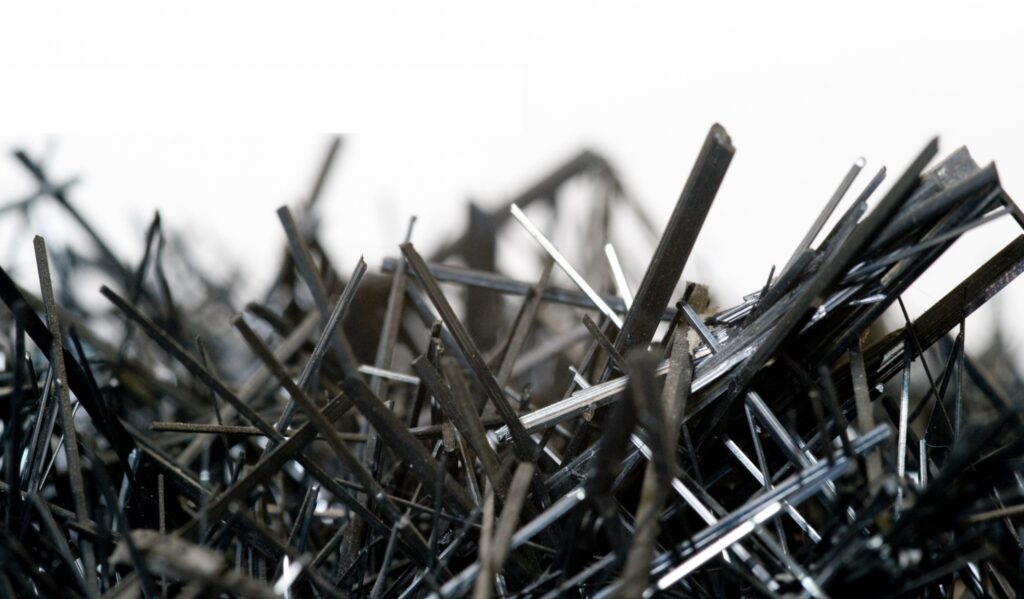
Antimony is a silver-grey metalloid, primarily produced from the mineral stibnite, and is sold as concentrate, metal, antimony trioxide and a range of specialist compounds. Its main uses include:
- flame retardants: antimony trioxide makes fire-resistant additives more effective
- lead-acid batteries: improves strength and corrosion resistance
- solar and specialty glass: antimony compounds act as clarifying agents
- alloys: to harden lead and other metals
- semiconductors: infrared detectors, diodes and printed circuit boards
- military equipment: including ammunition primers, hardened projectiles, night-vision equipment, infrared sensors and explosive formulations
Antimony is designated a critical mineral by the US, EU, Japan and Australia.
Antimony demand
Global demand or antimony is expected to rise from 179,000 tonnes in 2025 to 186,000 tonnes in 2030.
But antimony’s supply crisis is not just being driven by explosive demand growth — it is being driven by military and national security necessity.
Defense and national security
Ammunition accounts for only about 2% of measured antimony demand, but volume understates its strategic importance.
Antimony metal hardens the lead alloys used in projectiles; antimony sulfide is a combustion-supporting ingredient in ammunition primers, detonators, tracer rounds and other pyrotechnic systems; antimony compounds are also used in infrared and night-vision equipment, military electronics and flame-resistant materials. In many of these applications, specifications restrict substitution and the cost of antimony is negligible relative to the value of the finished weapon.
This gives a small, price-insensitive military market outsized influence over the marginal tonne – just as the US and its allies are expanding ammunition production and rebuilding depleted stockpiles.
For the US, the vulnerability is particularly acute, with estimates suggesting the US was 91% import reliant for antimony metal and oxide in 2025, while China- and Russia-controlled operations account for approx 80% of global mine supply and 81% of processing capacity.
The USA has not produced antimony domestically since the closure of its last mine in Idaho in 2001, and stockpiles in 2003 were reportedly just 1,100 tons (vs consumption of 23,000 tons).
And, Washington is already treating antimony as a defense-industrial bottleneck.
- in March 2026, the US Department of War awarded US$27 million in Defense Production Act funding to expand domestic antimony mining and processing, describing antimony as one of its most critical munitions and materials supply chains
- the Defense Logistics Agency has separately awarded an up-to-US$245 million contract to replenish the National Defense Stockpile with antimony ingots
“For too long, DOW has depended on overseas sources for its critical mineral production… this investment will address risk in one of our most critical munitions and materials supply chains” — said Assistant Secretary of War for Industrial Base Policy Mike Cadenazzi, in March 2026
And this supply crisis is becoming more acute just as the US and its allies race to replenish depleted stockpiles and expand ammunition production, especially with the conflicts in Ukraine and the Middle East. For example:
- the US Army increased production of 155 mm artillery rounds from approximately 14,000 a month in 2022 to about 36,000 a month by March 2026
- NATO reported that Europe’s annual artillery-ammunition capacity had increased sixfold in two years and was expected to reach approximately 2 million rounds a year by the end of 2025
- global military expenditure reached a record US$2.9 trillion in 2025, the eleventh consecutive annual increase
This gives defense demand an impact far beyond its 2% market share: it supports stockpile purchases, government financing and price-insensitive offtake for non-Chinese supply. And, will therefore help determine which mines and smelters are financed.
Civilian demand
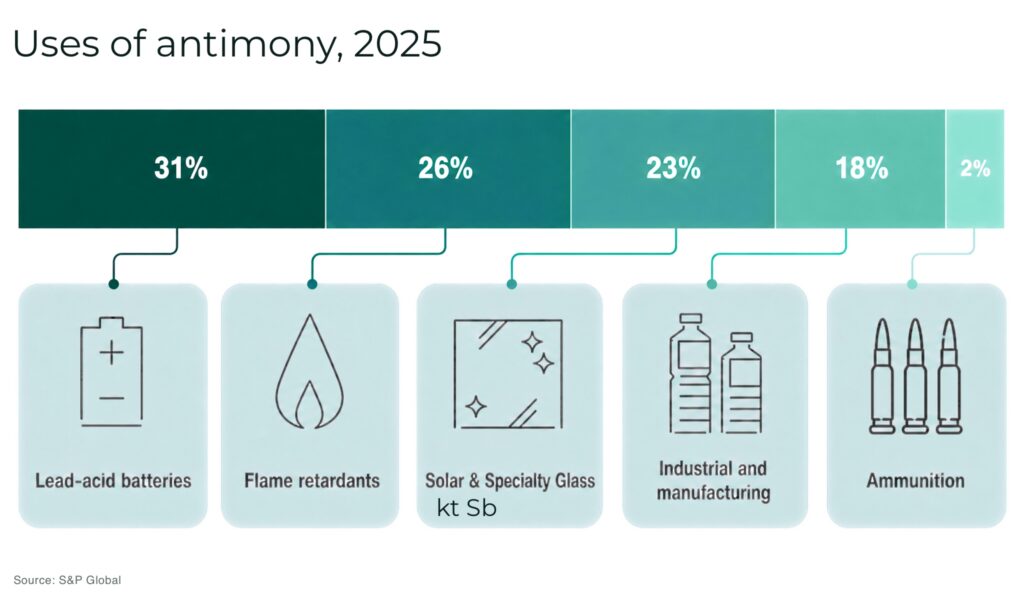
Civilian applications will, however, continue to determine overall market volume: In 2025:
- lead-acid batteries accounted for approx 31% of global demand
- flame retardants 26%
- solar and specialty glass 23%
- industrial and manufacturing 18%
- and ammunition 2%
Demand from lead-acid batteries is expected to fall by approx 4% a year through 2035 as electric vehicles displace internal-combustion engines and battery producers continue to reduce the amount of antimony used in each unit.
But growth in flame retardants, solar glass and defense are expected to more than offset the fall.
Flame retardants
Antimony trioxide is used as a synergist in flame-retardant systems for plastics, electronics, wiring, construction materials, textiles and vehicle components.
S&P Global expects flame-retardant demand to grow by approximately 3.6% a year through 2035, supported by rising electronics production and the increased use of fire-resistant materials in electric vehicles.
Solar glass
Antimony compounds are used as clarifying agents in photovoltaic glass, helping remove bubbles and improve light transmission.
Solar and specialty glass already account for approximately 23% of global antimony demand, up from a much smaller share a decade ago.
(However, note, demand can be price sensitive, with reports of weak purchasing by photovoltaic-glass and flame-retardant consumers in the first half of 2026 as buyers delayed orders in anticipation of lower prices)
Global antimony supply
In August 2024, China introduced export controls on antimony products “in order to safeguard national security and interests,”it’s Commerce Ministry said. Then, in December 2024, it prohibited exports of controlled antimony items to the US.
The antimony 99.65% CIF Northwest Europe price rose from approximately US$23/kg in August 2024 to US$63/kg by mid-2025, according to S&P Global.
China temporarily suspended the US-specific prohibition in November 2025 — supporting a fall in prices to approx US$27/kg during 2026 — with the suspension due to expire on November 27, 2026. But the underlying export-licensing system remains, and the prohibition on exports to US military users or for military end use was not removed.
But China’s export restrictions are not just about geopolitics.
The largest antimony producer, by far, is China, but the country’s output is steadily decreasing:
- in 2000, China produced 100,000 tonnes, out of a global total of 121,000 tonnes
- in 2024, China produces 40,000 tonnes, out of a total of 83,000 tonnes
The challenge is that supply elsewhere in the world is not acting as a substitute for the fall in China production.

As we reported previously in our analysis on “Why are antimony prices exploding“, according to recent estimates the industry fell into a deficit in 2021 and for the first time in history, Chinese ingot smelters had become critically reliant on imported antimony concentrates.
Russia has the second largest antimony reserves in the world, at 350,000 (after China’s 640,000), and is currently the fifth largest producer in the world. Russia also operates one of the largest antimony mines in the world, with the Olimpiada mine in Russia, operated by Polyus, was responsible for more than 20% of global antimony mine supply in 2023. However, Polyus has been subjected to Western sanctions, imposed after Russia invaded in Ukraine in 2022, disrupting supply to the West.
Outside China and Russia, in particular Myanmar and Tajikistan, mine capacity was only about 24,000 tonnes.
All of which is only reinforcing China’s position at the most important stage of the supply chain.
Structural cost
S&P Global estimates a structural cost of US$11-13/kg in 2028 would support economic operations for at least 80%, or approx 54,000 tonnes, of current and possible antimony smelting capacity outside China and Russia.
This is the full cost required for the marginal projects to achieve their target return on investment, including feedstock, operating costs, capital recovery and a 10% operating margin.
At approx US$27/kg in Northwest Europe, antimony still trades at more than twice the upper end of S&P Global’s estimated long-term structural range. This should provide an incentive for new investment.
However, as with so many other metals, the challenge is turning that incentive into operating mines and smelters.
Australia
Australia is likely to provide the most important near-term increase in non-Chinese mine supply.
Larvotto Resources began staged commissioning of its Hillgrove gold-antimony project in New South Wales in July 2026. First ore has been crushed, and the operation is forecast to produce approximately 4,900 tonnes of antimony a year and more than 40,000 ounces of gold over its current seven-year mine life.
At Port Pirie, Nyrstar moved from pilot-scale recovery to its first commercial antimony shipment in February 2026.
The Australian government has also prioritized antimony in its US$850 million Critical Minerals Strategic Reserve, alongside gallium and rare earths. The reserve will use government-backed transactions to secure rights to Australian production and sell those rights to domestic and allied buyers. US$700 million has been allocated for transactions through the Critical Minerals Facility, with a further US$135 million for selective stockpiling and implementation. This could support the price floors and long-term offtake agreements needed to finance new antimony projects.
USA
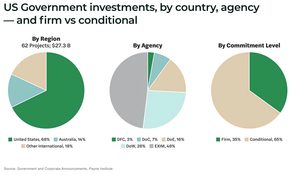
The US government is now supporting antimony at every stage of the supply chain: mining, processing, qualification and stockpiling.
- in May 2026, the US Export-Import Bank approved a US$2.9 billion senior secured loan for Perpetua Resources’ Stibnite gold-antimony project in Idaho. The 13-year facility includes an upfront commitment of US$2.4 billion, with the remainder covering capitalized interest and fees. Funding remains subject to final documentation and customary conditions
- Perpetua has also received approx US$81.8 million through disclosed US defense grants and program awards to advance permitting, engineering and a domestic military-grade antimony trisulfide supply chain. Their Stibnite project holds an antimony mineral reserve of approximately 149 million pounds and is targeting production in 2029. The company estimates it could supply about 35% of US antimony demand during its first six years of operation, based on the demand benchmark used in its study
- Perpetua is also working with Idaho National Laboratory on a modular pilot plant designed to produce military-specification antimony trisulfide from Stibnite ore
- United States Antimony Corporation received a US$27 million Defense Production Act award in March 2026 to expand and modernize its Thompson Falls smelter in Montana and support mining integration in Alaska. The company has also secured an up-to-US$245 million, five-year contract from the Defense Logistics Agency to supply antimony metal ingots for the National Defense Stockpile
- US Antimony delivered approx 82,000 pounds in its first two shipments, invoicing about US$2.6 million in June. Total delivery orders had reached US$57.3 million by July
- Nova Minerals’ Alaska Range Resources received a further US$43.4 million Defense Production Act award to develop an integrated mine, concentration and military-grade trisulfide supply chain at the Estelle project and a proposed refinery at Port MacKenzie. The company is targeting Stage 1 production in late 2026 or early 2027, but still needs to demonstrate its resource, metallurgy, commissioning and scale-up
The US strategy is extensive and clear: use grants to accelerate projects, loans to finance construction and government procurement to create contracted demand.
However, the scale remains small compared with the projected processing deficit.
Conclusion
Antimony demand is expected to grow by only about 3% between 2026-2030, but this modest growth is enough to expose a much larger problem.
Lead-acid battery demand is falling, while solar glass, flame retardants and defense are taking a larger share of the market. These applications require different products, purity levels and processing routes.
Meanwhile, China and Russia still control approximately 80% of global mining and processing capacity.
New supply is coming, but is being measured in years, just as geopolitical disruption is being measured in days. And, even if the three announced ex-China smelting projects are completed, a 27% processing gap remains in 2030 — and the price boom of 2024-2025 shows what happens when supply is disrupted.