
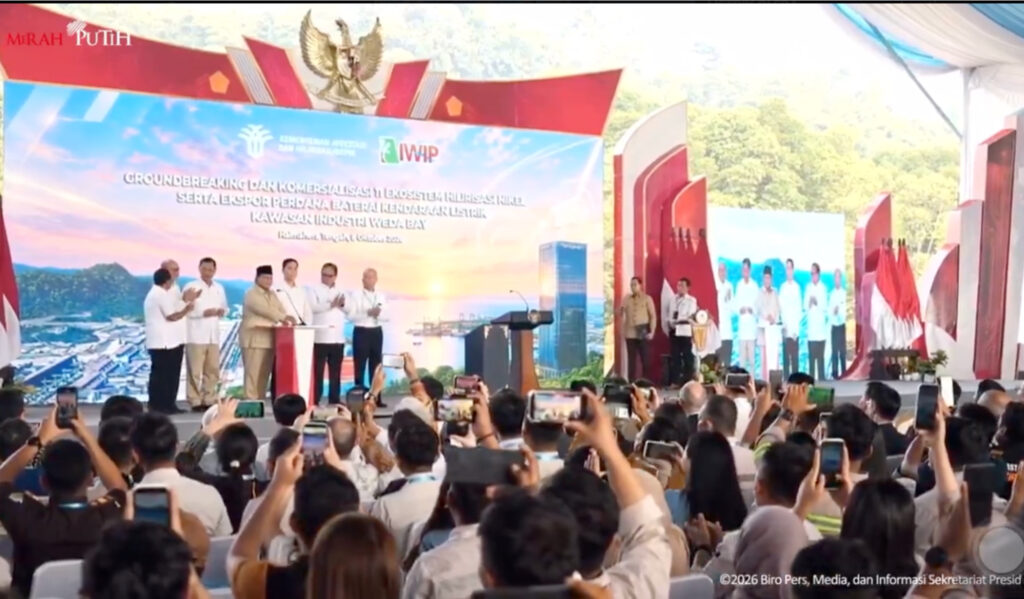
Indonesia has launched 11 China-backed nickel, battery, aluminium and solar projects worth US$10.2billion — one day after revealing it may stop approving more plants that produce semi-processed nickel.
Together, the two announcements mark the next stage of Indonesia’s mineral strategy: restrict further growth in low-value intermediate products while continuing to build factories further down the supply chain.
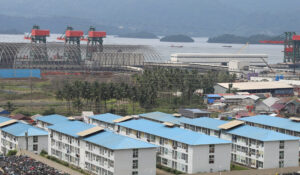
Indonesia’s President Prabowo Subianto launched four commercial facilities and marked the start of construction on seven more at the Indonesia Weda Bay Industrial Park in North Maluku on October 8. The ceremony also marked Indonesia’s first exports of domestically manufactured EV-battery products, including nickel-manganese-cobalt and lithium-iron-phosphate materials produced by REPT Battero.
“Today’s first export of batteries and electric vehicles is a significant step. This is clear evidence that our downstreaming strategy is sound, and we will continue it as best we can,” said the President Prabowo in his remarks at the Indonesia Weda Bay Industrial Park (IWIP) in Central Halmahera Regency, North Maluku Province, on Thursday, October 8, 2026.
Four projects are operating; seven are not
The US$10.2 billion figure combines assets at different stages of development, with dour facilities valued at US$3.4 billion have entered commercial operation; seven projects worth US$6.8 billion have only started construction.
The four projects, valued at US$3.4 billion, that have entered commercial operation include:
- Blue Sparking Energy, with stated annual capacity of 67,000 metric tonnes of mixed hydroxide precipitate
- REPT Battero Indonesia, with eight gigawatt-hours of annual EV-battery-cell capacity
- Pioneer Aluminium Industries, designed to produce 300,000 metric tonnes of electrolytic aluminium annually
- XCMG Indonesia Manufacturing, with stated capacity for 700 electric industrial and mining vehicles a year
Seven additional projects, collectively valued at US$6.8 billion, have broken ground but are not operating include nickel and cobalt processing, battery materials, battery chemicals, aluminium, photovoltaic glass and electric commercial vehicles.
The Weda Bay industrial park has already attracted more than US$20 billion of cumulative investment, according to the President, with a further US$7 billion planned. The park, partly controlled by China’s Tsingshan Holding Group, has become one of the main centres of Indonesia’s Chinese-backed mineral-processing expansion.
Why is Indonesia considering a nickel moratorium?
Jakarta is considering a moratorium or restrictions on new smelters producing semi-processed nickel, despite it being Indonesia’s downstreaming policy that transformed the country from an ore exporter into the dominant supplier of processed nickel.
The problem is, it worked too well.
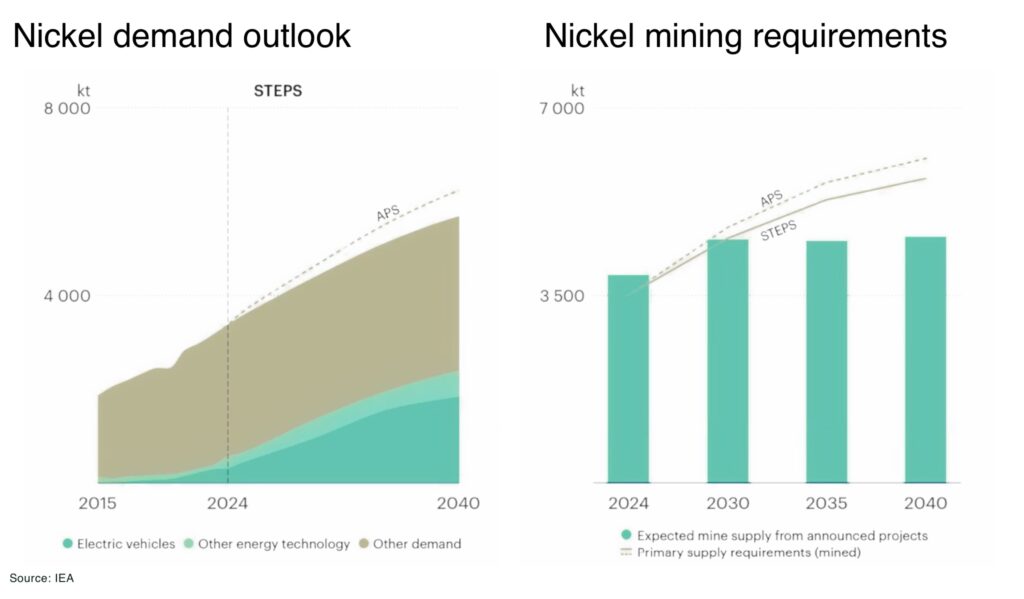
Between 50% and 60% of Indonesia’s nickel smelters still produce semi-processed products, but supply now exceeds demand by approximately 2.5 million metric tonnes, placing sustained pressure on prices. For example, nickel fell to a 2026 low of US$15,510 per metric tonne on October 2.
Indonesia has 422 active nickel-mining permits and 79 major processing facilities, comprising 55 RKEF smelters, ten HPAL plants, eight nickel-matte plants and six integrated stainless-steel plants, according to 2026 data from the Indonesian Nickel Miners Association cited by the OECD.
At full capacity, these smelters could require approx 415 million metric tonnes of ore annually. The Energy and Mineral Resources Ministry expects 2026 ore production of approximately 290 million metric tonnes, already above the earlier mining-quota range of 260 million to 270 million metric tonnes.
Jakarta is therefore considering a moratorium on new plants producing nickel pig iron, ferronickel and other intermediate products, possibly using mining quotas to manage production.
Indonesia wants more value, not necessarily less nickel
Indonesia previously measured success through smelters, production volume and export value, but it now wants investment in battery cells, precursors, chemicals, vehicles and other products that capture more value per tonne of ore.
The new Weda Bay projects reflect that shift.
As we at The Oregon Group have previously argued in Indonesia’s nickel dilemma, the country’s rapid expansion has lowered prices while forcing higher-cost Western mines and refineries to close or seek state support.
The proposed moratorium could give those producers some relief, but it would also strengthen existing Indonesian operators by limiting new competition and preserving the value of their installed capacity.
China remains central to Indonesia’s industrial strategy
Indonesia is capturing more processing and manufacturing at home, but much of the capital, technology and corporate ownership remains Chinese.
The 11 Weda Bay projects are Chinese-backed, while Tsingshan and other Chinese groups remain central to the industrial park’s development.
This produces a more complicated geopolitical outcome than simple supply-chain diversification.
Nickel ore, once exported from Indonesia, is now processed domestically, with ore jobs, tax revenue and industrial activity remain inside the country — but the supply chain is still heavily integrated with Chinese companies, financing, technology and customers.
For Western governments, the problem is no longer just access to Indonesian nickel, but instead access to nickel products produced under commercial structures that meet Western ownership, environmental, traceability and trade requirements.
FAQ
Has Indonesia imposed a nickel-smelter moratorium?
No. The government is considering a moratorium or restrictions on new plants producing semi-processed nickel, but no final policy has been announced.
What projects did Indonesia launch at Weda Bay?
Four projects entered commercial operation and seven began construction. They cover MHP, battery cells, aluminium, battery chemicals, solar glass and electric industrial vehicles.
Are all US$10.2 billion of projects operational?
No. Operating facilities account for US$3.4 billion of the stated investment, while projects valued at US$6.8 billion have started construction.
Will the proposed moratorium reduce nickel supply?
Not necessarily. The effect will depend on whether Indonesia restricts existing production, mining quotas and projects under construction—not simply future plants producing selected intermediate products.
Why does Weda Bay matter?
Weda Bay is developing into an integrated Chinese-backed industrial cluster that connects Indonesian mineral resources with processing, batteries, aluminium, solar products and electric equipment.