
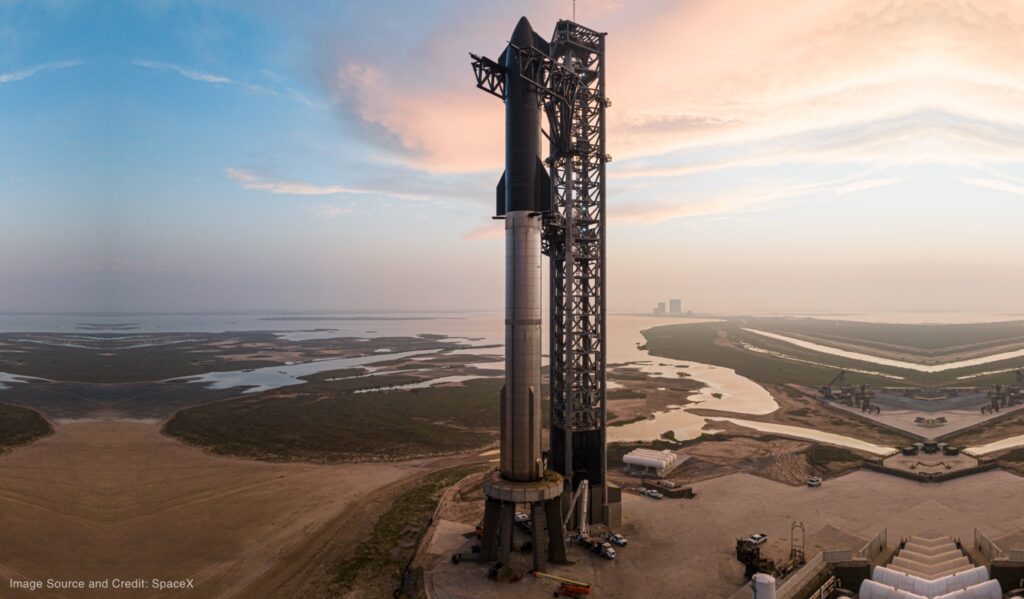
Within days of its IPO, SpaceX’s market value was pushing toward US$3 trillion, putting a public-market valuation on reusable rocket launches as the infrastructure layer for the next space economy — and, suddenly, space mining looks a little less out of this world.
The reason is that Elon Musk’s SpaceX reusable launch systems (reuseable rockets) have the potential to turn space into an industrial logistics chain.
SpaceX’s IPO filing also points to asteroid mining as a future market, with reusable rockets, robotics and space processing potentially making it commercially viable.
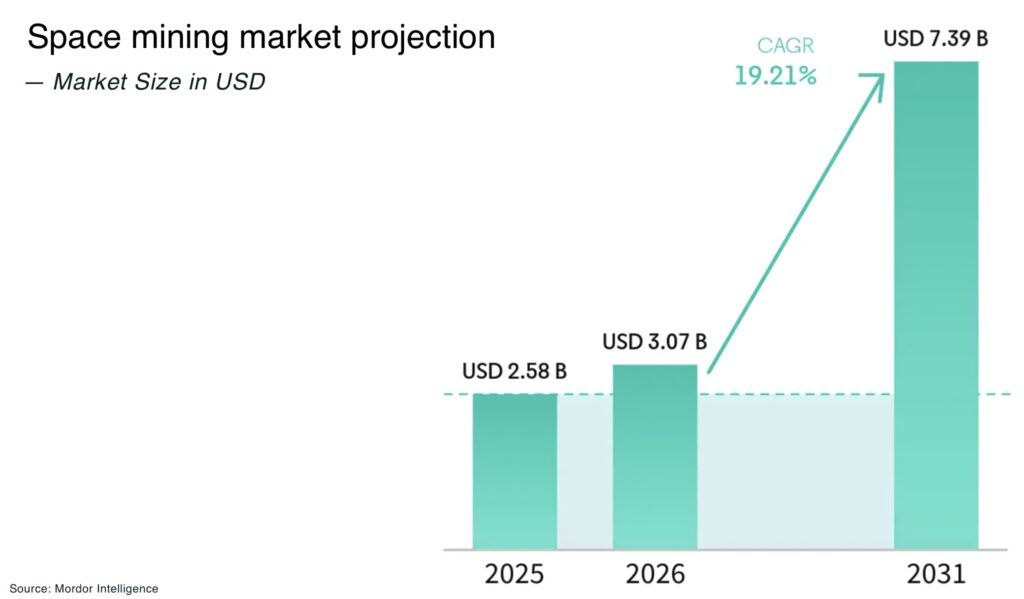
But, they’re not the only company with their eyes on the stars (asteroids) with the space mining market estimated to grow 19.21% CAGR between 2026-2031, from around US$3 billion in 2026 — US$7.39 billion in 2031.
How much metal in space?
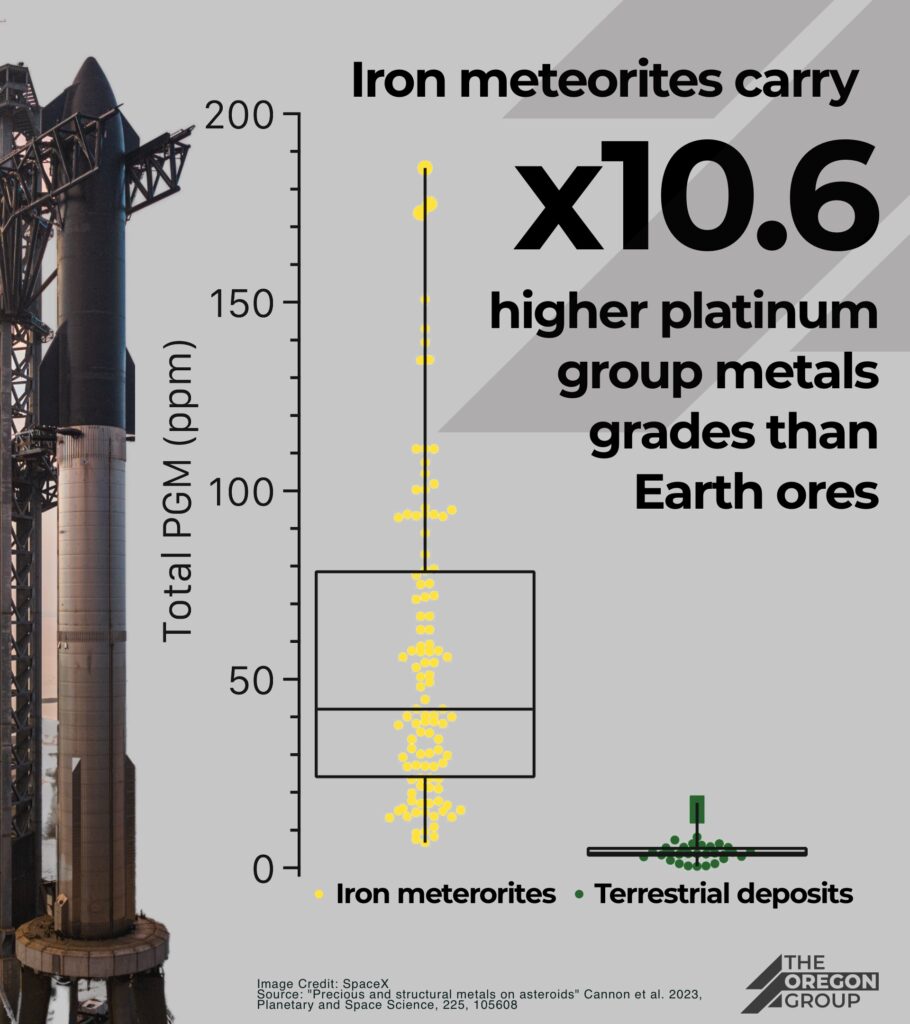
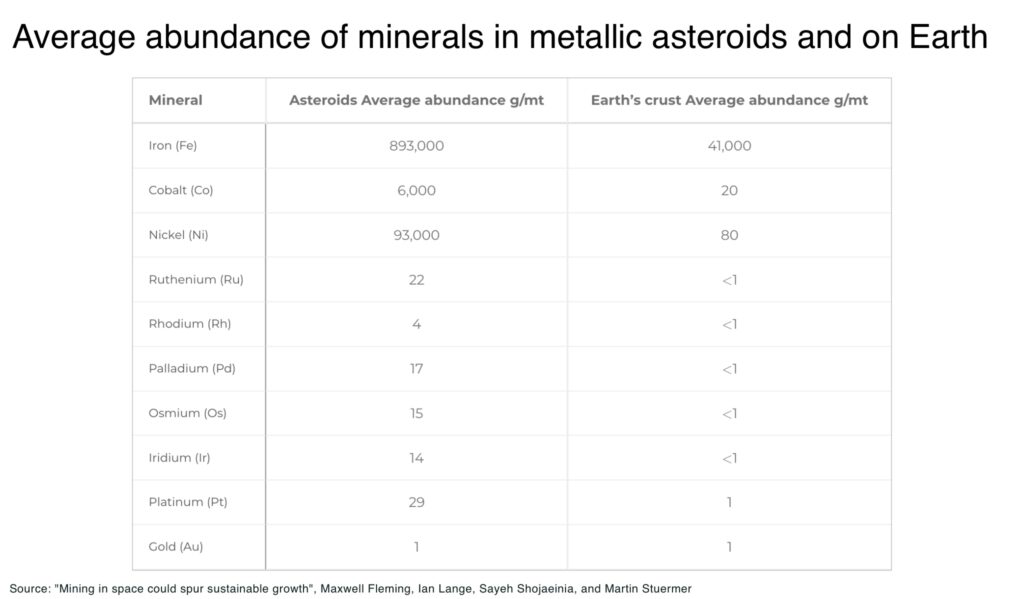
Asteroids are key to mining in space. In particular, Iron and M-type (metallic asteroids), which are thought to be, basically, metal-rich rocks left over from the violent formation of planets — with ore grades thought to exceed terrestrial percentages — flying through the solar system, including:
- cobalt
- gold
- iron
- magnesium
- nickel
- palladium, platinum
- rhodium, ruthenium, iridium, osmium
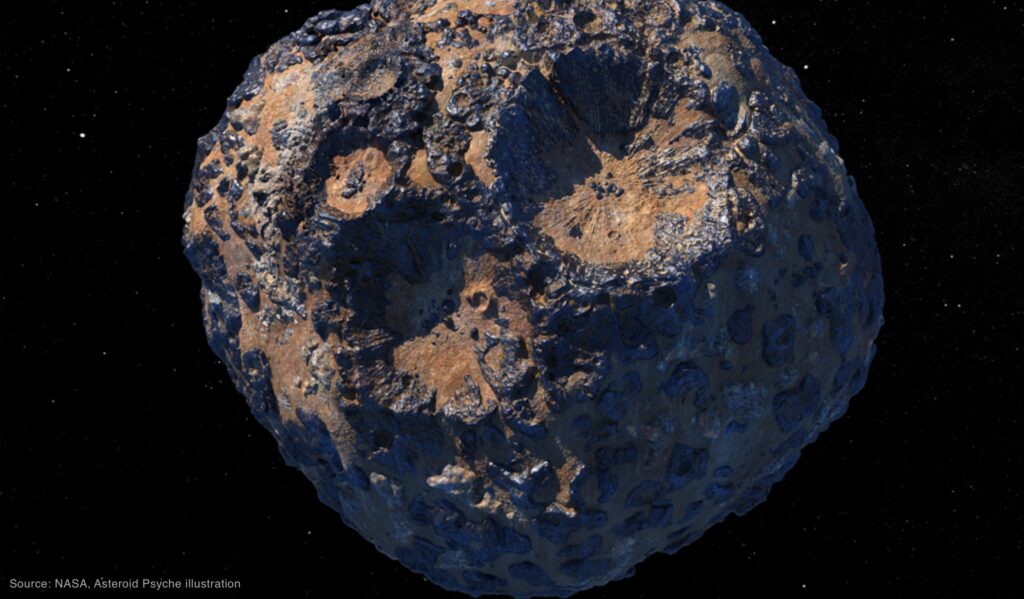
For example, NASA’s Psyche mission is heading to a metal-rich asteroid whose surface contains substantial amounts of metal.
Research suggests some metallic asteroids may contain more than 1,000 times as much nickel as Earth’s crust, cobalt x300 more abundant, and iron 22 times more abundant.
How would Space Mining actually work?
In theory, there are no permitting worries or environmental concerns for mining companies on asteroids (although that may change). The challenge, instead, is logistics.
Space mining companies would first have to send prospecting spacecraft to near-Earth asteroids, identify composition, map rotation and surface conditions, then attempt anchoring, excavation, heating, magnetic separation or other extraction methods.
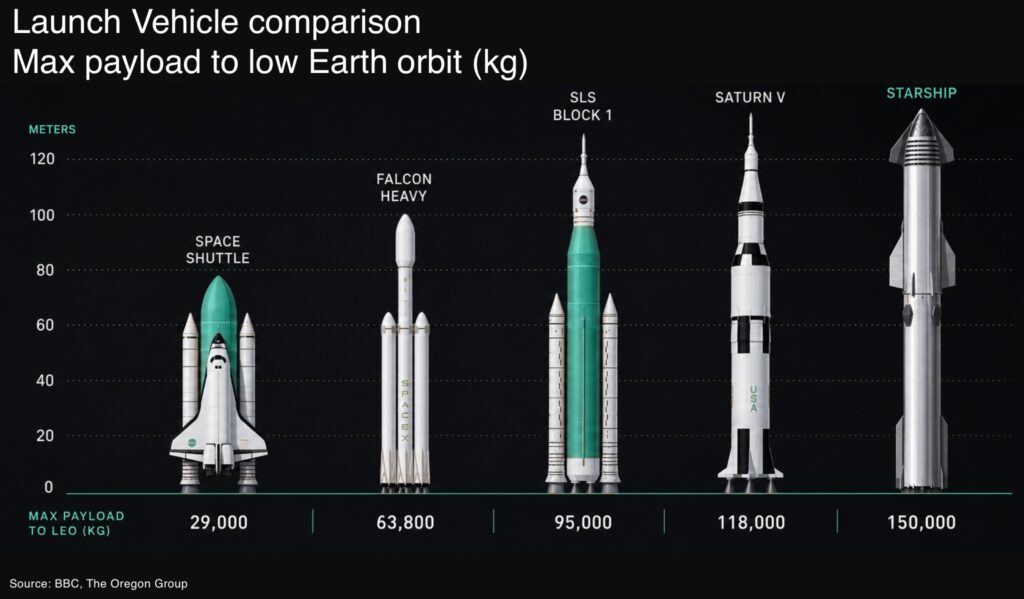
Reusable launch lowers the transport cost and logistics barrier significantly. For example, Elon Musk’s latest SpaceX Starship landing attempts to revolutionise rocket systems by making controlled landings, refueled quickly, and then launched back into space again and again — with capacity to carry more than a hundred tonnes to orbit in one go.
Of course, that’s just the start, and there remains significant work yet to do on how the mining would actually be done in space, most likely by robots using, for example, 3-D printing.
Why mining in space?
The case for space mining has two main drivers:
- supply security: platinum group metals, nickel, cobalt, tungsten and other advanced materials already sit inside fragile terrestrial supply chains, with falling grades and rising environmental concerns — all of which are driving up prices for mining on Earth
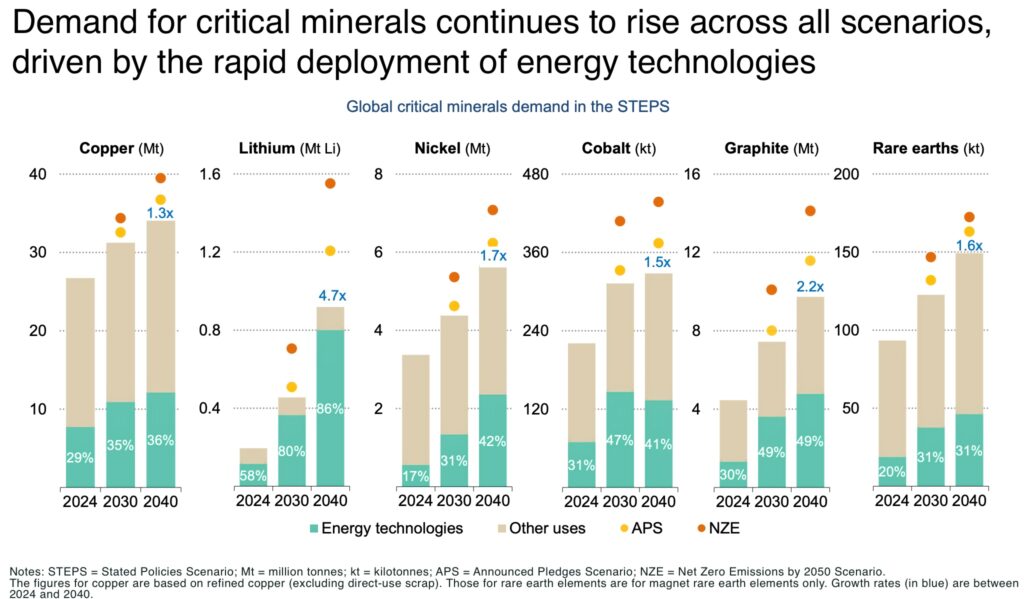
- rising demand: with the energy transition, data centers and AI, robotics, and re-industrialisation, demand for critical minerals is expected to rise significantly over the coming decades
For example, the IEA estimates global refined copper demand (excluding direct-use scrap) increases to almost 37Mt by 2050 (from 27Mt in 2024).
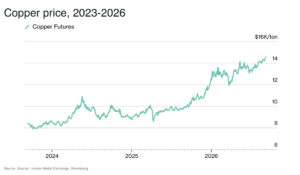
All of which is driving up the costs of the metals themselves, making options such as mining in space increasingly economical.
What does Space Mining need to cost?
Cost is critical.
The OSIRIS-REx was the first US mission to collect a sample from an asteroid, returning to Earth on Sept 24, 2023. Then, in 2023, NASA launched the Psyche mission to a “unique metal-rich asteroid orbiting the Sun between Mars and Jupiter… that it appears to be the exposed nickel-iron core of an early planet” — it is expected to reach its destination in 2029. Japan has also sent up ground-breaking missions to asteroids — Hayabusa and Hayabusa2 — to collect samples.
These latest missions prove sample return, but not industrial extraction.
NASA’s OSIRIS-REx mission returned material from Bennu in 2023, but the agency’s early curation milestone was just 70.3 grams of asteroid material, while the wider mission was reported at about US$1 billion.
That is science, not mining.
So, how much could space mining cost? Independent work on fully reusable launch systems has modelled costs could be US$300-400/kg, while Google’s Project Suncatcher analysis suggests some orbital infrastructure begins to make economic sense near US$200/kg.
| Benchmark | Cost signal |
| Current launch-cost datasets | still broadly in the low-thousands/kg for LEO, with CSIS noting a steep cost decline after 2005 but not Starship-level economics yet via CSIS launch-cost data and Our World in Data |
| Current smallsat rideshare | around US$7,000/kg, per reporting on SpaceX’s 2026 rideshare pricing and Google’s space-data-center economics |
| Independent reusable-launch modelling | US$300-400/kg for a fully reusable launch-system concept in this reusable launch feasibility study |
| Google Project Suncatcher threshold | about US$200/kg by the mid-2030s for orbital data-center economics, per Space.com’s summary |
| SpaceX/Starship aspiration | potentially below that, but still company-forecast territory, not a proven commercial price |
“Space mining represents the most ambitious of all emerging extraction frontiers, with lunar and asteroid deposits thought to encompass vast amounts of nickel, iron and platinum group metals. The commercial case remains in its early stages… however, falling launch costs, driven in large part by private sector investment aimed at fundamentally altering the economics of reaching low Earth orbit, have the potential to progressively improve the economic feasibility of space mining over a multi-decade horizon” — BMI, Metals And Mining Megatrends To 2050
What’s happening in Space Mining now?
The new space-mining race is led by a small group of pure plays such as AstroForge, Interlune, TransAstra and OffWorld, but the larger capital flow is also flowing into the “picks and shovels” logistics infrastructure, such as launch, lunar transport and delivery, as well as surface mobility and rovers.
AstroForge, one of the leading companies, claims its DeepSpace-2 spacecraft, planned for launch in the Q4 2026, will be “the first commercial spacecraft to rendezvous with an asteroid” — with a roughly 200 kg spacecraft platform that could eventually support payloads up to 50 kg.
| Company | Focus | Why it matters |
| AstroForge | Asteroid mining, especially platinum-group metals | Raised about US$13 million in seed funding and later US$40 million, and is developing DeepSpace-2 to revisit a metallic asteroid |
| Interlune | Lunar helium-3 | Raised US$18 million and signed a reported US$300 million-plus helium-3 purchase deal with Bluefors |
| Karman+ | A Denver-based asteroid-mining startup focused on extracting water and usable regolith from near-Earth asteroids to supply fuel, shielding and raw materials in orbit | The company raised US$20 million in seed funding in 2025 and says its first mission will target a kilogram-scale regolith capture demonstration before moving toward returned material for orbital use |
| TransAstra | Asteroid capture, optical mining, in-space logistics | Developing systems such as a Capture Bag for asteroids and debris, plus concepts for resource extraction and transport |
| OffWorld | Autonomous mining robots for Earth and Moon | Builds robotic mining systems and says it is working across Earth and lunar mining, with customers/partners shown including BHP, Anglo American, NASA and Luxembourg |
| ispace | Lunar transport, rovers, resource mapping | Japan-listed lunar company aiming to enable clients to map and use lunar resources; also linked to lunar water and helium-3 resource work |
| Magna Petra | Lunar helium-3 recovery | Partnered with ispace on AI-based, non-destructive helium-3 recovery from lunar regolith |
| Lunar Outpost | Lunar rovers, prospecting, surface infrastructure | Builds lunar mobility and space-resource systems; NASA selected it with Intuitive Machines and Astrolab for a lunar rover services program worth up to US$4.6 billion |
| Venturi Astrolab | Lunar logistics and rovers | Not a miner, but its FLEX rover is a key surface-logistics platform; NASA selected Astrolab for the same LTV program |
| Intuitive Machines | Lunar delivery and resource payload transport | A major lunar infrastructure player under NASA’s CLPS program, which has a combined maximum value of US$2.6 billion through 2028 |
| Astrobotic / Firefly Aerospace | Lunar payload delivery | Not miners, but part of the CLPS delivery network that can carry prospecting and ISRU payloads to the Moon |
Have we been here before?
The problem is not imagination. It is execution.
AstroForge’s Odin mission is a useful warning. The company said Odin launched successfully in February 2025, contacted Earth multiple times, but then struggled with communication and ground-station issues during its deep-space journey, after assigning the mission only a 30% chance of success. That is not necessarily failure, but the cost of learning — however, it shows how far the sector is from routine mining.
And we’ve already seen companies, such as Planetary Resources and Deep Space Industries, claim mining asteroids will be possible by 2025. Both have since ceased operations.
The regulatory picture is another watch point. The Outer Space Treaty bars national appropriation of celestial bodies, while countries including the US have created domestic frameworks for commercial space resources. That leaves room for business, but not yet the legal certainty of mature mining codes.
The investment case makes sense only if reusable launch cuts the cost of mass to orbit from thousands of dollars per kilogram toward the low hundreds.
Conclusion
Logistics capacity and current costs are, obviously, still too high for space mining to be considered a serious option at scale. Huge challenges space mining also has to solve deep-space transport, autonomous extraction, processing, storage and the question of whether the product is sold in orbit or returned to Earth.
But SpaceX has sent up a green flare — that both the investment case and reusable launch cost are no longer blowing up on the launch pad. It may take decades, but the reaching for the stars no longer seems so far away.