
Critical Minerals and Energy Intelligence

Sulphuric acid crunch pushes key critical minerals cost exposure up 33% since Iran war

The sulphuric acid crunch is now feeding directly into critical minerals production costs, with sulphur and acid accounting for an average 33% of C1 costs across key supply chains — rising to 42% for HPAL nickel and 30% for Chilean SX-EW copper.
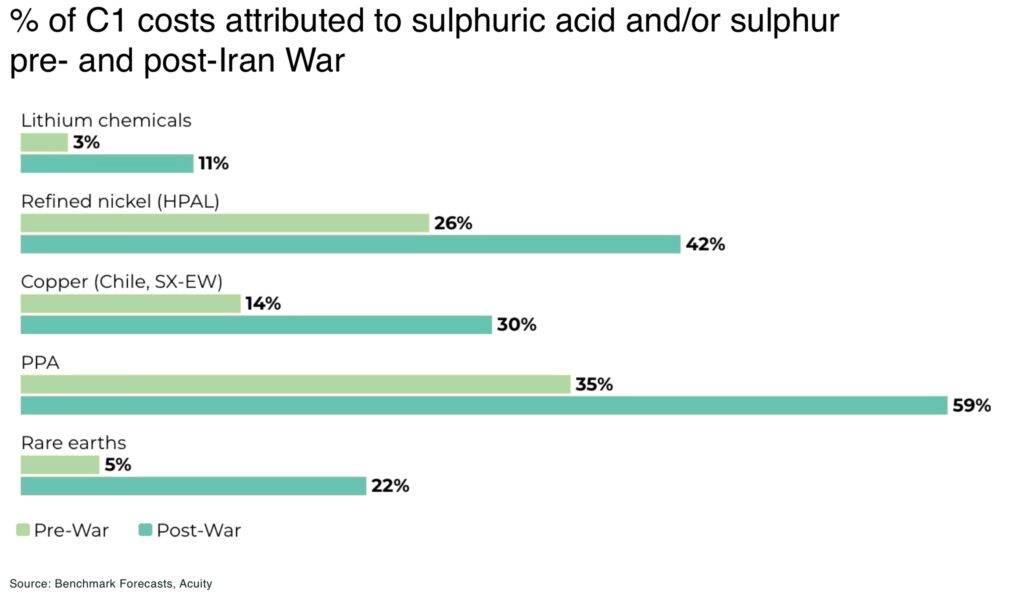
of C1 costs attributed to sulphuric acid andor sulphur pre and post Iran War - The Oregon Group - Critical Minerals and Energy Intelligence

According to the latest data from Benchmark Minerals, between the start of the conflict in the Middle East at the end of February and mid-April, sulphuric acid prices surged by more than double and sulphur prices rose by 50% (albeit with regional variations).

The reason, as per our recent analysis on the Strait of Hormuz as a chokepoint for critical minerals, the Middle East accounts for about 24% of global sulphur production, including 50% of seabourne trade of sulphur — which must be exported via the Strait of Hormuz. And sulphur is the feedstock for sulphuric acid used across nickel, copper and fertilizer supply chains

“Sulphuric acid is a vital feedstock for many critical minerals,” Benchmark raw materials research manager Will Talbot said. “The outstanding risk is that more critical minerals players cut production or even shut down operations entirely.”

Benchmark estimates more than half of global lithium, cobalt, rare earth and purified phosphoric acid production expected in 2026 is exposed to sulphur and sulphuric acid disruption. High-purity manganese sulphate monohydrate, used in electric vehicle batteries, is fully dependent on sulphuric acid supply.
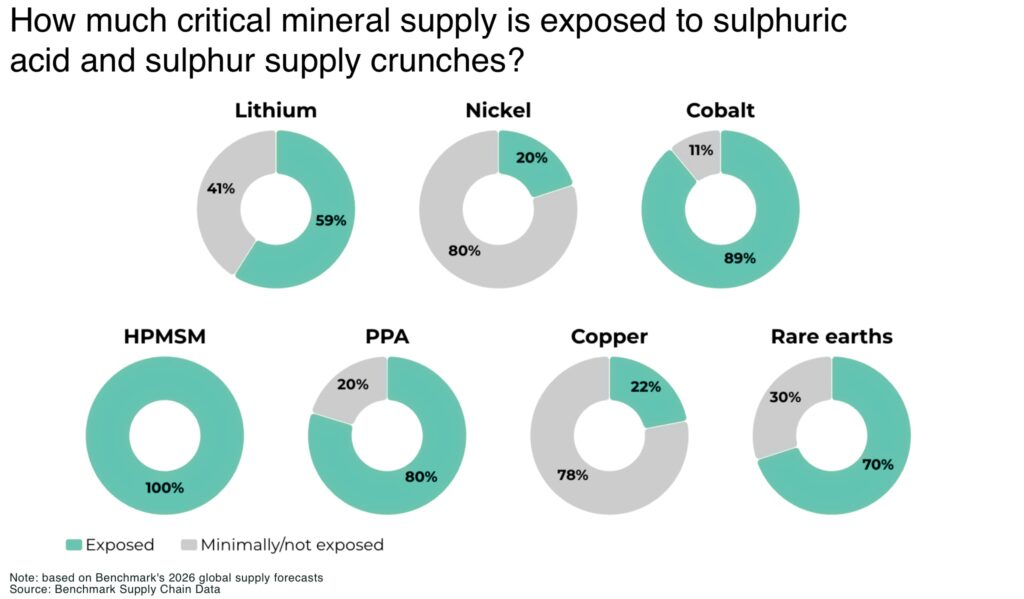
How much critical mineral supply is exposed to sulphuric acid and sulphur supply crunches - The Oregon Group - Critical Minerals and Energy Intelligence

That matters because sulphuric acid is not optional in large parts of the energy transition supply chain. It is used to leach copper, process nickel through high-pressure acid leaching, convert spodumene into lithium chemicals, produce purified phosphoric acid for LFP batteries and make high-purity manganese sulphate for battery cathodes.

The cost shock is already showing up in lithium. Benchmark warns sulphuric acid previously represented around 3% of the cost of producing lithium chemicals from hard rock sources. It now accounts for 11%, overtaking energy as the largest individual C1 cost component. Sulphuric acid now makes up 22% of total hard-rock lithium conversion costs.

Nickel is also exposed, with sulphur now representing 42% of HPAL nickel costs, up from 26% before the conflict. Indonesia, the world’s largest nickel producer, sourced 76% of its sulphur imports from the Middle East last year. HPAL processing can require more than 10 tonnes of sulphur to produce one tonne of nickel.

Copper is more complicated.

Solvent extraction and electrowinning operations, which account for roughly 22% of global mined copper output, need large volumes of sulphuric acid. That puts acid-leach copper operations under pressure, particularly in regions such as Chile where imported acid is critical to mine supply.

But copper smelters can benefit because sulphuric acid is produced as a by-product of smelting. Higher acid prices can improve smelter economics, even as leach operations face rising costs.

The wider message is clear: critical mineral supply chains are not just constrained by ore bodies, mine permits and capital. They are also constrained by chemicals, reagents, shipping routes and industrial infrastructure.

Subscribe for Investment Insights. Stay Ahead.

Investment market and industry insights delivered to you in real-time.

[mepr-membership-registration-form id="4595"]

Disclaimer

The Oregon Group maintains full editorial control over all content published on this website. While sponsored and advertised placements may be featured, the content remains the sole opinion of The Oregon Group. The author may receive compensation or remuneration for providing content, but all statements and expressions are made independently and are not influenced by sponsors or advertisers. From time to time, The Oregon Group and its directors, officers, partners, employees, authors, or members of their families, as well as persons who are interviewed for articles on this website, may have a long or short position in securities or commodities mentioned and may make purchases and/or sales of those securities or commodities in the open market or otherwise. By accessing and using this website, readers are cautioned to assume that each of the foregoing persons may have a financial interest in all companies and sectors mentioned on this website. Any projections, market outlooks or estimates herein are forward looking statements and are inherently unreliable., and any such statements are based upon certain assumptions and should not be construed to be indicative of the actual events that will occur.  Other events that were not taken into account may occur and may significantly affect the returns or performance of the securities or commodities discussed herein. The information provided herein is based on matters as they exist as of the date of preparation and not as of any future date, and The Oregon Group undertakes no obligation to correct, update or revise the information in this document or to otherwise provide any additional material. The information provided on this website is for informational purposes only and is not, directly or indirectly, an offer, solicitation of an offer and/or a recommendation to buy or sell any security or commodity, and the information provided on this website should not be construed as any advice or an opinion as to the price at which the securities of any company or commodity may trade at any time. The Oregon Group is a publisher of financial information, not an investment advisor.  We do not provide personalized or individualized investment advice or information that is tailored to the needs of any particular recipient, and the information provided on this website is not and should not be construed as personal, financial, investment or professional advice. Readers are cautioned to always do their own research and review of publicly available information and to consult their professional and registered advisors before purchasing or selling any securities or commodities and should not rely on the information contained herein. Neither The Oregon Group nor any of its affiliates accepts any liability whatsoever for any direct or consequential loss howsoever arising, directly or indirectly, from any use of the information contained herein. By using the Site or any affiliated social media account, you are indicating your consent and agreement to this disclaimer and our terms of use. Unauthorized reproduction of this newsletter or its contents by photocopy, facsimile or any other means is illegal and punishable by law.

Share this article

about the author

Picture of The Oregon Group

The Oregon Group

The Oregon Group is an investment research team focused on critical minerals, mining, energy and geopolitics.

Our Podcast

Tags

Subscribe Now

Subscribe and get market and industry trends delivered to you in real-time.

Recommended to Read NEXT

SUBSCRIBE FOR INVESTMENT INSIGHTS

Welcome to The Oregon Group, an investment research team focused on critical minerals, mining, energy and geopolitics.

Our independent capital markets experts are sharing their boardroom expertise and institutional experience to help you profit and hedge your investment exposure during this time of unmissable opportunity.