

- global first-use tungsten demand is forecast to rise from approx 162,000 tonnes WO₃ in 2025 to 180,000 tonnes in 2030 and 202,000 tonnes by 2035, according to a new S&P Global report
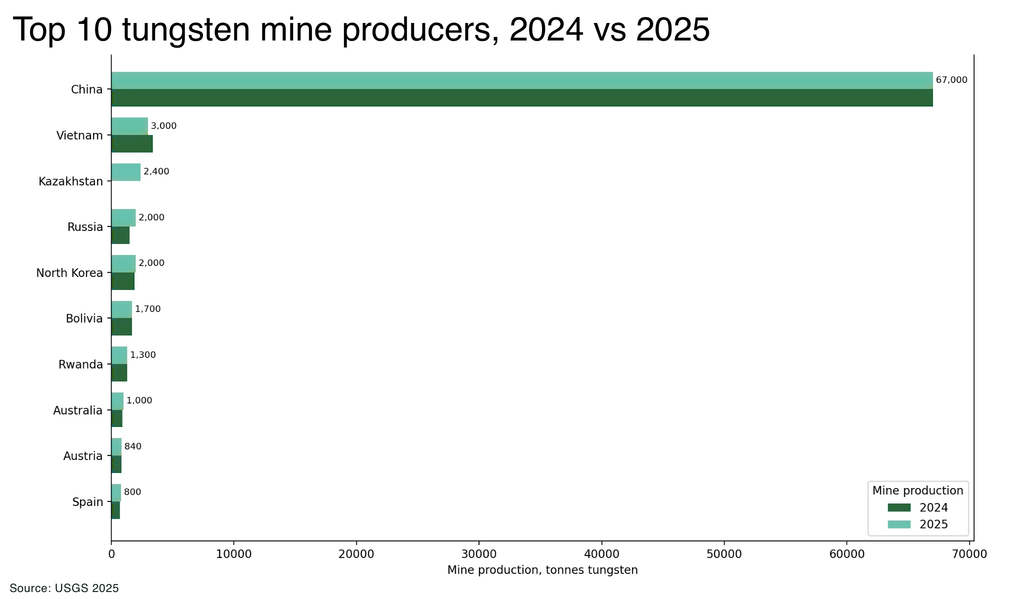
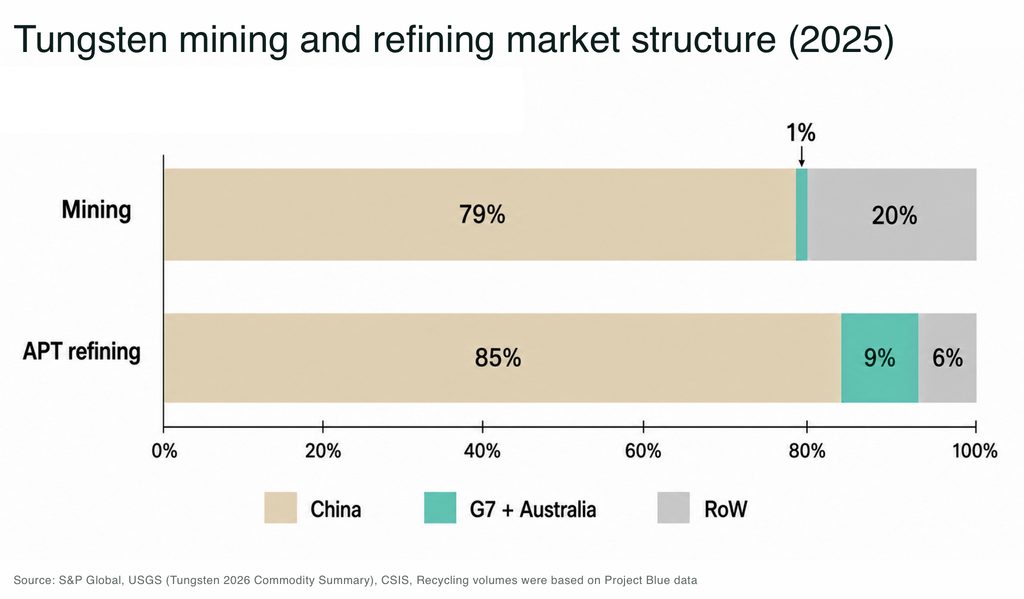
- China produced 67,000 of the 85,000 tonnes of tungsten mined globally in 2025 and controls approximately 85% of APT refining capacity
- 11 announced projects could add about 20,000 tonnes WO₃ of annual mine capacity outside China by 2030. Even if they all arrive on schedule, S&P Global still projects a 16,000-tonne ex-China primary mine-supply gap
Tungsten prices increased 310% between January-July 2026 — one of the sharpest commodity rallies of the year — as Chinese export controls and rising military demand squeeze tight supply.
(see our recent newsletter Why tungsten prices are rising so fast: inside the supply crunch)
The price surge also exposed a deeper structural problem, with the pipeline of new tungsten mines outside China still too small to meet projected demand: by 2030, accessible tungsten mines outside China are projected to meet only about 68% of projected ex-China primary demand.
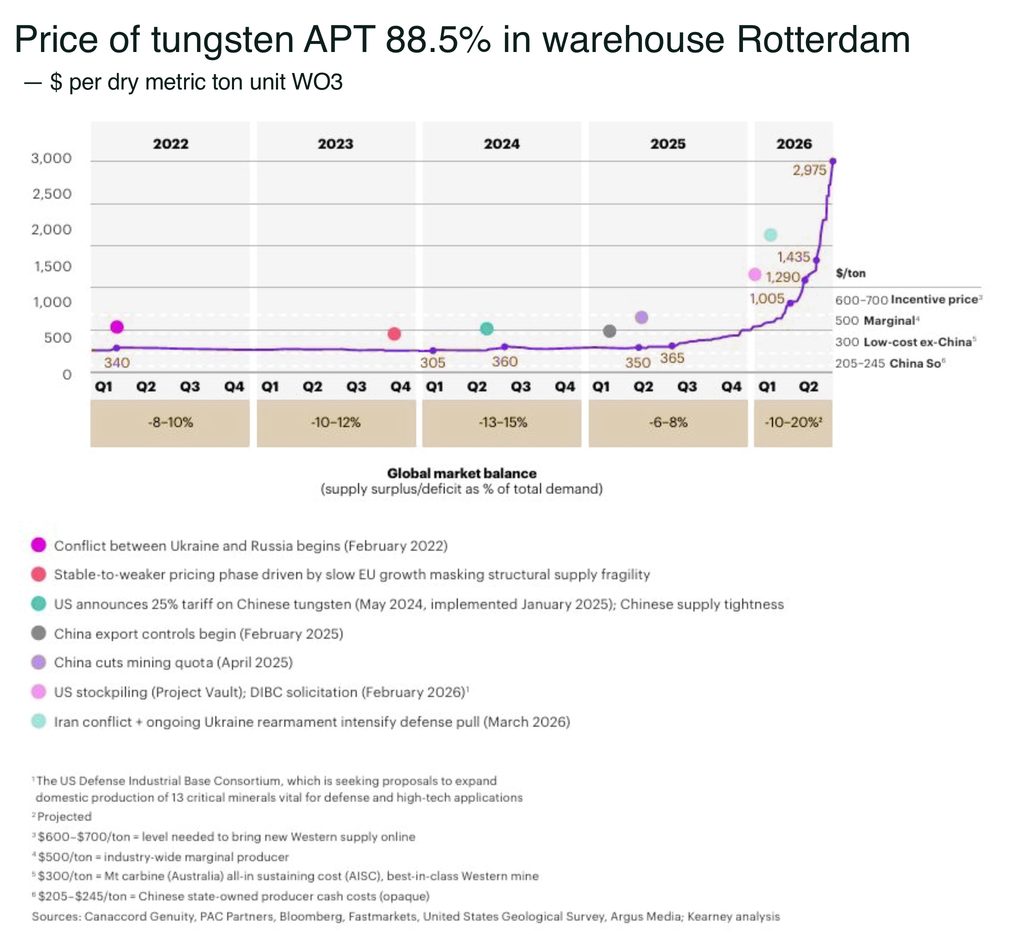
Eleven announced mine projects are forecast to add nearly 20,000 tonnes of annual capacity by 2030, lifting accessible ex-China supply to an estimated 34,000 tonnes WO₃, against projected primary demand of roughly 50,000 tonnes (after recycling), which would leave the market facing a deficit of 16,000 tonnes WO₃.
And that’s, of course, only if every announced project is delivered on schedule.
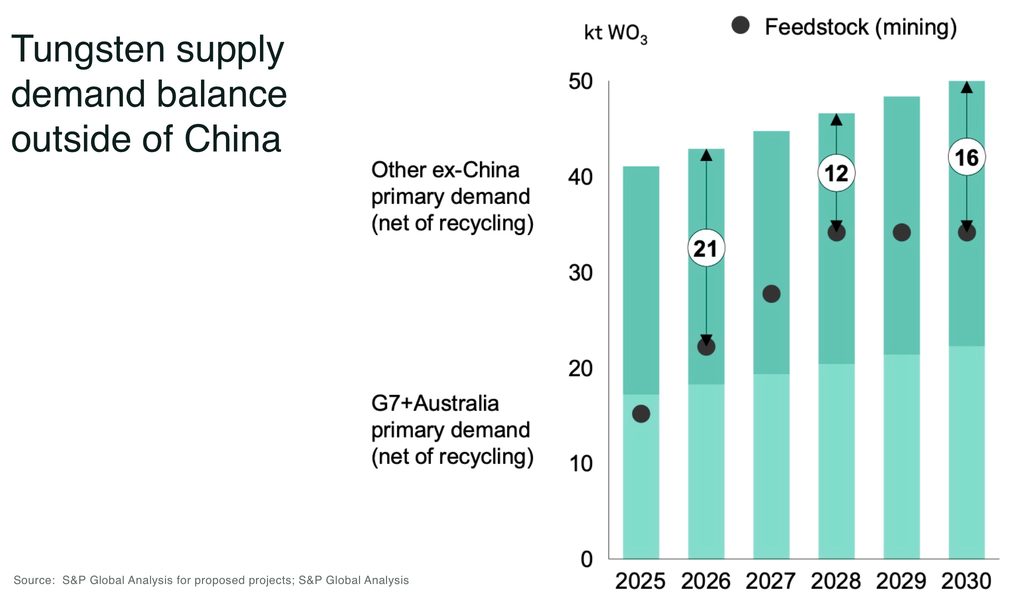
The APT CIF benchmark (the principal intermediate price for the tungsten market) increased from approx US$83/kg WO₃ in Jan 2026 to US$340/kg in July 2026, equivalent to an increase from US$830 to US$3,400 per metric tonne unit.
S&P Global estimates that US$36–48/kg WO₃ would support more than 85% of accessible current and proposed supply in 2028, so a structural cost of about US$90/kg would support every project in its modelled pipeline (let alone at US$340/kg). So, tungsten prices have already cleared the theoretical investment hurdle for most new supply outside China.
But, the challenge is that price is no longer the principal constraint. Instead, the bottleneck is development across financing, permitting, construction, commissioning and qualification.
Price has cleared the economic hurdle, not the financing hurdle
Financiers do not underwrite mines — that can take up to 16-30 years to develop — solely against an exceptional spot price. They test projects against:
- conservative long-term assumptions
- cost inflation
- construction risk
- and risk that exports from China or weaker industrial demand might pull prices down again
That is why long-term offtakes, government procurement and investment, as well as potential critical-mineral price mechanisms are being increasingly used to support project development through the “next cycle”.
Which projects could deliver new tungsten supply?
ex-China tungsten mines highlighted by S&P Global report
| Project | Latest position |
| Sangdong, South Korea | Almonty began processing stockpiled ore in June 2026; Phase I is designed to produce approximately 2,300 tonnes of tungsten concentrate annually |
| Hemerdon, UK | Tungsten West said its phased commissioning programme would begin in July 2026, with full commissioning targeted for the first quarter of 2027 |
| Mt Carbine, Australia | EQ Resources approved an A$39 million expansion designed to double crushing capacity and initially add approx 500 tonnes WO₃ of annual production |
| Northern Katpar, Kazakhstan | Tau-Ken Samruk and Cove Capital agreed to jointly develop the deposit as part of an approx US$1.1 billion tungsten mining and processing project; preparatory work has begun on the final feasibility study, including plans for domestic APT production |
| Upper Kairakty, Kazakhstan | Upper Kairakty is being developed alongside Northern Katpar under the same Tau-Ken Samruk-Cove Capital joint venture; the two deposits are being advanced as one integrated mining and processing development |
other potential major developments:
| Project | Latest position |
| Mactung, Canada | The US Department of Defense awarded Fireweed Metals US$15.8 million to advance Mactung; Canada agreed up to C$12.9 million for supporting infrastructure planning |
| Pilot Mountain, US | Guardian Metal completed a prefeasibility study in June 2026, supported by a US$6.2 million Defense Production Act award |
—
What is tungsten
Tungsten has the highest melting point of any metal and an exceptional combination of density, hardness and heat resistance,
It is listed as a critical mineral in the US, EU, China, UK, Australia, Japan and others, for good reason, with properties that make it difficult to substitute:
- defense: its density and hardness support armour, munitions and missile components
- industry: cemented carbides provide wear resistance in cutting tools, drill bits and equipment used in metalworking, mining, construction and oil-and-gas drilling
- technology: tungsten is used in semiconductor interconnects and other high-temperature electronic applications
- electric vehicles: electric vehicles require approx 2kg of tungsten for gearing systems, battery anodes and cathodes, as well as about 2,000 wiring looms in the vehicle’s semiconductors
- energy: its resistance to extreme heat and radiation makes it a leading plasma-facing material for nuclear-fusion reactors
Why are tungsten prices rising so sharply?
The price rally reflects a collision of policy and physical supply across of US tariffs, Chinese export controls, strategic defense stockpiling, and limited new mine supply.
Tungsten does not need explosive demand growth to stay tight
Demand, however, is not standing still.
S&P Global projects demand of 180,000 tonnes in 2030 and 202,000 tonnes in 2035, equivalent to growth of roughly 2% a year:
- cemented carbides account for 64% of demand, with tungsten’s hardness and wear resistance making it difficult to replace in cutting tools, drill bits and industrial components
- defense consumes a smaller volume, but understates its strategic importance, with the US Department of Defense describes tungsten as essential to national security and indispensable across industrial and military applications, which means its price sensitivity is lower
- Project Blue expects military-related tungsten consumption, including demand from aircraft, helicopters and ammunition, to increase by about 12% in 2026
Tungsten is a small, opaque market, so even modest disruptions can have an outsized effect on prices.
But, it’s not just at the margins that tungsten supply is being squeezed.
China supply
China produced 67,000 tonnes of tungsten in 2025, equal to 79% of the global total of 85,000 tonnes, and controls roughly 85% of global APT refining capacity.
Then, in February 2025, China introduced export controls covering APT and other tungsten products and technologies. Chinese shipments of controlled tungsten products subsequently fell by about 40% in 2025, and, by March 2026, European APT prices had risen 557%.
Ostensibly, China’s export restrictions were introduced after US tariffs on Chinese imports earlier in 2024.
But, the move also comes as China’s mined production fell 10% year-on-year to 61,000 tons in 2025, according to Project Blue’s estimates, due to ageing mines (some over 30 years old), lower ore grades, and increased production costs with environmental clampdowns on smaller miners.
The catch is that ex-China production is not necessarily ex-China supply.
China’s refineries import roughly 30% of the tungsten concentrate they process, making China both the world’s dominant producer and a major competitor for international mined supply.
If declining domestic production forces China’s refineries to source more feedstock from overseas, even less of the projected 34,000 tonnes of ex-China mine capacity may be available to other buyers.
New refining capacity still needs feedstock
Operating refining APT capacity outside China is approx 42,000 tonnes — already greater than accessible ex-China mine production. Four announced projects could add another 27,000 tonnes by 2030, increasing total ex-China APT capacity to about 70,000 tonnes.
But mine capacity ex-China is projected to reach 34,000 tonnes in an unrisked 2030 scenario.
The refinery buildout therefore only increases competition for concentrate and scrap.
And nameplate capacity overstates what is available with some mines and refineries vertically integrated, or other producers committing output through long-term offtake agreements.
The freely traded market can therefore be considerably smaller than headline production figures suggest.
The 2027 defense deadline will split the market
The US has not mined tungsten commercially since 2015 and remained more than 50% reliant on imports in 2025, yet from January 2027, is set to impose significant restrictions on tungsten imports:
- from January 1, 2027, US defense procurement rules will generally prohibit the acquisition of tungsten metal powder, tungsten heavy alloy and covered components if the material was mined, refined, separated, melted or produced in China, Russia, North Korea or Iran. The restriction also reaches back through the supply chain to ore, feedstock and recycled material, subject to specified exceptions and non-availability determinations
- a July 2026 executive order also directed defense officials to stop granting routine waivers from January 2027 unless contractors provide an accepted mitigation plan and demonstrate exhaustive efforts to secure compliant supply
As The Oregon Group previously reported, major US mineral suppliers have warned that the domestic industry will not be ready to meet the January deadline.
This 2027 deadline therefore creates another bottleneck in processing, traceability and qualification — and increasingly divides the market between material that meets US procurement rules and material that does not, putting further pressure on ex-China supply.
Conclusion
At current prices, the economics of new supply may work, but the supply chain still does not.
Tungsten does not lack a price signal. It lacks enough financed, permitted and qualified production — linked to secure refining and recycling capacity — to respond on the timetable Western industry now requires.
Tungsten: Q&A
Why have tungsten prices risen so sharply?
Tungsten prices have been driven by China’s February 2025 export controls, reduced shipments, limited inventories and rising military demand. Chinese exports of controlled tungsten products fell about 40% in 2025, according to Project Blue data reported by Bloomberg.
Why have high tungsten prices not solved the shortage?
Mine supply responds slowly. Projects still require financing, permits, construction, commissioning and customer qualification. Mine-development timelines average about 16 years, although advanced restarts can move faster.
What is the projected 16,000-tonne tungsten supply gap?
It is S&P Global’s estimate of the 2030 gap between accessible ex-China primary mine capacity and primary demand outside China after recycling. It is not a forecast deficit for the entire global tungsten market.
What about supply from recycling?
Recycling provides approximately 35% of global tungsten demand and around 60% of ex-China APT output, according to S&P Global.
On July 30, 2026, the White House delegated Defense Production Act authority over recoverable critical minerals. The determination authorises the Commerce Department to take action, including possible export restrictions. Reuters reported that the administration particularly wanted to retain tungsten-bearing scrap for domestic recyclers.
How much tungsten does China produce?
China produced an estimated 67,000 tonnes in 2025, or approximately 79% of global mine production. S&P Global estimates it also controls around 85% of global APT refining capacity.