- China will require licences for exports of tunnel boring machines (TBMs) and their key parts to “sensitive” countries from November 18, under an October 19 Commerce Ministry and customs announcement
- Chinese manufacturers account for nearly 70% of the global TBM market, and market leader China Railway Hi-tech claims 85% of China’s TBM market at non-coal mines
- the rules also cover cutterheads, main drives, remanufacturing technology and wet-shotcrete machines built for work above 3,000 metres
China has added tunnel boring machines to its dual-use export control list, extending the licensing approach it has used on rare-earth magnets to the heavy equipment that builds underground mines.
The rules take effect on November 18. They cover shield and hard-rock TBMs, plus cutterheads, screw conveyors, segment erectors, main drive systems and the technology used to remanufacture them.
Exports to “sensitive countries and regions” in disputes with China will need a licence. Shipments elsewhere will go through a registration system, but exporters and end users must promise not to pass Chinese-made machines on to those destinations. Beijing has not said which countries count as sensitive.
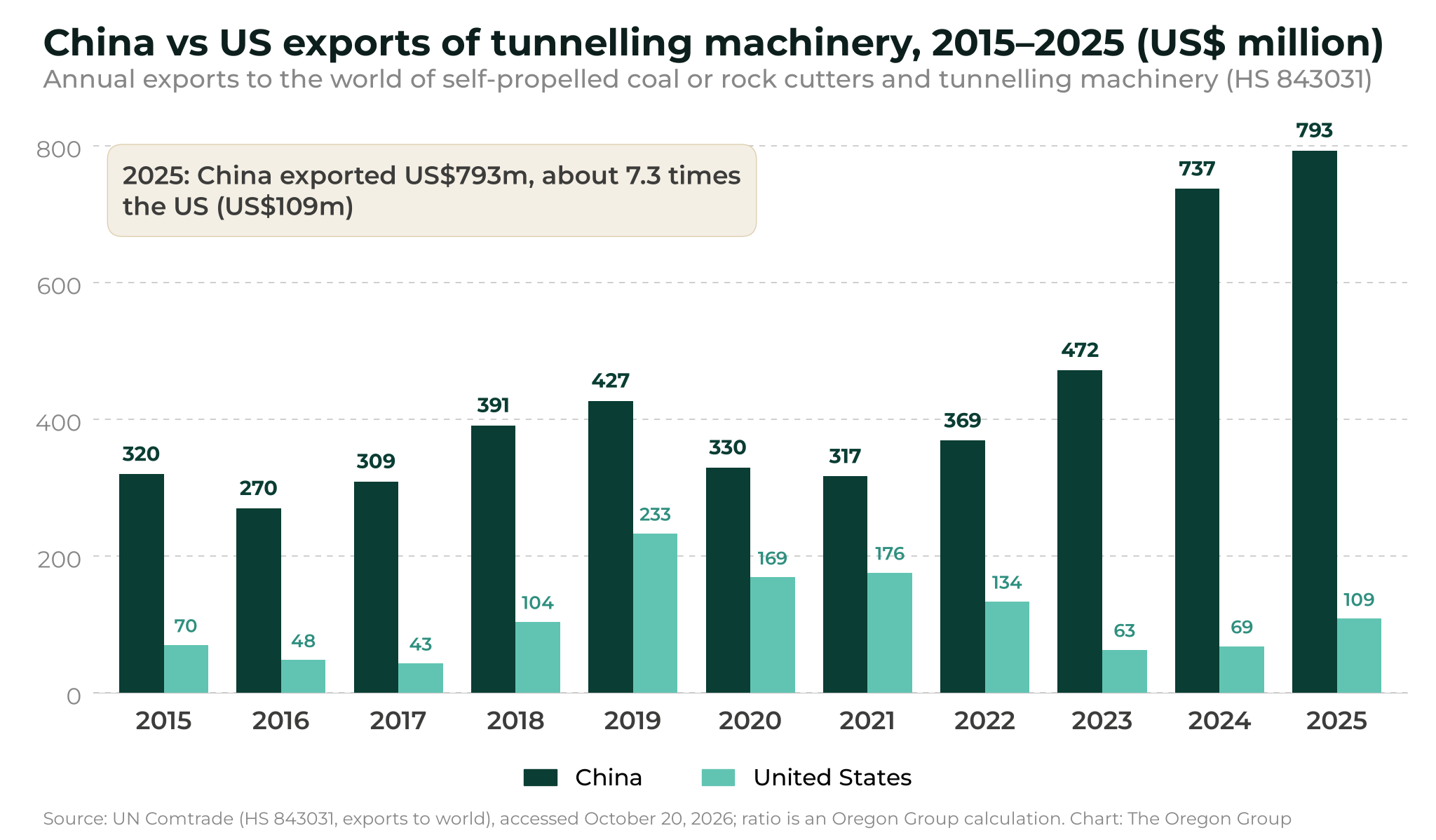
That leaves a lot of buyers exposed as Chinese manufacturers account for nearly 70% of the global TBM market, exporting about US$793 million of rock cutters and tunnelling machinery in 2025.
The mining angle
Much of the early coverage has focused on India’s metro, rail and border tunnels. But TBMs are increasingly used to cut declines and access tunnels at mines. For example:
- Chinese manufacturer CRCHI shipped a 5.63-metre mining TBM to Zambia’s Chambishi copper mine to bore a 9.7-km tunnel for a US$830 million project
- Anglo American drove an exploration tunnel of about 8.1 km towards its Los Sulfatos copper prospect in Chile, finishing in 2011, and Codelco agreed in 2022 to trial a mining TBM with Komatsu
- Ivanhoe Electric plans to start boring a 4-km decline at its Santa Cruz copper project in Arizona in the third quarter of 2027
Ivanhoe Electric’s executive chairman, Robert Friedland, has already said the controls won’t hold up Santa Cruz as its machine comes from Ohio-based Robbins, in a package costing about US$64.7 million that includes refurbishment and a material-handling system.
“Over the past 20 years, Chinese-produced TBMs have grown from ZERO to 60-70% of the global market share,” Robert Friedland wrote on X. “So, we suspect that this news will cause a PANIC in the global TBM market.”
Notably, the rules reach beyond new machines: rebuilt TBMs are common in mining outside China, and controls on cutterheads, main drives and remanufacturing technology give Beijing a say over the rebuild cycle as well as new sales.
Chinese groups have also bought up Western TBM technology, including France’s NFM, Aker Wirth’s TBM intellectual property and Caterpillar’s former Lovat business in Canada. Even Robbins was 61% owned by China’s NHI from 2016 until industry veteran Lok Home bought back substantially all its assets, in a deal announced in February 2021.
Why the impact may be limited
This is a licensing regime, however, not an embargo, with China’s Commerce Ministry saying it will approve applications that meet the rules — and Chinese makers need foreign orders.
For example, CRCHI’s overseas revenue rose to a record 32.4% of its main-business revenue in the first half of 2025.
TBMs also remain a niche tool in mining. For example, at Montana’s Stillwater platinum and palladium mine, TBMs have historically cost about a third as much to run as a conventional mining fleet, but needed about 1.5 times the capital.
The more likely result, as the Payne Institute argues, is longer lead times and a standing option for Beijing to slow deliveries to particular countries.
But, the timing still matters. Copper miners are already struggling to add supply, as we explained in our earlier article Refined copper surplus forecast, but copper mines struggle to keep up:
“The forecast therefore relies on project execution, but the ICSG has already cut 2026 mine growth twice, from the 2.3% it expected in October 2025 to 1.6% in April and 1.3% now.”
Any further disruption, however marginal, threatens to tighten long-term supply further.
The controls don’t stop any mine from being built, but they give Beijing influence over how fast some of the West’s new underground copper supply gets dug.