- Wood Mackenzie warns a sulphur shortage puts more than 600,000 tonnes of incoming Indonesian nickel capacity at risk, in projects that would produce mixed hydroxide precipitate for batteries
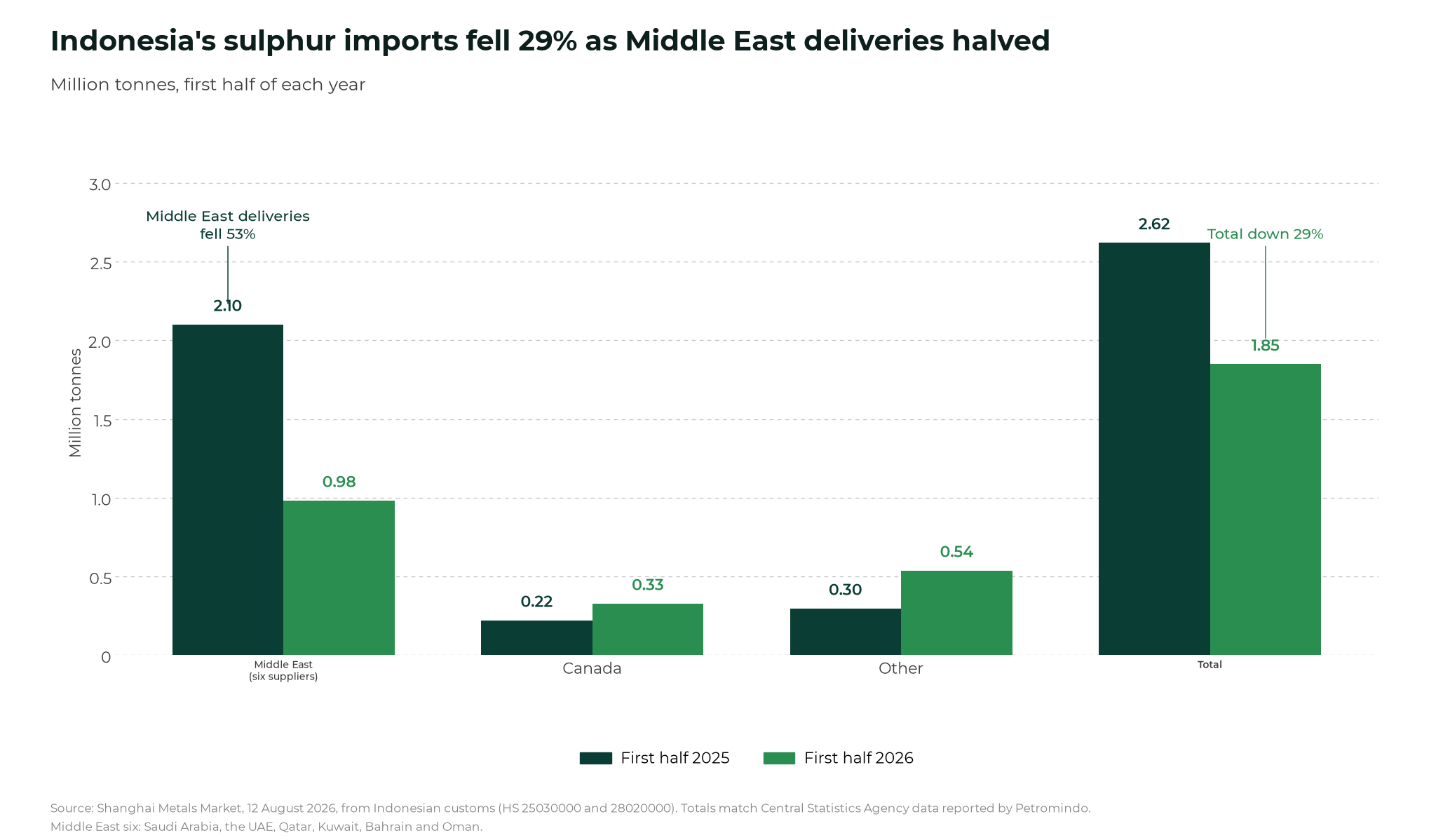
- Indonesia’s sulphur imports fell 29% in the first half of 2026 and average prices nearly tripled, after the country had relied on the Middle East for about 80% of supply
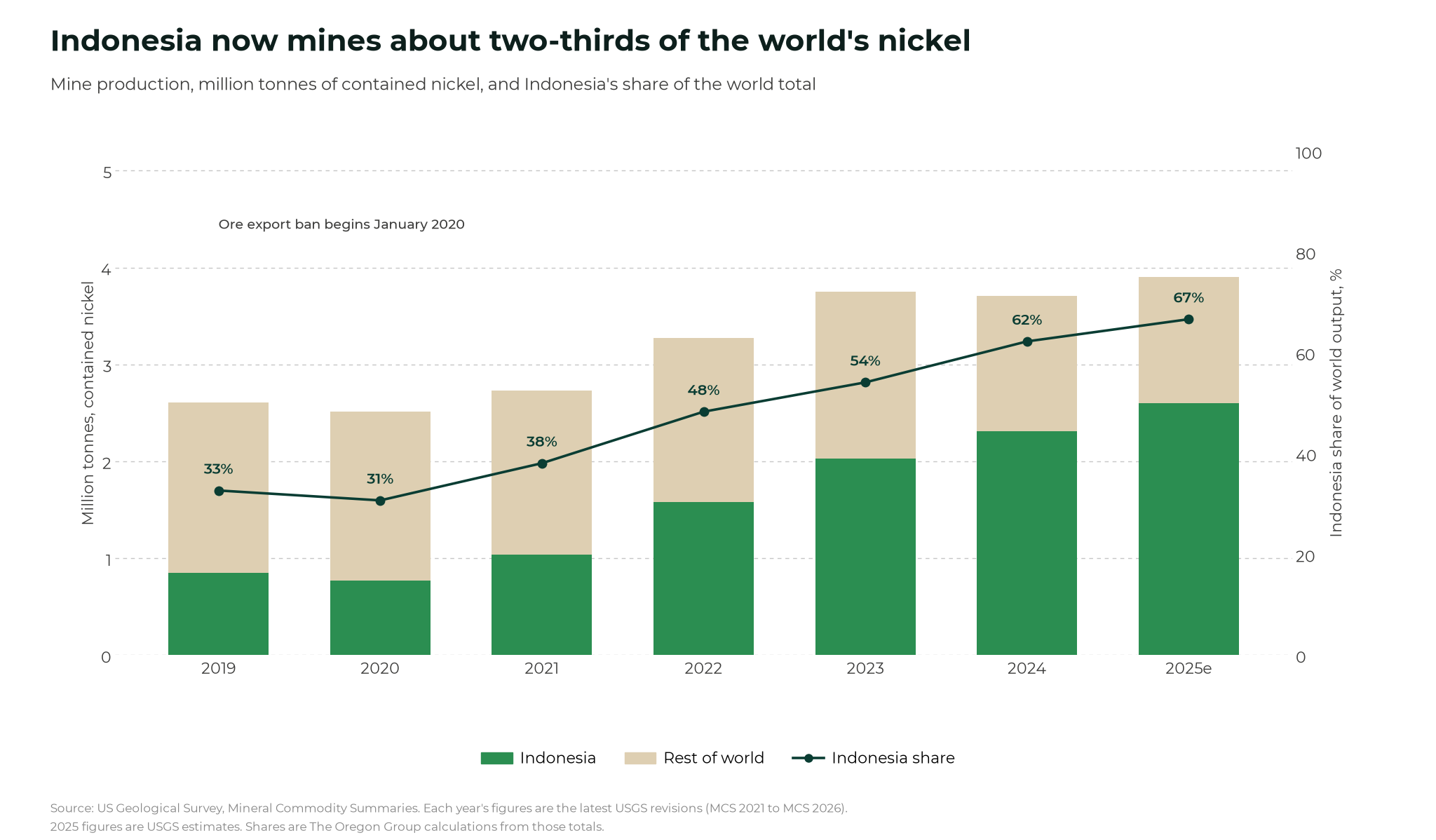
- Indonesia mined about two-thirds of the world’s nickel in 2025; much of the Western industry is shut or impaired
- in our view, that concentration is flashing red for Western buyers: Chinese firms control at least 75% of Indonesia’s refining capacity, and acid, policy, geology and ownership all point to a single point of failure
Wood Mackenzie has warned that a sulphur shortage puts more than 600,000 tonnes of incoming nickel capacity at risk in Indonesia’s battery-materials sector — equal to about 23% of Indonesia’s 2025 nickel mine output, or roughly 15% of global production, by our calculations — and more than the country’s entire high-pressure acid leach (HPAL) output last year.
But the warning is larger than a single project pipeline.
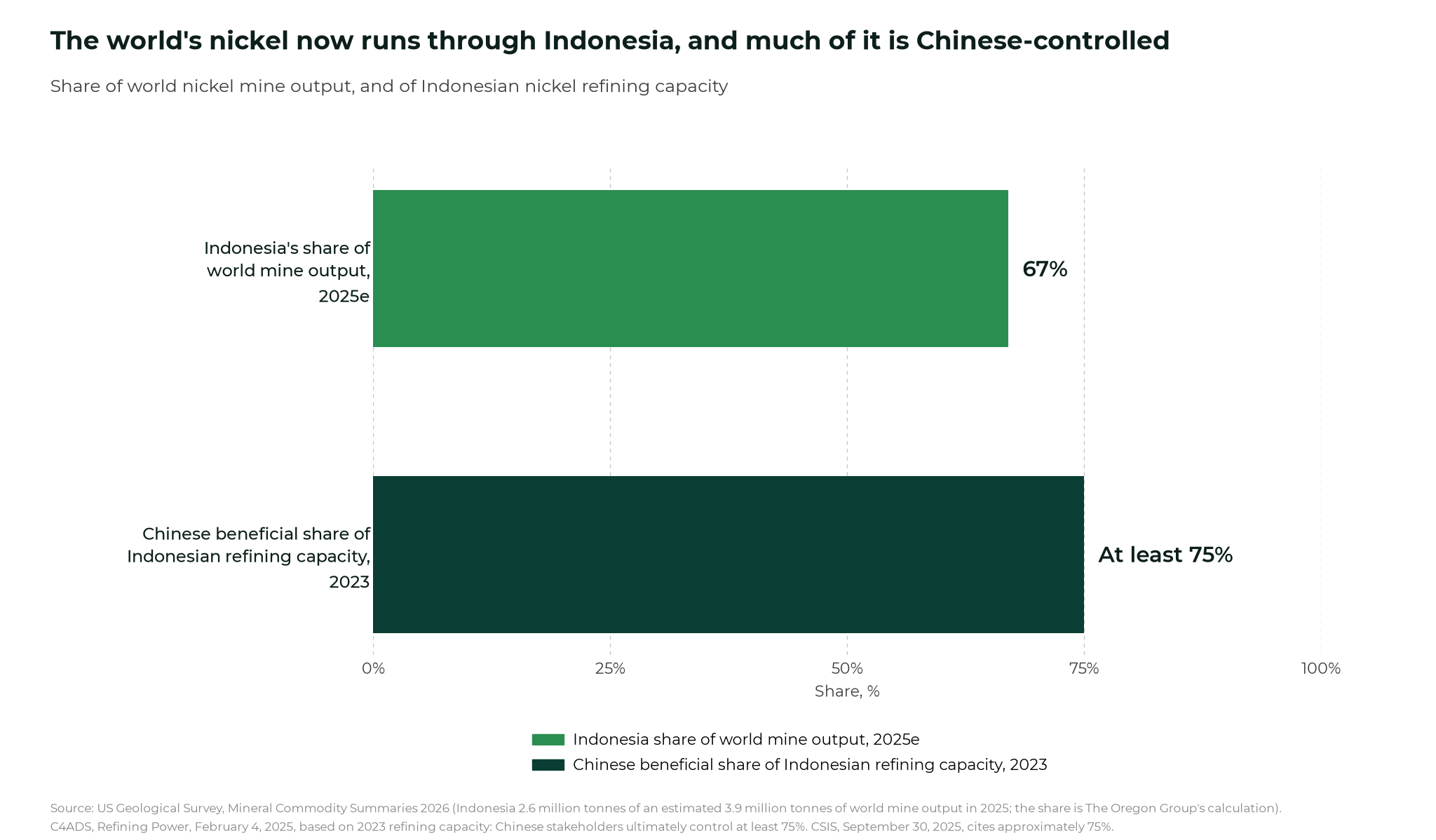
At around US$15,000 a metric tonne, the same acid shock is squeezing margins at plants that depend on imported sulphur, and it is arriving in a market Indonesia now dominates, with Indonesia mining 2.6 million tonnes of nickel in 2025, or about 67% of world mine output.
When two-thirds of supply sits in one jurisdiction, a nickel investment is, in practice, a bet on Indonesian government policy as well as on the metal.
That concentration has also become a single point of failure for global (and especially Western) supply chains.
Why Indonesia’s battery nickel depends on imported acid
Indonesia’s nickel boom runs largely on high-pressure acid leach (HPAL) plants, which need about 9 tonnes of sulphur for every tonne of nickel, and estimates suggest that an 80% rise in sulphur prices adds about US$1,700 a tonne to operating costs
The projects Wood Mackenzie has flagged would produce mixed hydroxide precipitate (MHP), an intermediate used to make battery chemicals, at HPAL plants. Those plants burn elemental sulphur to make sulphuric acid, then use the acid under high temperature and pressure to extract nickel and cobalt from low-grade laterite ore.
Indonesia produces little of this sulphur feedstock itself and must therefore import it, with about 80% of those imports coming from the Middle East before the Strait of Hormuz closed during the regional conflict that began in late February.
In the first half of 2026, Indonesia’s sulphur imports fell 29% from a year earlier and average prices nearly tripled. Data from the Central Statistics Agency, reported by Petromindo, show the same decline: about 1.85 million tonnes, down 29.4%, while the import bill more than doubled to US$1.27 billion. The average landed price in June reached about US$1,108 a tonne.
The HPAL process is estimated to need about 9 tonnes of sulphur for each tonne of contained nickel, and that an 80% rise in sulphur prices raises operating costs by about US$1,700 a tonne of nickel. As we reported in June, sulphur had already risen to 42% of HPAL nickel costs, up from 26% before the conflict.
The Indonesian Nickel Industry Forum says HPAL plants produced about 450,000 tonnes of nickel in 2025, and that capacity is expected to exceed 900,000 tonnes by the end of 2027, but they cannot do that without a reagent Indonesia does not make at home.
We flagged this bottleneck in March, in Strait of Hormuz is chokepoint for sulphuric acid and critical metal processing:
“The Strait of Hormuz disruption is not just an oil-market story. It is a metals-processing story (and food security story).”
And China is not a substitute for Gulf sulphur: it supplied only about 42,000 tonnes of crude sulphur to Indonesia in 2025, but it has been a major source of sulphuric acid. But then China halted sulphuric acid exports from May 2026. Chile and Indonesia together took half of China’s 4.7 million tonnes of acid exports in 2025, so importing finished acid is also harder. And the constraints are unlikely to ease quickly, because logistics take time to normalise and the fertiliser sector competes for what sulphur is available.
Canada has taken some of the strain, raising its shipments to Indonesia by nearly half in the first half, according to Shanghai Metals Market, but deliveries from six Middle Eastern suppliers fell by about 53% to 982,400 tonnes.
Drought added a separate squeeze, with smelters at the Indonesia Morowali Industrial Park reporting production cuts of 30% to 45% in late September.
What 600,000 tonnes would mean for global supply
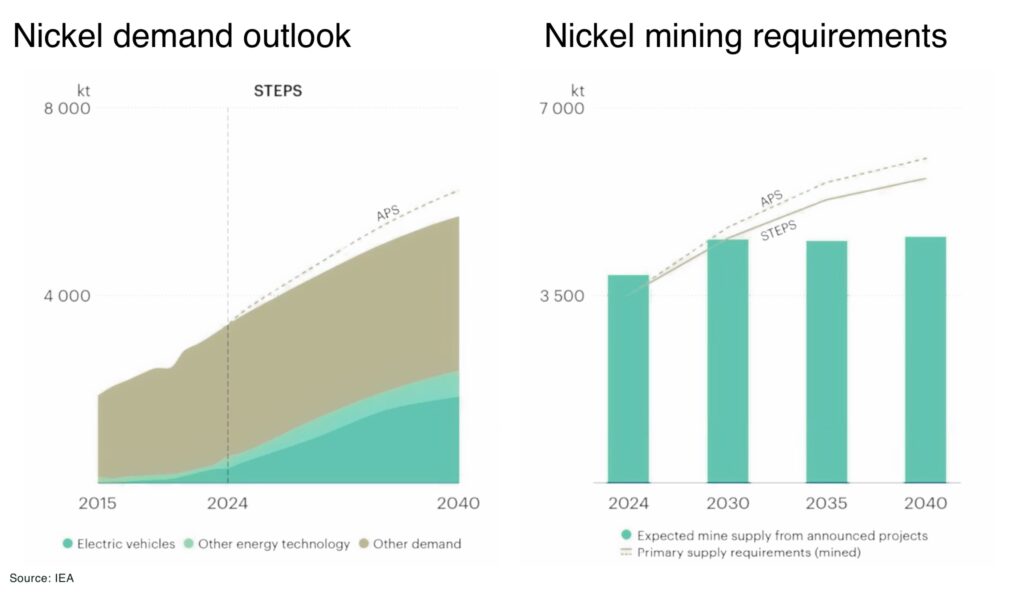
Nickel is a hard, corrosion-resistant metal that makes modern industry possible. About two-thirds of it goes into stainless steel, with the rest used in alloys for jet engines, defence and power plants, and in the cathodes of high-performance electric-vehicle batteries, where it adds range, with EV batteries seen as the main driver of demand growth to 2040.
The International Nickel Study Group forecasts world primary nickel production of 3.868 million tonnes in 2026 and 4.071 million tonnes in 2027, against usage of 3.849 million and 4.002 million tonnes, which implies a surplus of only 19,000 tonnes in 2026 and 70,000 tonnes in 2027.
By our calculation, 600,000 tonnes of at-risk capacity is about 15% of the 2026 production forecast, and about three times the 203,000-tonne increase in output the group expects between 2026 and 2027. It is more than 30 times the 2026 surplus and more than eight times the 2027 surplus.
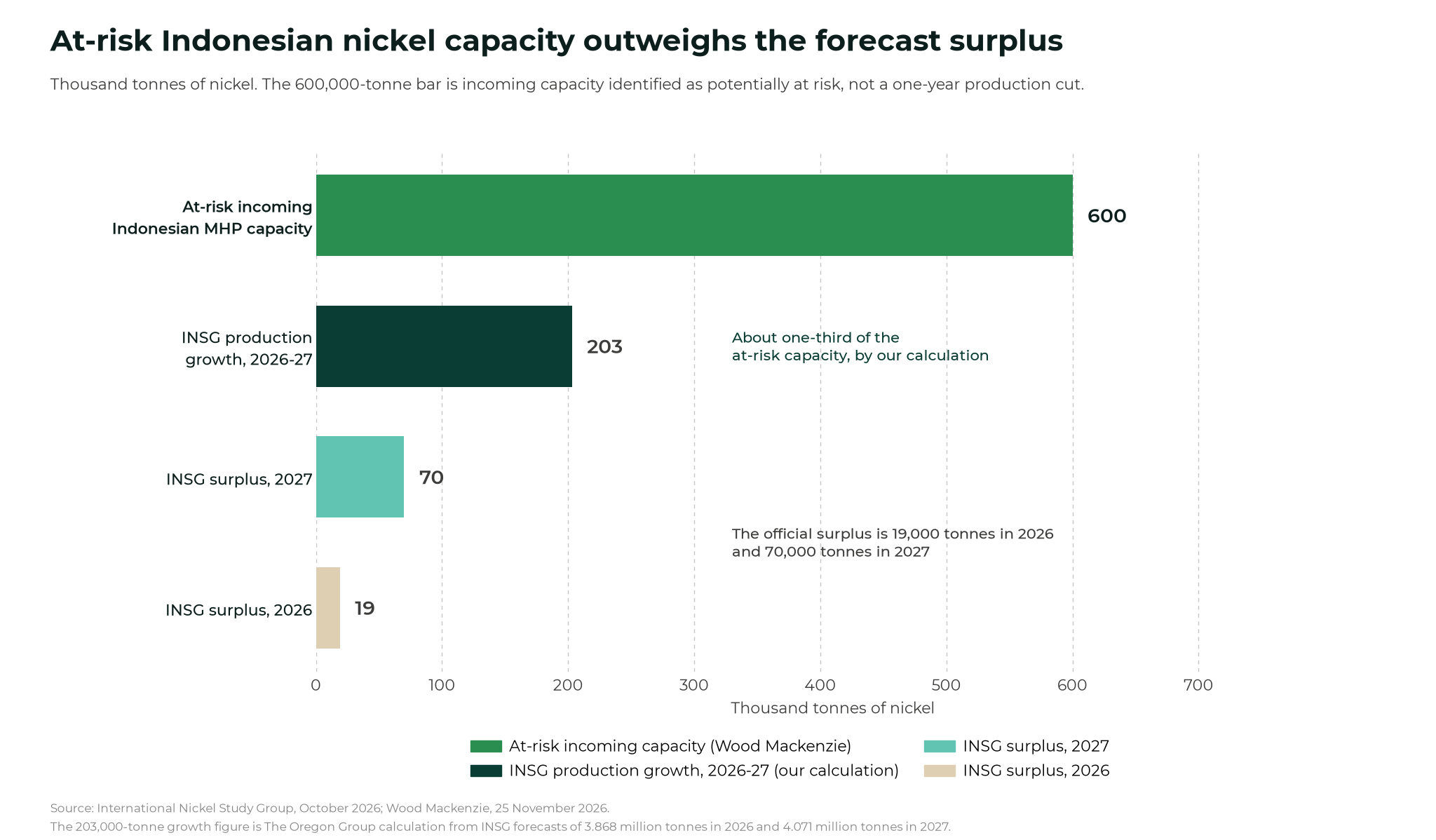
This does not mean the market would swing into a half-million-tonne deficit in 2027.
The Wood Mackenzie figure is incoming project capacity identified as potentially at risk, not a one-year cut to plants already running, and new HPAL lines do not operate at full rate from the first day. The study group also notes that its estimates do not include an adjustment for possible production disruptions. If a substantial share of that capacity were delayed or left idle, though, it would outweigh the modest surplus on which the official outlook now rests. Wood Mackenzie itself expects a surplus of high-purity nickel unless supply also falls.
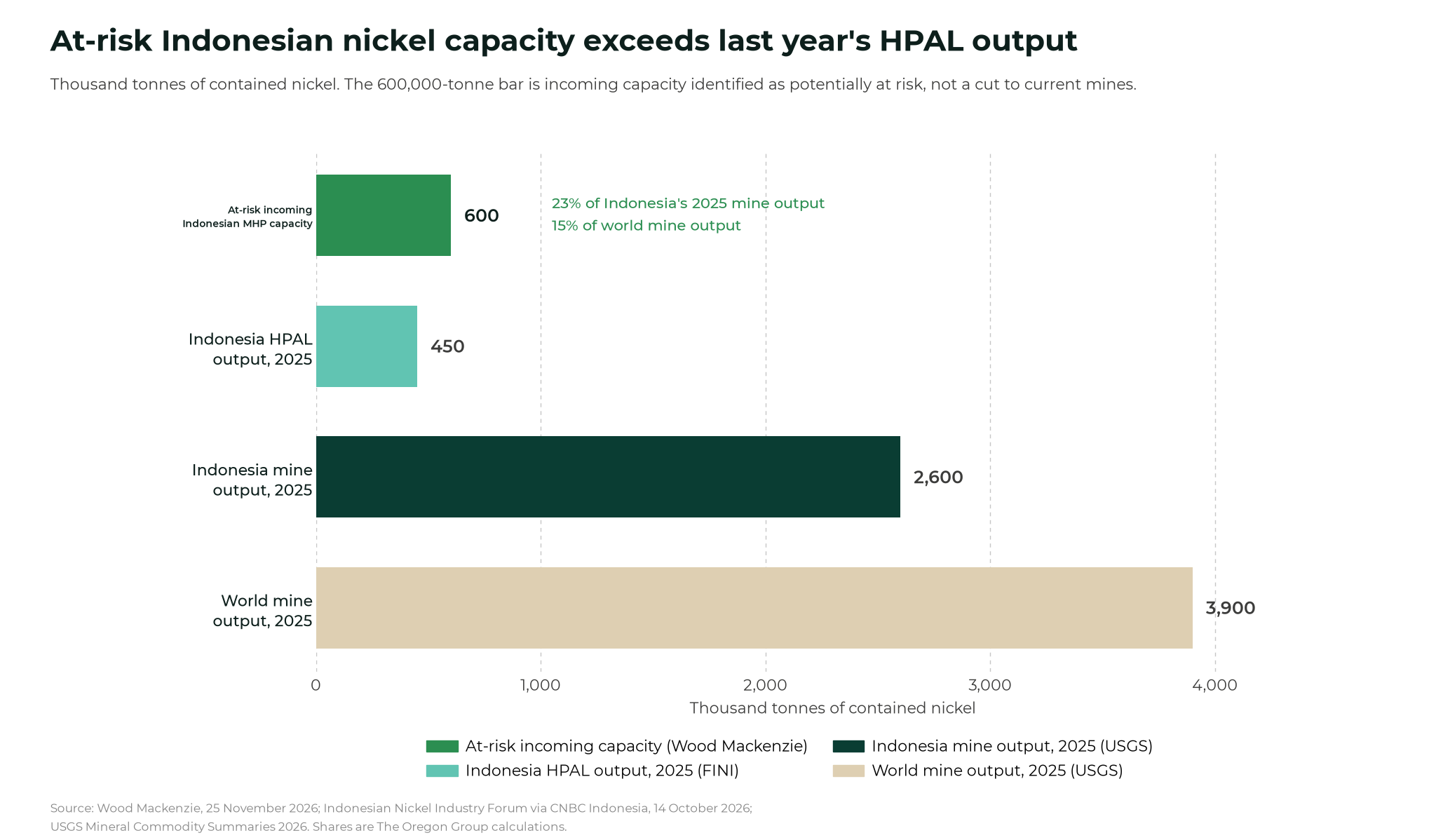
London Metal Exchange cash nickel settled at US$15,035 a tonne on November 25 and price is back near last year’s levels — but the sulphur bill is not.
Acid costs have squeezed margins. They have not erased every profit
It is tempting to conclude that, at this price, no nickel miner is making money, but the evidence does not support that as an absolute.
What it does support is sharper: much of the Western industry is shut or impaired, HPAL margins in Indonesia have been squeezed, and some acid-hungry lines have been cut — see our article on The Great Nickel Trade War — which has helped low-cost, integrated Indonesian producers, especially those selling nickel pig iron, ferronickel or matte rather than relying only on HPAL, to report substantial 2026 profits.
But the crisis across Western nickel producers continues, including Glencore’s Murrin Murrin HPAL plant in Western Australia is in production, but the company took a US$457 million write-down in the first half of 2026, “driven by a stronger Australian dollar and higher sulphur price assumptions,” and cut the carrying value to zero.
Inside Indonesia, the picture splits by process and by cost position:
- PT Vale Indonesia reported a nine-month net profit of US$147 million, up from US$52 million a year earlier, and EBITDA of US$297 million. In the third quarter, its matte cash cost was US$10,404 a tonne, against a realised price of US$14,053
- Nickel Industries reported first-half profit after tax of US$74.3 million and adjusted EBITDA of US$247.6 million. Its rotary kiln electric furnace (RKEF) cash costs were US$11,480 a tonne in the first half, against a sale price of US$13,784; by the third quarter those cash costs had risen to US$13,054 a tonne, with adjusted EBITDA of US$1,516 a tonne
- Harita Nickel, listed as Trimegah Bangun Persada, told investors that nine-month profit attributable to owners was Rp8.69 trillion, or about US$498 million at the company’s assumed exchange rate, with EBITDA of about US$695 million, although gross profit slowed on higher royalty and production costs
- Zhejiang Huayou Cobalt, a diversified cathode and precursor group rather than a pure nickel miner, reported first-half net profit attributable to shareholders of 3.507 billion yuan, up 29%. Its MHP shipments fell 19% to 96,800 tonnes, and it said subsidiary PT Huafei Nickel Cobalt would temporarily suspend some production lines from May 1, affecting about 50% of that plant’s capacity, citing a significant increase in the price of sulphur
So, the margin is (much) thinner, but it is not zero — which obviously raises the challenges facing Western nickel production hopes to try and compete.
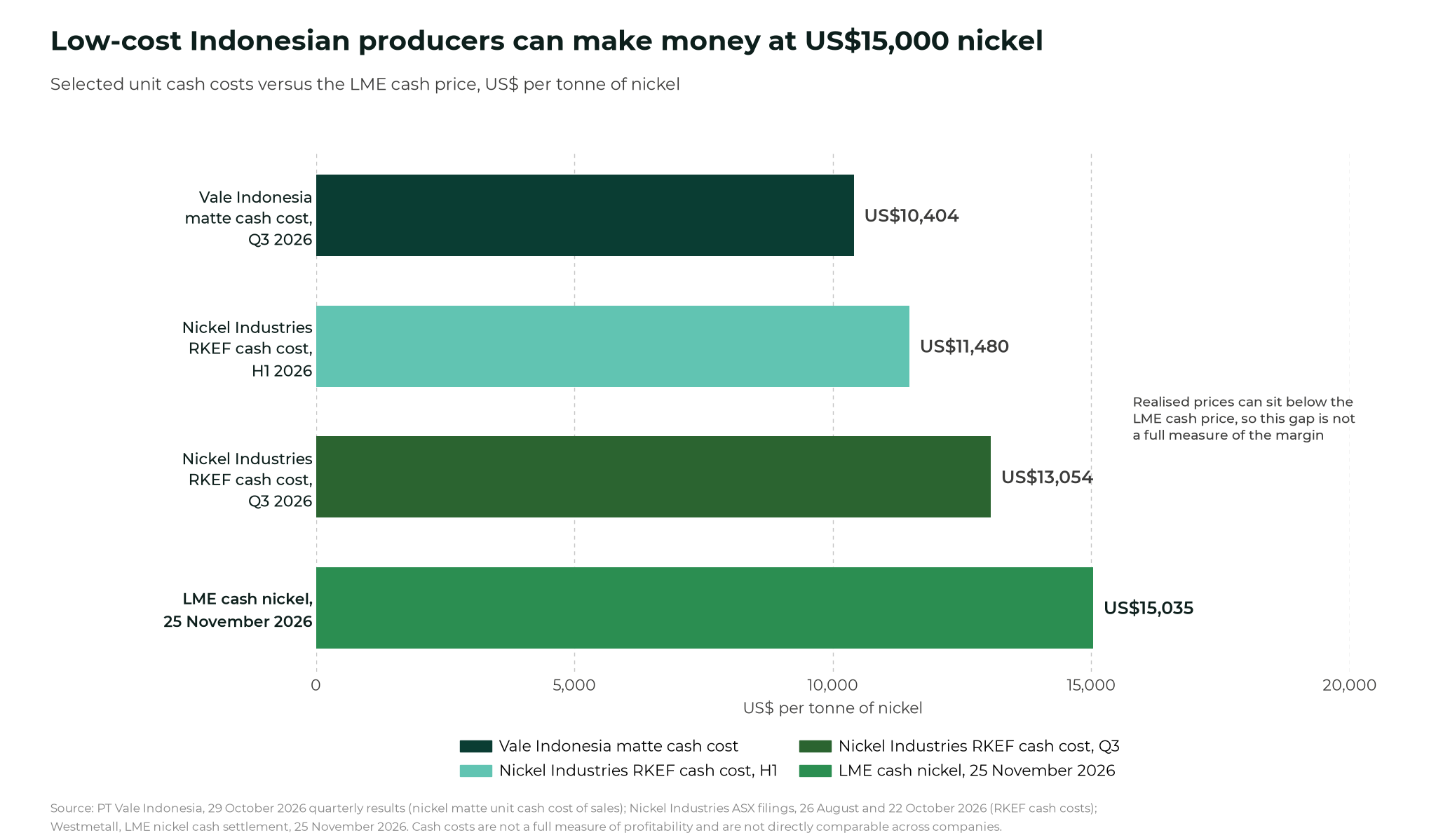
Sulphuric acid has cut deep into the margin at the acid-intensive end of the industry, but it has not yet put every profitable nickel company into the red.
Investing in nickel is a bet on Indonesian policy
Indonesia’s rise to about two-thirds of world mine supply is a policy outcome, not an accident of geology alone. Jakarta banned exports of nickel ore from January 1, 2020, forcing the metal through domestic smelters under its downstreaming programme, hilirisasi.
USGS figures, on the latest revisions, show Indonesia’s share of world mine output rising from about 33% in 2019 to 48% in 2022 and an estimated 67% in 2025.
Now, price action in the nickel market largely follows Indonesia’s government policy signals. For example, LME cash nickel, as a monthly average, jumped at the start of 2026 as Jakarta pointed to a tighter mining quota, and peaked at about US$18,805 a tonne in May after the Hormuz disruption. Glencore, in its half-year report, said first-half nickel averaged about US$17,700 a tonne, 15% above the first half of 2025, “driven by expectations of tighter Indonesian ore supply, higher sulphur costs and related production curtailments.”
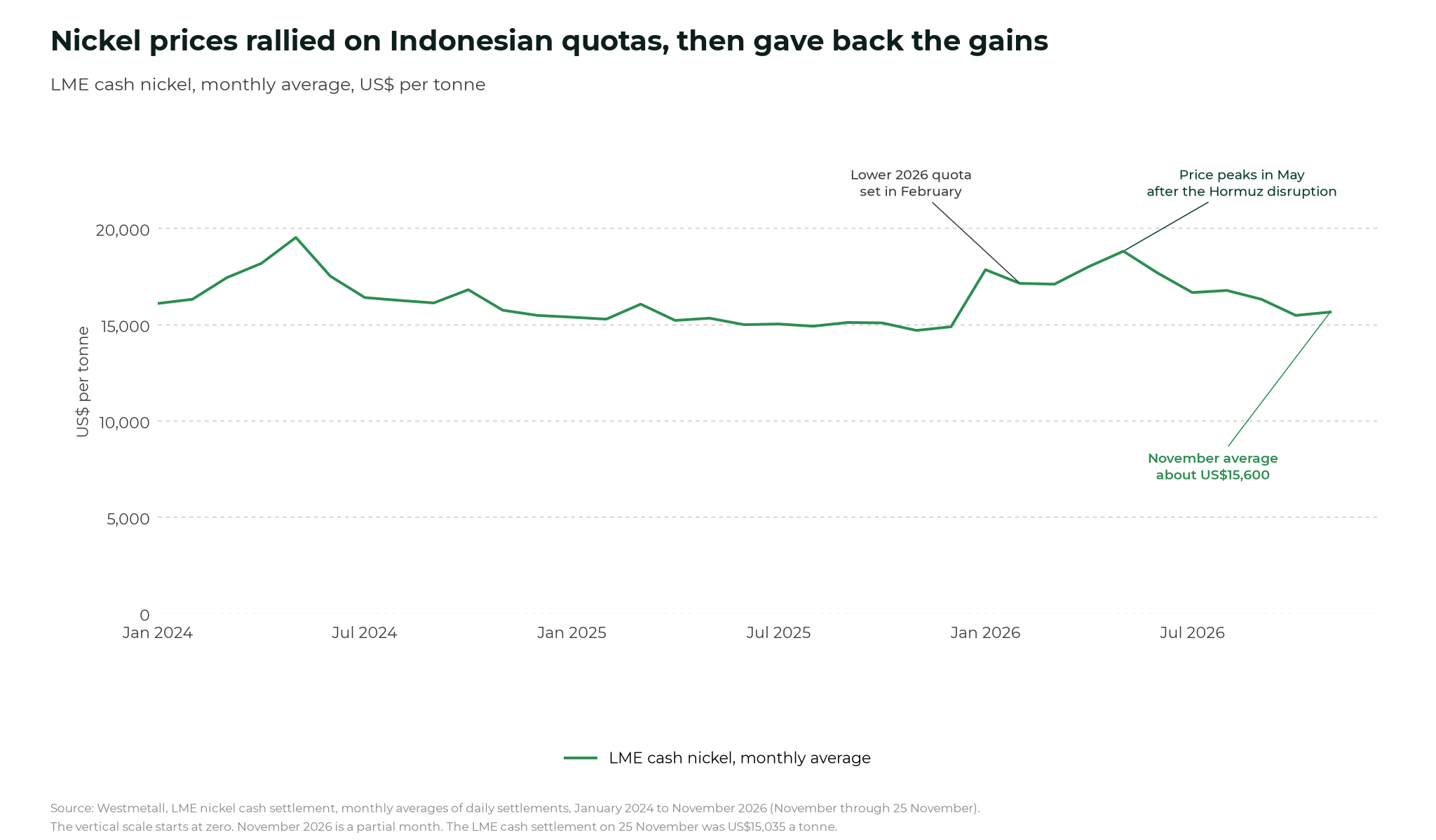
Over the past two years, Jakarta’s policy has steadily raised the cost floor for producing nickel in Indonesia, through environmental enforcement, a bigger state take and tighter control of processing.
On the environment, Indonesia revoked four nickel mining licences in Raja Ampat in June 2025, after a public outcry over mining in an archipelago known as the “last paradise”. It was a rare intervention by the world’s top producer, and a sign that environmental limits on its nickel industry are becoming harder to ignore. As we reported in Indonesia’s nickel dilemma is the West’s opportunity, it followed a presidential pledge to replace the coal plants that power the country’s smelters with renewable energy by 2040. Pressure is also building from abroad: Europe’s Battery Regulation will cap the carbon footprint of EV batteries from 2027, and nickel could be added to the EU’s carbon border tax from 2028.
On revenue, Government Regulation 19 of 2025, which took effect on April 26, 2025, replaced a flat 10% royalty on nickel ore with a tiered rate of 14% to 19% that rises with the price, and lifted royalties on intermediate products. As we noted in Can nickel prices hit $25,000 in 2026?, every US$1,000 rise in the nickel price now adds roughly US$250 a tonne to state revenue, nearly double the old sensitivity. That gives Jakarta a direct fiscal reason to want higher prices, and producers feel the cost: Harita blamed part of its gross-profit squeeze on the higher royalty.
On processing, Government Regulation 28 of 2025, issued in June 2025, restricted new industrial licences for plants that would only make intermediates such as nickel pig iron, ferronickel, matte or MHP. Alongside the move to one-year mining quotas, this means Jakarta now controls both how much ore is dug and what gets built to process it.
For investors, the result is a higher and more political cost floor, which in our view supports prices but leaves margins in the hands of policymakers.
Indonesia is nickel’s single point of failure
As Western governments try to secure critical minerals, nickel is the metal that most clearly fails the diversification test.
In our view, that supply is now flashing red.
The risks sit in the reagent HPAL plants require, in the companies that own the refineries, in the ore itself, and in Jakarta’s willingness to restrict or redirect exports.
Nickel is on the US government’s final 2025 list of critical minerals, published on November 7, 2025; the European Union has named nickel projects as strategic under its Critical Raw Materials Act.
The US signed critical-minerals frameworks with Australia on October 20, 2025 (and with Japan on October 28, 2025, covering finance, permitting, offtake and stockpiling, attempting to build a second source, but they have not yet created one of any size.
HPAL’s dependence on imported sulphur, much of it shipped through the Strait of Hormuz, is set out above.
But, Indonesia’s main nickel hubs also sit on active faults in one of the most earthquake-prone regions in the world — for example, a magnitude 7.6 earthquake struck at sea off North Sulawesi and North Maluku on April 2, 2026, and a tsunami warning was issued for Ternate, Halmahera and Bitung before being lifted. We have not seen a confirmed report that the quake halted nickel operations at Weda Bay or Morowali, but the might not be the case
A tailings landslide on February 18 at PT QMB New Energy Materials in the Morowali industrial park killed an excavator operator, and QMB halted production. IMIP denied reports that four smelters had stopped, but the waste-facility failure shows how quickly a single park can become a bottleneck.
And, when it comes to the refining bottleneck for the West, which is already facing a series of export restrictions by China across rare earths, tungsten, graphite, antimony, etc — C4ADS concluded in February 2025 that Chinese stakeholders ultimately control at least 75% of Indonesia’s nickel refining capacity, based on 2023 capacity, with China taking 82% of Indonesia’s nickel exports in 2024.
It’s not just a short-term acute problem, as long-term, nickel ore is not getting easier to mine in Indonesia.
Jim Lennon of Macquarie told an LME Week audience in October 2025 that average Indonesian ore grades had fallen from 1.8% nickel three years earlier to 1.5%. High-grade saprolite is being depleted first, pushing growth towards lower-grade limonite and HPAL. Irwandy Arif of the Indonesian Nickel Miners Association warned on September 21, 2026, that at a production rate of about 735 million tonnes, saprolite reserves would last about six years and limonite about 16 years. That assumed rate is well above the 2026 mining quota; in March 2024 the energy ministry spoke of about 13 years of saprolite and 33 years of limonite.
Those facts sit on top of the policy tools already described, from the 2020 ore-export ban to quotas, royalties and talk of export levies. Jakarta does not need a new law to tighten supply, it has already shown that it will.
The constructive response should be diversification.
Europe has put Sakatti, Dumont and the Brazilian SMP refinery on its strategic-project list; Talon Metals has a Tesla offtake for nickel concentrate from its Tamarack project in Minnesota, though the mine is not yet in production; existing output from Vale and Terrafame already sits outside Jakarta’s quota system.
None of this will quickly replace 2.6 million tonnes of Indonesian mine supply, but Dumont’s planned 25,000 tonnes a year after expansion would be about 1% of that total, by our calculation.
What to watch
The next series of hurdles for the nickel market are quite specific:
- the 2027 RKAB: whether Jakarta cuts the ore quota again to support prices, or eases it if smelters run short of feed
- sulphur supply: whether Gulf loadings through Hormuz recover, and whether China’s acid export halt remains in place
- HPAL utilisation: whether curtailed lines, including Huafei, return, and how much of the 600,000 tonnes of incoming capacity is delayed
- fiscal policy: whether an export levy or a further royalty change is revived for 2027
- the LME reaction: how far a quota headline can move a market that, for now, is back near US$15,000 a tonne
- non-Indonesian projects: whether names on Western critical-minerals lists, from Sakatti in Finland to Dumont in Canada, move into funded construction
A sulphur shortage at this scale is large enough to matter beside the official surplus, but it is not a reason to treat every nickel equity as a distressed asset. The producers making money are concentrated in Indonesia, at the discretion of the same government that built this supply.
At US$15,000 a tonne, and with two-thirds of mine supply in one country, nickel is no longer a general mining bet. Investors are investing not on nickel, but Indonesia and its government policy, including whether Jakarta keeps supply tight, whether HPAL plants can live with scarce, expensive sulphur.
However, for the West, and the rest of the world, nickel supply now largely hangs by a single thread, and this year has shown just quite how many things could cut it.