- the US Department of Energy (DOE) has awarded US$16 million, US$1 million each, to 16 universities under its PROSPECT Planning Prize, a first slice of a wider US$100 million programme to train workers for the mining, processing and recycling of critical minerals such as copper, lithium and rare earths
- US mining schools awarded only 162 bachelor’s degrees in mining engineering in 2023, against industry demand of about 500 to 600 engineers a year and a Department of Energy estimate that the US needs 6,000 new mining engineers over the next decade
- China, by comparison, has 45 mining engineering programmes that enrol about 12,000 students and graduate roughly 3,000 a year, about 18 times the US total
The US Department of Energy (DOE) has awarded US$16 million to 16 universities to help rebuild the workforce that is supposed to mine, process and recycle critical minerals at home.
Each school receives US$1 million under the PROSPECT Planning Prize, announced on October 26. The winners include:
- the Colorado School of Mines
- the University of Nevada, Reno
- the University of Alaska Fairbanks
- Virginia Tech
- and the University of Arizona
The money is meant to fund plans that raise the number of graduates and other credentialed professionals in mining and related supply-chain fields within two years — as other efforts continue to stall.
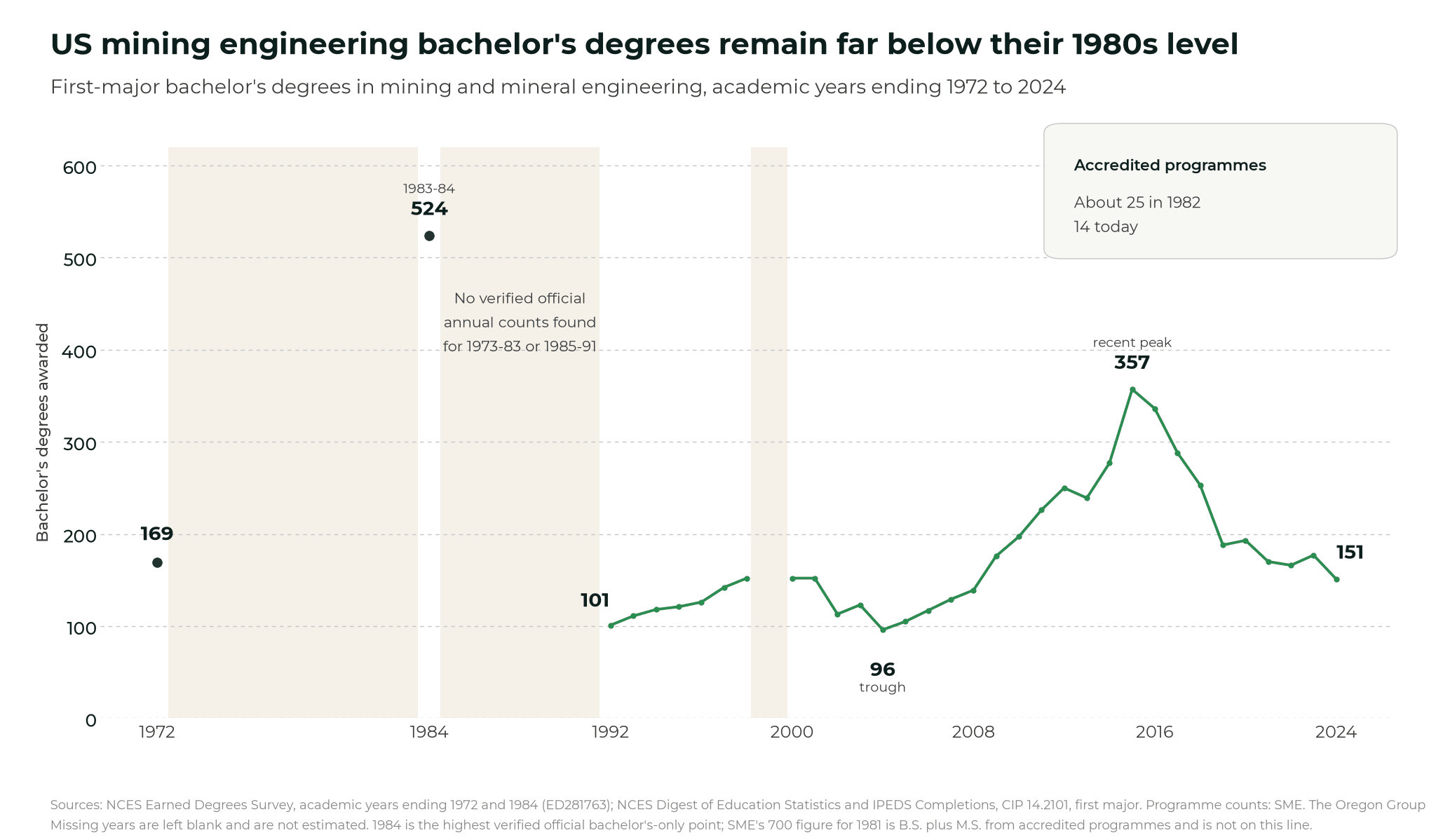
Federal data show 524 bachelor’s degrees in mining and mineral engineering in 1983-84, when the US still had about 25 accredited mining programmes — but, by 1991-92 the total was down to 101, and was 151 in 2023-24.
The awards are the first payment from DOE’s wider Providing Opportunities for Specialized Education in Critical Technologies (PROSPECT) initiative, launched in August with funding of up to US$100 million. The near-term goal is to double the number of graduates with mining, minerals and associated supply-chain credentials in two years.
As far back as 2023, we argued that the constraint was already human, not just geological. In The mining industry is running out of miners, we wrote:
“Demand is rising sharply, but supply is tightening at an unprecedented scale. We’re not talking about minerals, but miners.”
Three years on, Washington is finally putting money into the schools as the pipeline those schools feed has barely moved.
The graduate numbers have barely improved
The last comprehensive count, presented to a National Academies workshop in 2024 and based on data compiled by the Society of Mining Professors and the Society for Mining, Metallurgy and Exploration (SME), is stark.
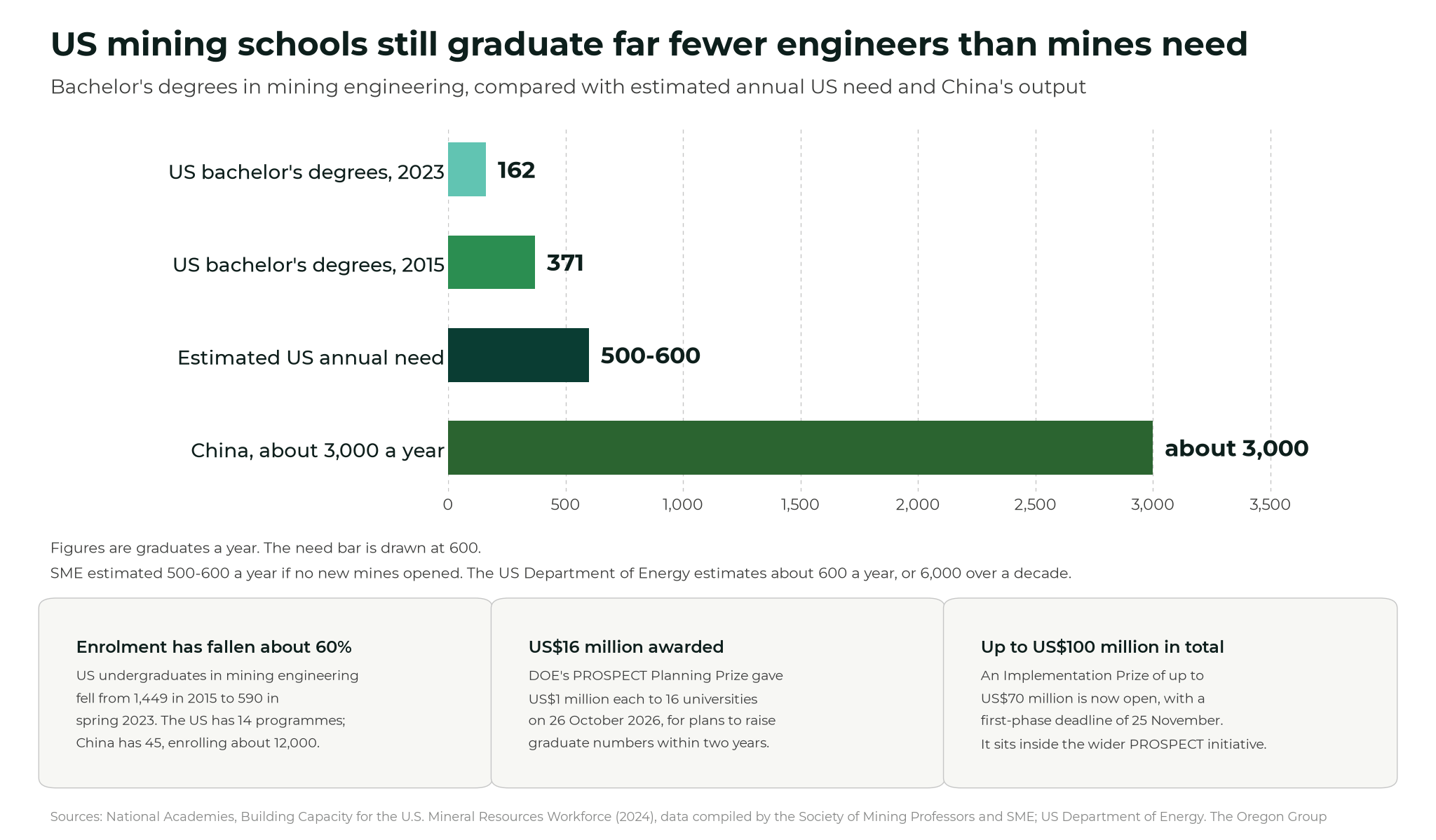
The US has 14 mining engineering programmes. They enrolled 590 undergraduates in spring 2023, down from 1,449 in 2015, a fall of about 60%. Bachelor’s degrees awarded fell from 371 in 2015 to 162 in 2023.
That 162 figure is what sits behind President Trump’s claim, at the August mining roundtable, that accredited US programmes now graduate fewer than 170 mining engineers a year. SME has estimated that the industry already needs 500 to 600 mining engineers a year, even if no new mines open. DOE puts the gap at 6,000 new mining engineers over the next decade, or about 600 a year.
The competition — China — is in a different league. The same National Academies session heard that China has 45 mining engineering programmes, enrolling about 12,000 students and graduating roughly 3,000 a year, about 18 times the 162 awarded in the US. The longer official record is bleaker still:
There are some signs of recovery, but only at a few schools. For example, undergraduate enrolment in mining engineering at the Colorado School of Mines has roughly doubled, from 101 students when department head Bill Zisch arrived in 2023 to about 183 last May, with a target of close to 200 in the autumn. At Virginia Tech, students who applied indicating an interest in mining engineering rose from two in the 2020 admissions cycle to 55 in the latest cycle. Fifty companies came to the school’s mining careers fair to recruit from a graduating class of about 30.
The official US employment outlook is more cautious than DOE’s, with the Bureau of Labor Statistics (BLS) counts only 6,200 mining and geological engineers in 2025 and projects about 300 openings a year to 2035, assuming trend growth rather than a policy-driven build-out of new copper, lithium, rare earths and antimony mines.
And pay is not the obvious problem.
The median wage for mining and geological engineers was US$106,220 in May 2025, against US$50,980 for all workers. Job openings in mining and logging stood at 26,000 in September 2026, a vacancy rate of 4.1%, down from the peaks we cited in 2023, but the training pipeline is still too narrow to staff a wave of new mines.
Sixteen million dollars is a first payment, not the fix
On its own, US$16 million is modest, coming to about US$1 million per university, less than the US$7.5 million private gift that helped Mines expand its own programme. It is also a planning prize: the schools were rewarded for implementation-ready plans, not for having already doubled their graduating classes.
However, the larger sums sit behind it:
- in August, the White House said DOE would put US$100 million into America’s 14 mining schools, with more than US$80 million more from the Department of War for workforce and technology hubs, as we noted in our account of that US$2 billion-plus project package
- on October 30, DOE opened the next stage, the PROSPECT Implementation Prize, which will award up to US$70 million to put those plans into action. The first-phase deadline is November 25. Winning programmes must spend at least 50% of their budget on scholarships, stipends or similar student support. Funding for later phases is subject to availability
However, even US$100 million is small beside the project finance Washington is putting into mines and plants — and doubling today’s graduate numbers, even if the two-year target is met, would still leave the US short of the 500 to 600 mining engineers a year that SME says the existing industry already needs, before the next wave of critical-minerals projects is built.
Canada and Australia are short of people too
This is not only an American problem, which matters because Western projects are already competing for the same scarce engineers and geologists.
In Canada, the Mining Industry Human Resources Council’s 2026 labour-market outlook forecasts baseline hiring needs of more than 246,000 workers between 2026 and 2035, mostly to replace people leaving the industry. It points to pronounced tightness in 2027, when nearly half of hiring requirements are projected to be difficult to fill.
In Australia, the Mining and Automotive Skills Alliance says nine of 11 key mining occupations are in shortage. Vacancies for mining engineers have risen 185% over the past decade, and vacancies for geologists, geophysicists and hydrogeologists have risen 247%.
EY’s latest mining survey, of 500 senior leaders at companies with at least US$1 billion in revenue, ranked workforce as the sixth-biggest risk for 2026. Seventy-five percent of executives were not confident they could resolve labour shortages at onsite operations.
Automation and artificial intelligence will not close that gap quickly. They may raise productivity at existing mines, but they also create demand for data, robotics and process skills that the same tight labour market does not have in surplus.
Conclusion
The US can announce mines, streamline permits and write large cheques for processing plants — but it cannot graduate a mining engineer in a single budget cycle. Until the schools actually double, and then more than double, their output, the limit on new non-Chinese supply of copper, lithium, rare earths and antimony will be as much about people as it is about rocks or capital.