
The Democratic Republic of Congo has banned exports of copper and cobalt concentrates with immediate effect under a June 29 order signed by three government ministers, according to a Reuters report that reveals the order states “the export of copper and cobalt concentrates is prohibited.”
The order pushes mining companies to process more material inside the country and so allow the government to retain a larger share of the value generated by its mineral resources.
Congo accounted for an estimated 73% of global cobalt mine output in 2025, as well as about 14% of mined copper and 10% of refined copper.
One-year export waivers are permitted in strategic circumstances and a three-month transition to a new tax regime for economically significant mining by-products has also been introduced.
Three-month copper on the London Metal Exchange rose as much as 1.8% after the news to US$14,369.50 per tonne, close to the record US$14,527.50 reached in January 2026.
Most of Congo’s copper already leaves as refined metal
Congo exported 696,725 tonnes of copper cathode in the first quarter of 2026. Over the same period, it exported 53,926 tonnes of concentrate containing 18,863 tonnes of copper metal, according to the official data. On a contained-metal basis, concentrate represented only about 2.6% of the copper in those two reported export streams.
In other words, this does not represent an immediate embargo on copper from the Congo.
The country already processes most of its copper domestically, while earlier concentrate bans introduced in 2013, 2019 and 2023 were softened by waivers when local smelting capacity was insufficient.
However, the latest order is still more consequential than the headline tonnage suggests as it repeals the 2023 framework and exemptions, forces operators to re-establish their right to export, and makes access to a domestic smelter — or to a government waiver — more valuable.
Kamoa-Kakula shows why the timing is different from previous attempts. The complex’s on-site smelter has 500,000 tonnes-per-year of design capacity and was operating at about 60% of capacity in the first quarter, producing anode copper and high-strength sulphuric acid. Ivanhoe Mines said the next stage of the ramp-up was constrained by concentrate availability and that it was considering toll treatment of third-party Congolese feed. That creates a potential domestic processing market.
It also creates a new chokepoint: smaller mines and exporters without integrated capacity may have to compete for smelter access, accept less favourable commercial terms, or seek a waiver.
Cobalt is already under state control
Since October 2025, the country has regulated cobalt exports through quotas. The 2026 ceiling is 96,600 tonnes of contained cobalt, including 9,600 tonnes controlled as a strategic quota by regulator ARECOMS.
The latest order adds a second layer of control for the quota to govern how much cobalt can leave, while the concentrate ban governs the form in which at least part of it can be exported.
That distinction matters as Congo shipped 51,940 tonnes of cobalt hydroxide containing 17,054 tonnes of cobalt metal in the first quarter. Cobalt hydroxide is a processed intermediate rather than a concentrate, and the order reported by Reuters specifically prohibits concentrate exports.
So the immediate cobalt shock will depend on how the government defines covered products, coordinates the order with the quota system and awards exemptions. The strategic direction, however, is clear with Kinshasa wanting greater control over volume, processing and value capture.
The economic logic is substantial. The IEA estimates that if Africa refined lithium, nickel, cobalt, graphite and rare earths locally — and processed two-thirds of its copper production within the region — the value generated could rise by nearly 50% from today to about US$220 billion by 2035. Its 2026 outlook also warns that Congo’s cobalt policy has already created a projected supply gap in what had previously looked like a better-supplied market.
Chile is exposing the geological constraint
The Congolese order, however, is not the only supply risk in the global copper market.
Codelco has paused work at Andes Norte, part of the project portfolio designed to extend the life of El Teniente by 50 years, after studies identified an emerging seismic risk associated with mining at greater depth. The decision comes a year after a rock burst killed six workers and generated an impact equivalent to a magnitude-4.2 earthquake.
Andes Norte contains 375 million tonnes of reserves and is designed to produce 35,000 tonnes of ore per day at an average copper grade of 0.99%.
The pause also follows a weak May for Chile’s largest producers, with Codelco’s output fell 18.3% year on year to 106,300 tonnes, Escondida’s fell 17.6%, and Collahuasi’s fell 19.3%.
Congo is restricting how material can leave. Chile is showing how difficult it is to replace production from mature, increasingly deep ore bodies. Both reduce supply.
There is copper, but much of it is in the wrong place
Visible inventories appear to offer a counterargument to the shortage narrative.
The US imported more than 200,000 tonnes of copper in July 2026, its largest monthly inflow in at least 12 years, as traders shipped metal ahead of a possible tariff on refined copper. Combined COMEX and LME stocks exceeded 740,000 tonnes, with another 110,860 tonnes held in private storage at US ports.
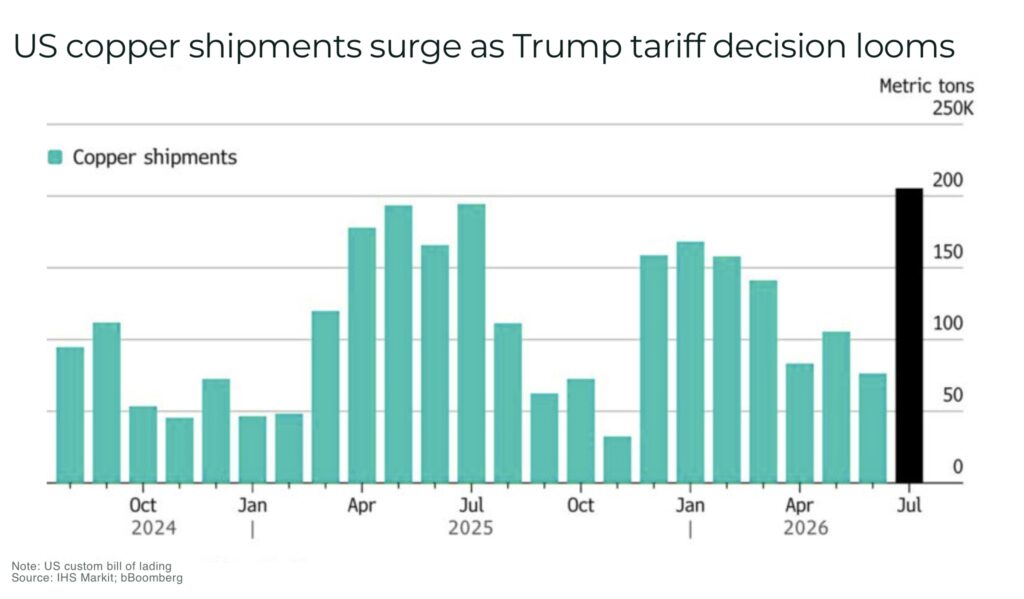
This is not the same thing as comfortable global availability, with tariff arbitrage pulling refined metal toward the US, while Chinese buyers have faced a much tighter physical market. China’s copper import premium reached US$100 per tonne in July as Shanghai Futures Exchange inventories fell to 79,909 tonnes, down more than 80% from their March peak.
The latest International Copper Study Group forecast still points to a modest 96,000-tonne refined copper surplus in 2026, but the group explicitly notes that unreported stock changes can materially alter the apparent balance.
That is the market Congo’s order enters: copper may exist in aggregate, but policy, geography and product form determine whether it is available to the next buyer.
The processing chokepoint is becoming the market
The near-term impact of Congo’s ban should not be overstated, as concentrate exports are small relative to cathode exports, existing smelting capacity is expanding, and the government retains the ability to grant waivers.
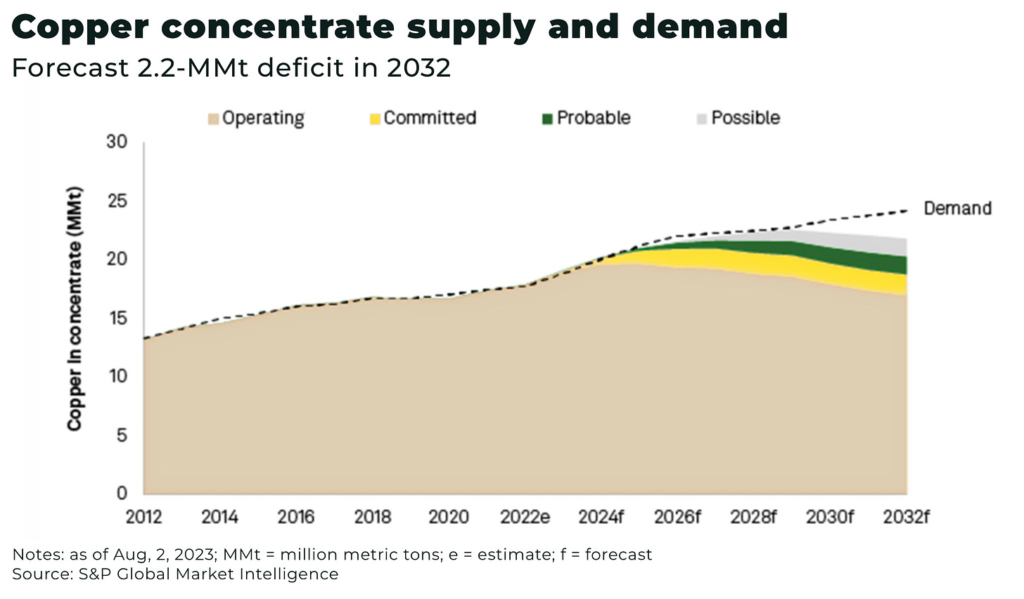
But the strategic impact should not be dismissed either, especially as global supply remains tight in the face of an expanding copper demand stack, making the impact of tight marginal supply even greater.