
On August 17, the US diesel crack — the margin between diesel and the crude oil from which it is refined — reached a record US$102.20 per barrel.
For mining, the crisis in diesel supply threatens to disruption global mine production and logistics.
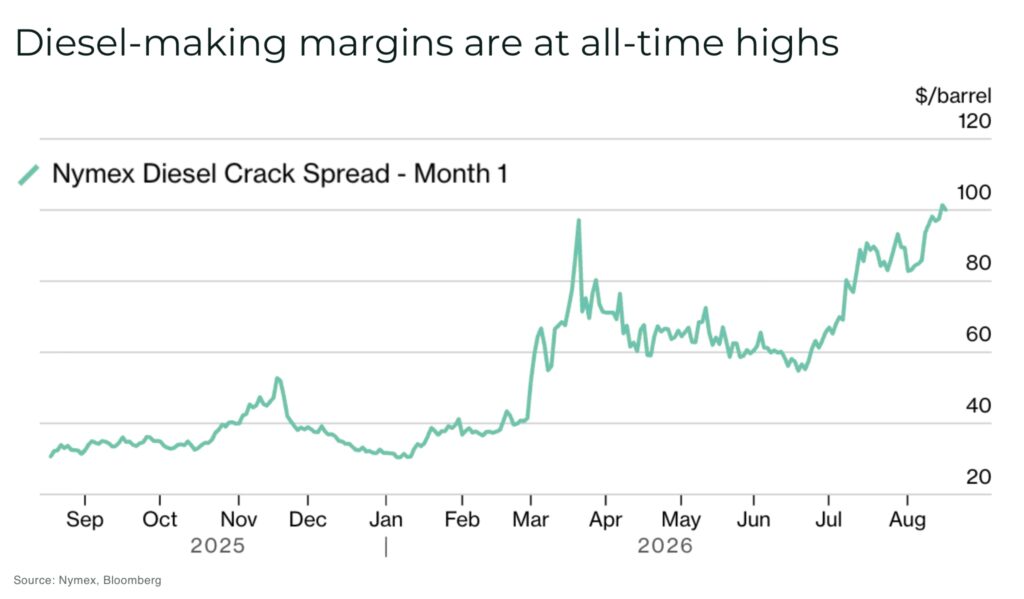
The US$102 figure compares NY Harbor ULSD futures with WTI crude. NY Harbor is the delivery point for the futures contract and is particularly exposed to the US Northeast’s limited refining capacity, pipeline constraints and reliance on imported products.
So, the headline may be US prices but the diesel shortage is global with regional crack prices all showing signs of significant stress:
- European diesel cracks exceeded US$90 per barrel in late July, more than triple their pre-conflict level of approximately US$27
- Singapore gasoil, the benchmark most relevant to Australia, traded approx US$56 above Brent in the week to August 12, compared with about US$16 before the conflict in the Middle East
- and, although Latin America has no single regional crack, but import-dependent markets such as Brazil price their marginal diesel barrel from the US Gulf Coast plus freight, transmitting the American refinery squeeze directly into local replacement costs
America is running hard and drawing its buffers
In the week ending August 7, US distillate stocks stood at 107.1 million barrels, 5.7% below the previous year. Ultra-low-sulphur stocks were down 7.3%.
Refineries were already operating at 96.2% of capacity nationally and 97.9% on the Gulf Coast. Total petroleum-product exports reached 8.67 million barrels per day, more than two million barrels per day above the same week in 2025.
The market-reported API estimates for the following week added another warning:
- commercial crude: down 328,000 barrels
- gasoline: up 1.076 million barrels
- distillates: down 2.797 million barrels
- Cushing crude: down 1.438 million barrels
- SPR: down approximately 5.3 million barrels
Those preliminary estimates still require confirmation from the EIA release scheduled for August 19, but if the distillate figure is confirmed, US stocks would fall towards 104 million barrels just as Northern Hemisphere harvesting and Southern Hemisphere planting support seasonal diesel demand.
The SPR can soften the price of crude, but it cannot directly refill a diesel tank.
Australia has fuel, but remains structurally exposed
As we reported in March, the conflict in the Middle East and closure of the Strait of Hormuz threatens an industry-wide shock across the mining industry — Strait of Hormuz diesel shock threatens mining industry.
And Australia threatens to be “ground zero” for the crisis with up to 40% of Australia’s diesel is consumed by mining, while Deloitte says the sector runs more than 50,000 large diesel-powered trucks.
As of August 11, regulated companies held 3.393 billion litres under the Minimum Stockholding Obligation, equivalent to 37 days of normal consumption, above the March-quarter average of 32 days. At least 3.7 billion litres of crude and refined products were scheduled to arrive during the following four weeks, while 38 clean-product tankers heading to Australia represented another 13 days of supply.
But the national number conceals three risks:
- first, Australia obtains more than 90% of its liquid fuel from imports, either directly as refined products or indirectly as imported refinery feedstock. Diesel therefore remains linked to Singapore product prices, shipping availability and Asian refinery operations
- second, official stock coverage includes fuel already inside Australia’s exclusive economic zone. A barrel on a tanker approaching a national terminal is not necessarily available at a Pilbara mine, Queensland coal operation or remote exploration camp
- third, strategic stocks and commercial supply are different things, as we reported — Western Australia has only 29 hours of diesel in the state’s 20-million-litre, government-controlled reserve for areas of acute need divided by total statewide consumption
Australia’s vulnerability is therefore not an immediate nationwide shortage, but the ability to replace imported barrels continuously and move them from ports and terminals to remote users when global supply chains are already stretched.
Mining converts the crack into a cash-cost shock
According to Fortescue, every 10-cent move in diesel changes the cost of mining (iron ore) by approx US$70 million, while the combined impact on the four largest iron-ore miners could reach US$500 million.
The effect will not be evenly distributed.
Large iron-ore producers have stronger margins, supply contracts, larger storage facilities and better access to ports and rail. Junior miners, exploration companies, contractors and marginal coal operations have less purchasing power and fewer options to absorb sudden price increases.
Higher strip-ratio mines are especially exposed because diesel is consumed moving waste before saleable ore is produced. Gold, nickel and lithium operations can also face high haulage intensity relative to output value, particularly where grades are falling or pits are deepening.
If diesel remains elevated, the likely sequence is:
- contractor margins and exploration budgets are compressed
- miners defer stripping, drilling and discretionary haulage
- marginal operations reduce shifts or production
- sustained physical shortages—not price alone—force temporary shutdowns
The next inflation shock?
Diesel demand at a working mine is difficult to defer. Haul trucks must run, ore must be moved and remote operations must maintain power. If elevated cracks persist, the shock moves from fuel bills into margins, project economics and, ultimately, production decisions.
The next mining cost shock may not begin with falling metal prices. It may begin with the increasingly expensive barrel required to extract them.